
Back in Budapest, the word "hamburger" automatically means "McDonald's." Fast food burgers in all their anonymous glory are what Europeans think of when you speak of America's contribution to ground meat culture. It is sad. Coming back to the US, I have redicovered the satisfying heft of a real, cooked to order diner burger, but my original Ur-Burger, back from my young days in the Bronx, was a White Castle. Known to the world today mostly from the stoner movie "Harold and Kumar Go to White Castle" the White Castle Hamburger is a tiny, cheap, oniony sliver of meat served on an impossibly soft bun inside a little paper box. Cheap, tacky, and invariably located near a highway in a dodgy neighborhood, it tastes like nothing else in the world. You don't eat one White Castle burger. You eat at least four - they're also called "sliders" due to the ease with which tey slide down the throat. Their old slogan "Buy a Bagful!" has now been replaced with "It's What You Crave" and they now even call their burgers "craves", but no matter. These are the Best Worst Food in the World.
 White Castles also follow the depression era practice of taking a miniscule bit of meat and doubling the bulk using onions, in this case, chopped onions soaked in water. The meat patties are stamped out with holes in them , and so the meat is "steam fried" on top of the onions. The result is a classically mushy, meaty wad that melts into the bun itself. In the photo below, the meat is being steamed while the buns warm on top of steamed onions. Anybody here against onions?
  New Yorkers vary widely in their opinion as to what makes White Castle so good, but many claim it is the cheapness of the meat - a combination of beef and , possibly, less appealing gut cuts - that makes the flavor so addictive and distinctive. I used to go to a White Castle in the Bronx when I was a kid, and the flavor has not changed at all. The packaging has modernized a bit, but White Castles are still owned by one family who refuse to expand their franchise, going against all modern rules of business expansion. That's why people will take road trips to fill up on sliders, and why every White Castle sells bulk boxes of frozen burgers to take home.
  I wouldn't have believed that White Castle could ever improve their burgers, but I tried the "Jalapeno Cheeseburger" at a whopping 74 cents. As you can see from the photo, I did not have just one. Founded in 1921, White Castle is the oldest American fast food hambuger chain, and which were priced at 5 cents until the 1940ss, and remained at ten cents for years thereafter while growing smaller. For several years, when the original burgers sold for 5 cents, White Castle periodically ran promotional ads in local newspaperss which contained coupons offering 5 burgers for 10 cents, takeout only. Today prices are bit higher, but still...affordable?

 White Manna used to be my lunch of choice while I worked on a Hackensack Municipal garbage truck back in the 70's. Since the garbage crew started out at 5 am, lunch was usually around 9 am - so we never had to wait for burgers. White Manna make
  That orange block is sliced cheese, which gets slapped on the cheeseburgers at the last minute. Cheese like this cannot be found at fine cheese shops - you can only get it at Jersey burger stands, Army bases, and on some less affluent Indian reservations. While we were waiting a guy dressed in classic restaurant chef's uniform came in and ordered fifty cheeseburgers to go for his kitchen workers. "These are the best" he said, "I've been eating them since I was a kid." He then proceeded to speak in rapid-fire Dominican Spanish to all the grill cooks - it sounded like music to me. After years of living in Europe I still shudder when I have to wade through an earful of Iberian Spanish. Madrid Spanish sounds like people speaking Castillano after getting a mouth full of novocaine at the dentist office. Carribean Spanish, Mexican, Bolivian, Columbian - now that is Spanish that my ears can accept.
  You don't order "one burger" at White Mana. We went easy and ordered a modest two. With Fries. The fries are real fries - somebody in the back actually cutting potatoes, and soaking them in water to get the starch out so they fry crispy. No plastic pseudo-fries anywhere near the premises - you'll have to wait for your fries. And the burgers are heavenly - soft potato dough buns and loads of fried/steamed onions. Although burgers like these may be the ancestor of the modern fast food burger, they are anything but fast food.
 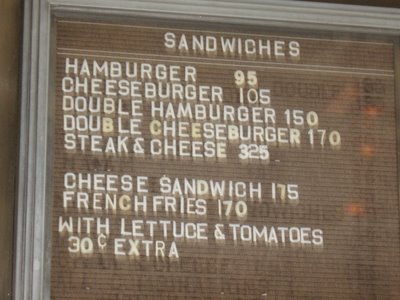 I have been having problems loading photos to the blog page over the last two days, so bear with me while I try and fix the problem. Brother Ron and I also visited the White Castle Hamburger joint in Fairview, New Jersey, but I can't get the pictures to load yet. Otherwise, much of my time is taken with meeting old friends in the New York Jewish music world, being overwhelmed when I walk into giant bookstores filled with books in English (I immediately go on the fritz trying to browse twenty years worth of reading into one hour) and trying to understand why things like
  I am back in the place of my birth, the largest village in the world, Noo Yawk, Noo Yawk. A small island nation located off the east coast of the United States of America. Things are... different here. Yes, you can find certain reminders of the fact that an entity called the United States exists somewhere to the east and north of us. Even the south of us. Many of the inhabitants speak English as a native language, making it easy to ask for directions. Of course, it takes some time to get used to some of the food.
 But where else does a portrait of Chou En-lai grace a bank machine (located in the Pearl River department store on lower Broadway in Chinatown. Pearl River is a Chinese state enterprise. Who says the Commies don't have a sense of humor? At least in New York....)
  And just like in Budapest, one can find Chinese underwear everywhere!
  I hadn't really planned to be in New York, but my siblings conspired to fly me over from Bpest. Am spus, dece nu? Daca sint Dumneazul... The Big News is that we get to meet our newest family member, Ron's wife Roong, who is from Bangkok and tracks cargo for a major international shipping company. The Cohen family is slowly - and happily - filling up with Buddhists, who at least are forcing us to take showers at far more regular intervals than we have ever experienced and teaching us proper manners that our other ancestors (like the Ribnitzer dynasty of Moldavian Hasidic rabbis) conveniently forgot about.
 My family is what we call "Old" New York - we immigrated here from Hungary and Moldavia, not from Minnesota or after Art School. My pop was a gold shield cop, everybody in the family speaks Yiddish and Spanish, and "normal food" means Chinese (Cantonese) food. I hadn't even realized, until I got on the plane (Lufthansa. Not happy. Motto: We used to serve food!) that I was going to be in the US for Thanksgiving. Apparently, the date for this holiday has been changed to accomodate better marketing for the shopping season. I never celebrated Thanksgiving - I used to work with an American Indian radio program in New England, and my colleagues were Abnakis and Wampanoags whose ancestors were not at all nostalgic about the circumstances of the Pilgrims arrival. For the descendants of the tribes that met the Pilgrims, Thanksgiving was a day of fasting. They used to go to Plymouth Bay every year and stand on a hillside overlooking the Pilgrim ceremonies with their backs facing the proceedings, singing war songs, while I manned the radio show for them back in Boston. No matter. In Amereekah, everyone celebrates Thanksgiving. We had a turkey. We had stuffing. We had cranberry sauce. We had history on a plate. My Mom preserves recipes learned during the 1960s, such as baked sweet mashed potato balls stuffed with a marshmallow and rolled in cornflakes. Just like the Pilgrims ate!
 One thing about Da City, you can eat well cheap. Although New York was recently rated one of the most expensivce restaurant cities in the world after Tokyo and London, at least here you can get good chow cheap. If you know where to look. But my brother, Chef Ron, who is in New York even more rarely than me, is determined to stuff damn near every New York local specialty into his gaping maw before two weeks is up.
 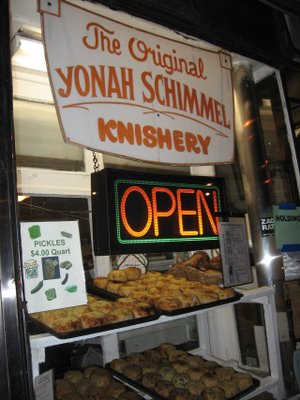 As I mentioned in an earlier post, priority Number One on arrival in New York is a trip to Katz's Deli down on East Houston Street. Most American citizens only need to have a stamp in their passport to get in the US. New Yorkers have to eat at Katz's.
 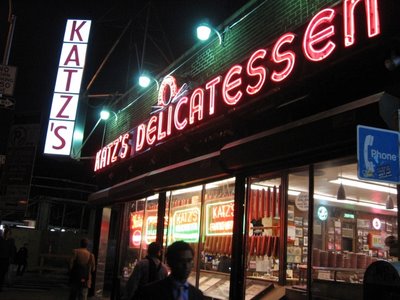 I will take some time later to do full justice to Kat'z's in another post. My brother and I ate there last night. For a native Old-School New Yorker, the pilgrimage to Katz's (now that Second Avenue Deli has closed) is the symbol that one has come home to Turtle Island, arrived in the Center of the World, balanced the Enemy Way, made the broken halves whole, repaired the kelipoth. And smeared mustard all over it too. Best. Frigging. Corned Beef. And. Pastrami. In. The. Universe.
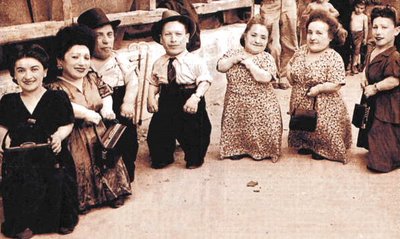 There is an extensive
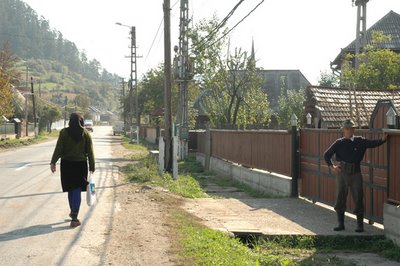 We asked the oldest person we could find for direction to the Ovitz house. I showed her the photos from the book and she remembered the Ovitz family immediately. In these villages, where literacy is not a prime objective, people keep oral traditions with amazing accuracy. Most old people had stories about the Ovitz family, who were about as close as Rozavlea ever got to local celebrities.
 The present occupant of the Ovitz home is the former Mayor of Rozavlea, who was the teen age boy who guarded their possessions - including the only automobile in the village - during the war. After returning from Auschwitz, the family was able to recover their jewelry and money from its hiding place - buried beneath their car. This is one of the characteristics of inter-ethnic culture in Maramures - Jews were generally on good terms with their neighbors, one of the few places in east Europe where Jews enjoyed a normal status amomg their neighbors, were allowed to own land and farm, and generally fit in well and prospered. Pogroms were unknown in Maramures.
 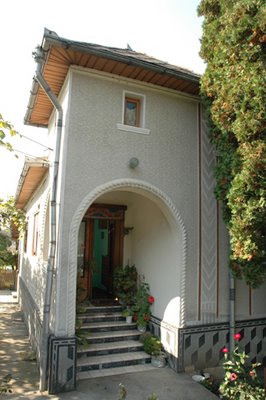 Typically, in Maramures, Jewish homes were often located towards the very center of town and were often the only homes built of stone. The family sponsored a small synagogue located next door to their home, which today is the barn yard of the neighboring house. More typical Maramures log houses are located offf the main street, such as those below on the road to the Rozavlea Jewish cemetery.
  The Jewish cemetery is on an island located across a very scarey rope and wire suspension bridge crossing the Iza river. Surprisingly, it was well trimmed and kept. Even though there are no Jews in the village today, the cemetery is not neglected or derelict as many village Jewish cemeteries often are in Romania.

 Maramures used to be home to one of the most concentrated Jewish populations in east Europe, and - as a territory held directly by the Hapsburg Treasury - the Jews here held rights, such as the right to own farmland, that were unique in East Europe. The Jews here were mainly farming Jews, strictly Hasidic orthodox but living in a healthy coexistence with their Romanian, Hungarian, and Hutsul (Ukrainian Catholic Ruthene) neighbors. Today there are about 75 older Jews, mostly living in the main town, Sighet. I go to Maramures a couple of times a year to hear and collect music in the local fiddle style, especially from older fiddlers who still remember the repetoire of the Jewish instrumental music. There used to be a lot more such fiddlers but these days it isn't that easy to find somebody who played for Jewish weddings - there haven't been many since the 1960s. in fact, it was
  Above are
  Plum brandy starts out with... err... plums. The plums are placed into barrels, usually made of blue plastic, and covered to sit for a few weeks to ferment. Quite honestly, you don't want to peek inside the barrels at this time. Not only does the fermentation produce alcohol, it produces fruit flies and their wormy little larvae. No matter, it all goes into the still. I think the worms are part of the saveur... a fine larval aftertaste that I think is something Scottish single malts and many Cognacs lack.
  The plum mash gets distilled through a still into huge vats of tsuica, which gets a second distillation to become horinca. This still was in the village of Rozavlea. A liter of horinca was about 5 Euro, sold in various plastic soda pop bottles. If it is in an old fanta bottle, it has to be good. Good horinca is like fine quality vodka - so pure that even after drinking vast Maramures-like quantities of it one can wake up in the morning without any hangover, ready to hitch the horse to a plow and do a few acres of ploughing or sheep castrating after, of course, the obligatory shot of horinca with breakfast.
 The cuisne of Maramures is simple and seasonal - people eat meat when they kill animals, which is around Christmas time and again around Easter when they cull the lambs. At other times of the year the villagers are virtually vegetarians who eat large amounts of cheese. On weekends everybody cooks up huge batches of sarmale - stuffed cabbage filled with rice, onions and root vegtables. There are no butcher shops in the villages - if an animal is killed, somebody heads into the center of the village and yells that there is meat for sale. The shops do not stock anything except nasty salami and frozen chicken, which nobody buys since everybody has dozens of chickens in their yard already.
  Mamaliga is like polenta, but with balls. A coarser ground of corn meal than Italian polenta, more flavor, and the cheese is usally very rich with sheep fat, which cook out during the baking process. People eat this day in, day out for their whole lives in Maramures, and they are still stronger than almost any group of people I've ever seen. With a bottle of pure full strength horinca... the Maramures Happy Meal!
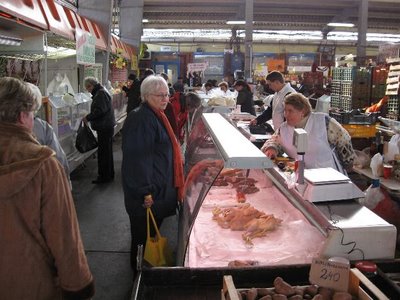 The Bosznák Market used to be the central magnet Market for all of Budapest before the Nagybáni Wholesale Market was opened around 1993. Although the name means "Bosnian Market" a large portion of the vendors here speak Slovak or Bulgarian. For the Slovaks, who live in the villages just east of Pest, it is the closest city market. The Bulgarians came to Hungary in the 1870s, and brought their own style of irrigated, raised-bed gardening with them, introducing previously unknown vegtables such as the eggplant and yellow pepper. Once, when Fumie and I were buying cabbage at the market one of these guys asked Fumie where she was from. "Japan? Really? Well, I'm Bulgarian!" He nearly shat himself when Fumie said "Da? Govorim, mnogo dobro..." and simply continued shopping for her vegetables in Bulgarian.
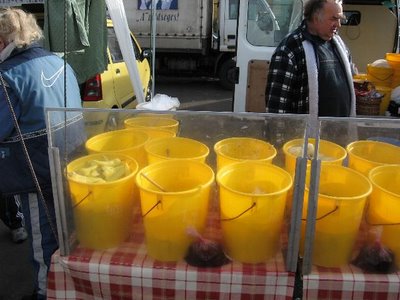
 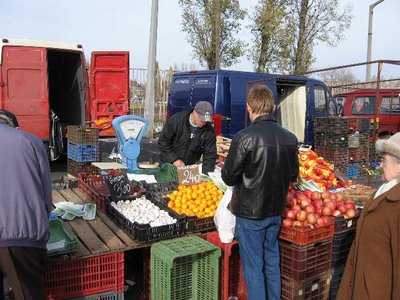 The pickle man in the area behind the main market. We have pickled beets, cucmbers, peppers, watermelon, and squash, sourkraut, and whole pickled heads of cabbage are pickled for use in stuffed cabbage. I don't remember the last time I ate pickles that came out of a jar.
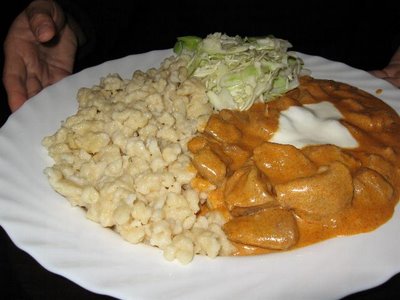
  It's become rather cold and stormy in Budapest, and after a summer of great fresh Turkish food I am back to eating nice hot Hungarian winter stodge. We were downtown earlier this week, and wound up at the old
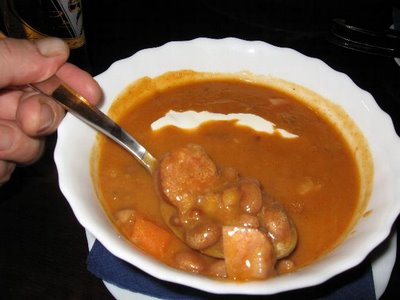
  Bean soup - bableves - for Ft 750 (about US $3.50) This baby has smoked pork knuckle, sausage, beans, carrots, and onion. Never has flatulence had a better excuse. I spent the rest of the afternoon imitating the sound of a a Serbian Gypsy brass band using only my tuches.
  And now the Big News: thanks to my brother Ron, I am headed back to New York in a few days for a month and a half. Ron hasn't been east in years and so both of us are going to chow down on the traditional New York foods of our mispent youths. Pastrami sandwiches, real pizza, chow foon noodles! Katz's Deli here I come! I've promised to take Ron to
 Since I can't treat millions of those who voted Democratic to a real party, let me at least provide virtual goodies, left over from our time in Istanbul in August. Hey, it's on me. Dig in. No ice cream for the Republicans though. They have to be fit and trim to face their corruption and war crime trials. Oh... and isn't it about time the US institutes socialized medicine? Go to it, Speaker Pelosi!
 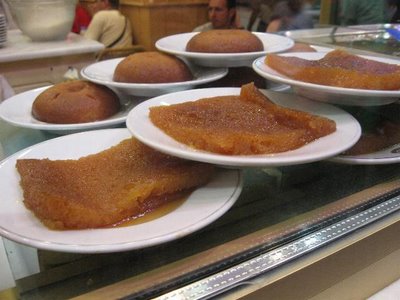 Syrup soaked semolina slabs, not as sweet as you would imagine.
  Morer semolina slabs, topped with cream in some cases, from the Sarayi sweets shop on Istiklal Caddesi. Baked custard to the right, and profiterol below.
  Asure, the classic ramadan sweet pudding. As with many Turkish sweets, the ingredients are surprising - a pudding made with whole wheat and beans, sweetened, and topped with chopped nuts and dried fruits. If the Sultan ate Maypo, this is what it would taste like.
 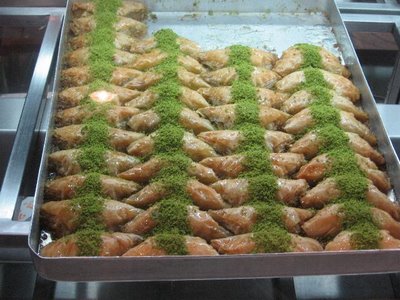 More pistachio baklava. Believe me, this is much better than the stuff you get at your local felafel and gyro joint.
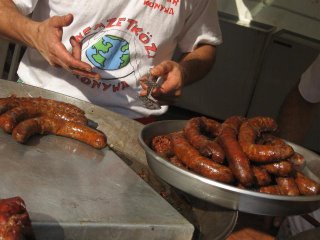
 Hungarians take their sausage very seriously, and yes, it is considered the perfect breakfast food to start a day of browsing among the cabbages and late season zucchinis in the market. A bit heavy, yes, but then you are simply not peckish for the next 72 hours... and there are only pork sausages available. No duck and herb, no veal, no beef, only pork and paprika... or pork with even more paprika. No garlic, pepper, herbs, or any other flavorings allowed. Truth is, they do get a bit boring after a while. One day I'll post photos of us making sausages at home - I am simply unable to live in a place with no Italian sausages. So I make them myself.
  What is interesting about Hungarian national holidays is that on these days most resident foreigners stay indoors and do not go out for the day. A sad comment on life in Hungary, but true. Finally I was going stir crazy, mad with cabin fever - so I went to the Álmassy tér Dance House on Thursday... Puma was playing kontra with the Matokabinde Band as usual.
  A great set of Mezöseg tunes from Palatka at the end of the evening. Sally from Australia was on second kontra fiddle - she may well be the world's best female kontra player, and she certainly is the only one that has ever played with the Palatka band itself.
 Last night was a big treat - the Tecsö Band was at the Fonó in Buda. They are Gypsy musicians from the Hutsul region of Karpato-Ukraine, from the village of Tjaciv (Tetch, in yiddish) just across the Tisza river from Maramures in Romania, and near the border of Hungary. The band consists of the Csernovics brothers - Joska on accordion, Yura on drum, and Mishka on small tsymbaly (cimbalom) with Ivan Popovics on fiddle. They are one of the last real traditional bands to maintain any active Jewish repetoire (alongtside the Ruthenian, Hungarian, and Romanian tunes that are their bread and butter) and they played with me as guests when I recorded our
  Mishka, the cimbalom player wasn't with them on this trip due to illness, but I sat in for some tunes, and