Sunday, July 24, 2022

Hurka: The Tastiest Turd in Hungary

Blood and guts and oh so good!

East Europe doesn't offer a lot in the way of extrémé foods. We don't eat bugs, we don't find grubs and worms very tasty, and we do not to eat anything alive. This makes us a bit boring for the TV food travel shows - like Tony Bourdain's No Reservations - which tend to dwell on the portion sizes (case in point: the Pleh Csarda) and the exciting blood and gore of a countryside pig killing feast. But there is one food most visitors to Hungary and its neighbors will probably miss out on: hurka. Hurka is the dark underside of Hungarian sausage. Hurka is the lunch which dare not speak its name. Hurka haunts the nightmares of small children and vegans. Hurka is neither a polite nor a dainty food. Hurka is a culinary afterthought stuffed into a pig's ass. Unless you are invited to a pig killing feast, you are not likely to taste hurka outside of a butcher shop lunch counter. No restaurant offers it - none - and most home cooks avoid it due to its tendency to explode while cooking, splattering grease and guts around the kitchen and reacting exactly like a garden slug that has just been sprinkled in salt. Hurka is a problem food. Also, it tastes really good. 

Blood sausage and liver sausage, in action.

Hurka is a kind of sausage made out of spiced ground pork liver or blood mixed with rice as a filler. Hurka is not really that strange except for one thing: it really looks like pooh. This is a point not lost on Hungarians, for whom the term hurka is a polite alternative term for "turd". Hurka was the first food I discovered that could also be used as a psychological weapon against my sister. When I was growing up in New York my Mom used to take us down to the -now vanished - Hungarian neighborhood in Yorkville, on Manhattan's upper east side, to stock up on essentials like poppy seeds and paprika at the famous Paprikas Weiss Hungarian delicatessen on 2nd Avenue. 


The next stop stop was at the aptly named "Valodi Magyar Hentes" butcher shop to pick up some kolbász and hurka and the wonderous thing sold there which was actual Magyar bread. The bread was unlike anything available in the USA in the 20th century... which is to say it was real bread. At home my Mom would cook up a family favorite - lecsós kolbász -  and a couple of hurkas on the side. Nobody except me and my Mom would eat the hurka. It elicited groans and cries of "ewwwww gross!" from my brother and sister, who couldn't bring themselves to taste the turdlike mix of organs and blood. The mere idea of eating a tube of congealed blood and ground pig weenie was enough to send my sister running from the table. (Update: she has since become a respected and world renowned Oncologist.) You know the saying "don't ask how the sausage is made"?  The stuff they don't use to make the sausage is what goes into the hurka. 
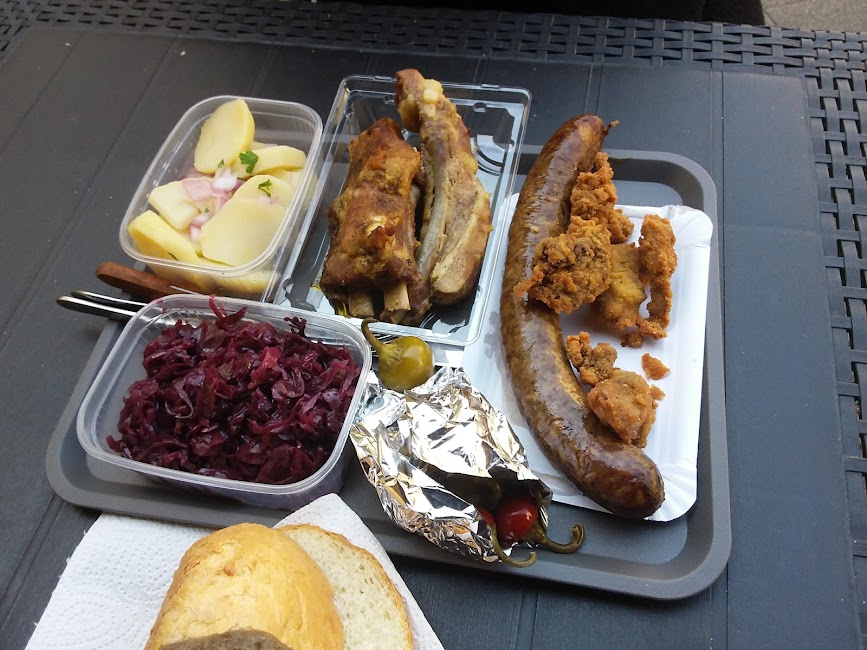
Hurka, fried liver, ribs at Brunch at Ica Mama Meatshop

You may ask yourself "Why were these otherwise traditional Yiddish speaking New York Jews happily eating pig privates ground with pig blood in casing made of pig intestines?" Simple: my mom was born in Hungary, and we are not orthodox Jewish, kosher, or otherwise bound for glory on tkies hameysin when the souls fly up to find their reward in heaven. When I was nine my Dad took me to City Island in the Bronx to introduce me to eating live clams on the half shell, which is about as unkosher as anything you can put in your mouth except maybe for rabbit. It was a rite of manhood, but also a guarantee that I would not adopt the ritualized eating disorders of my more observant mates... I mean, dude, you ate a living clam, for pete's sake! As for my Mom... Hungarian Jews split into orthodox and Neolog (reform) a long time before that was an issue with the rest of East European Jews, and part of the social assimilation of Hungarian Jews was the acceptance that virtually everything ever eaten in Hungary is made out of a pig. Pushing boundaries is just what we do. The origin of the Neolog movement in Hungary started in 1798 when Rabbi Aaron Chorin chose to make a foodie argument about whether or not sturgeon was a kosher fish. Today many Orthodox Jews won't eat sturgeon, yet it features in the less rigid Jewish tradition of the New York smoked fish "appetizing" shops like Barney Greengrass and Russ and Daughters. 

Poland: Kiszka or kaszanka at a restaurant in Krakow

You can go into virtually any Budapest hentesbolt - a butcher shop serving hot foods - and there will almost always be a steaming tray of grey liver majás hurka or black veres blood hurka. Most are made from ground mystery meats mixed with rice, but you may see some labeled "Svab hurka". For some reason, the German speaking Schwabians of Hungary - most of whom were deported to Stuttgart after WWII - preferred to mix their mystery meat with bread crumbs. Those crafty Svabs... what will they do next? Either way, most commercially made hurka is insipid, oversalted, and usually dried out by the time it gets served. Never buy hurka from a supermarket meat refrigerator. Most of the hurka available today is made in factories, and is a rather banal and usually too dry and salty ghost of what a good guts'n'organs'n'blood sausage should be. Worst of all they are often kept warm under infared lamps which dries them out into a sandy, dry, unpalatable bit of pooh in stick form. 

The butcher at Klauzal Piac. Hurka on the lower left...

The search for a good, locally made artisanal hurka is never ending. The best was once found at the lunch stand run by an old guy named Palibacsi who made his own organic meats on a farm north of Budapest and for a couple of years his lunch counter at the Klauzal market was easily the best place to experience Hungarian food in Budapest besides the also now defunct Kadar Etkezde, located four doors down from the market. Today, seek out private butcher shops and look for misshapen, odd looking, and juicy hurkas that defy commercial sizing and try your luck. Hurka and other meat products sold by peasant stands at big markets or smaller farmers markets like the one at the Sunday Szimpla Piac or the Czako kert are a good bet. The lady who brings homemade bacon and smoked meats to the Klauzal market on weekends has good hurka, but it sells out fast. At home you can bake them in an oven (in a tray with a bit of water) or fry them at low heat in a pan, but either way they tend to explode while cooking. If you have the time, try soaking them in water for an hour or two before cooking: it helps the skin resist exploding.


Sunday, July 10, 2022

Germany: It Gets Würst...

June found us traveling around the Berlin vortex of the European Klezmer music world, a world in which Jewish traditional music comes in contact with two of my favorite things: Turkish food and Würst. Berlin has two iconic street foods: the Berlin doner kebab and the curry wurst. I managed to not eat either of them. I have eaten curry wurst, many curry wursts... and I don't like curry wurst, which is basically a wurst with ketchup and curry powder or some hausgemakht version of the same. I like my bratwursts clean, hot, and straight off the grill. 

Bratwurst, Leipzig, Mozart ate these.

I especially do not enjoy the post WWII east German invention of the "ohne darm" skinless bratwurst such as those served by the famous Konnopke's Imbiss in Prenslauerberg. One stop up the Ubahn at Schönhauser Allee is the nostalgic East German Alain Snack kiosk, which provided the classic bratwurst and mustard seen above. It was so good I tried to get a bockwurst (more like a fat Katz's Deli frankfurter that went to heaven) in a bun with mustard but the chef objected to the mere thought: the Ketwurst was designed by the East German State Gastronomical Research Center to provide the communist workers of Berlin with a convenient snack. 

The stupidest food I have ever posted.

A Ketwurst is basically a hot dog (in this case a pretty darn good bockwurst) stuck in a bun heated on a toaster spike which has been filled with "special sauce" (i.e., ketchup.) It is an unmistakably East Berlin nostalgia flavor and it is an incredibly stupid food in a country known for incredibly stupid food. East Germans didn't simply melt into a post 1990 German" identity: a lot of them cling fiercely to the small things that once defined them as Ossies... like Ketwurst! 

Bockwurst is the one item I always bring home with me after visiting Berlin. For some odd reason, Hungarians - who love German sausages - do not produce anything nearly as good. Only the Czech and Slovak supermarket parky rivals the Hungarian virsli for lowest place on the frankfurter quality index (as defined by snap of skin, texture of mystery meat filling, and rate at which it dries out into a wrinkled turd in your fridge.) So all available space in my home bound luggage is filled with bockwurst. Did I mention that Berlin is probably also the most vegan -friendly city in Europe? Yes, it indeed is. As if I could give a shit.

The other thing I bring home is mustard. The mustard available in Hungary does almost nothing beyond stain your white T-shirt yellow. Somehow people in Eastern Europe fucked up mustard. I don't know how, they just did. So I bring it back from my trips to Germany, in particular the Dusseldorf brand Lowensenf, which beats any French Dijon mustard for making sauces or just dipping hot dogs into. We picked up a bit of the Bautz'ner brand, which we tried in Leipzig, and while in Erfurt we picked up some of their local "Born" brand, which is good but definately a classic "Ostbloc" mustard. Erfurt has a beautiful old town that seems to go a bit overboard about their mustard industry. There is a Mustard Museum downtown, and I was even given a gift bottle of "Born Mustard Brandy". It was truly vile, but it is the thought that counts. 

Berlin is easily the city where a visitor can spend less and eat better than almost any other European capitol. There are other things to eat in Berlin besides Turkish food and sausage, but trust me: they suck. I don't use the term "suck" to simply indicate lesser quality... I mean "Whoa! That sucks!" Most of the nicer places specialize in what we ex-kitchen staff know as "pretentious tweezer food". Another problem is that Germans can not eat spicy food. That is not a stereotype." If a German unexpectedly encounters a blast of hot pepper they can - and sometimes do - sue the restaurant. So the smart chef dumbs everything down: watery stocks pass as pho, bland plates of noodles with peanuts sprinkled on top are labeled "pad thai" alongside menu categories identified as "Asia Wok" and of course, "China Box".  There are hundreds of these "pan-asian" monstrosities all over Germany. The late Ed Ward - one of the best American expat writers ever to set foot in Europe took umbrage at the easy racism that powers this perception that all "Asian" food is the same  It's undeniable, though, that this sort of racism -- Orientalism, to give it its proper name -- is acceptable here. There's a snack food that comes in "Thailandische süss-scharf" (sweet-hot) flavor, and features a "Thai" on the package wearing a coolie hat, slanty eyes, a pigtail, and those kind of Japanese wooden shoes with the two platforms, the kind that geishas wear. It's an offensive stereotype, but it isn't even a remotely accurate offensive stererotype.

Köfte

On the other hand, Berlin has glorious Turkish food. Most of the Turks living in Germany today have Anatolian roots, and also something very few people in Anatolia have: a decent income. And it shows in the restaurants in neighborhoods like Wedding. Wedding has the lowest income level and the highest percentage of foreign born residents in all of Berlin. That may sound like something out of a Viktor Orban fever dream, but it is one of the more pleasant parts of Berlin, especially if you have an appetite. We randomly chose Köyluoglu Turkish Restaurant in Wedding and it was one of the best restaurant meals we've had in years. I was converted to köfte (roughly: meatwads) years ago in Istanbul: Fumie always goes for Adana kebab. Either way, nobody understands ground meat better than a Turkish kitchen. I have spent decades trying to make a decent Turkish style köfte in my home, and only recently had any success in producing something that does not resemble a small dried hamburger. Good köfte  proves the rule that simplicity can be deceiving. Köfte is rapidly replacing doner as the King of Turkish street meat on Berlin's streets. 

Köfte sandwich at Gel Gör 

Later, after rehearsing in Neukölln, I had late lunch at Gel Gör, a grill famous for its inegol köfte and that stays open all night long and is famous for impromptu street dancing at 4 AM on weekends. This rates as the best sandwich of the year so far, considering that I have not been able to visit Katz' Deli this year.  And just down Kottbusser Damm on the next corner was La Femme, specializing in Turkish breakfast. There is a saying in Turkish (I am not making this up) that "lunch is for your friends, dinner is for your family, but breakfast is just for you." Omelets, cheese and olive plates, perfect for wasting a morning outside with your friends. I even ordered a breakfast to go on a travel day, only to offer it in sacrifice it to our unfed cimbalom player who was driving us to our next gig. 

Su burek: think non-tomato lasagna for breakfast. 

On the upside, the music - with Craig Judelman's Klezmer Kompanye - was great. With Craig and Zoe Aqua on fiddle, Shaun Williams on accordion and cimbalom, and Dasha Fomina on flute. We played the Panda Platform in P-berg, Berlin, and it was like a homecoming for all kinds of Yiddish friends and klezmerei... Michael Wex, Shane Baker, Tamas Wormser were all in the house. The road always leads home.


Friday, May 27, 2022

Hungary: It Could be Wurst...

Lunch at Pinczi Hús és Hentesüzlet
I've been back in Greater Magyaristan for several months without any updates to the blog. There are good reasons for this. Putin's insane war in Ukraine and the Hungarian election essentially rendered me mute with rage for two months. You wouldn't like me when I am mute with rage. Also, my wife went to visit her family in Japan. This meant that I would awake in the morning to find that I was somehow transformed into some kind of unsanitary zoo animal whose keeper had forgotten to clean his cage and give him his proper feed. ("Hey... this isn't mine... this tastes like... PENGUIN FOOD!") But it also meant that I could pretty much eat whatever I wanted for two months without guilt or portion control. (Or residual religous conviction. Seriously.)  Yes, I am talking about pigs. I ate a lot of pigs.

Szafalade: Tubular Baloney of the Titans

Regardless of Hungary's historical and contemporary shortcomings one thing they do well is cook pig meat. While it is easy to imagine that the Magyars eat more pork than anybody else in Europe, they don't - Spain and Austria lead the pack for treyf hounds. But the plucky Hungarians make up for it in ease of availability. Sausages are available for snacking within a five minute walk of almost anywhere you might find yourself in Budapest... but you have to know where to find them. We don't have wurst stands like you would find in Austria or Germany, nor do restauarants serve the humble kolbász (as many foreign born Hungarians are shocked to find when visiting the motherland for the first time and find that their favorite national delicacy is not on the menu. Ever.) This isn't tourist food on sale at the faux-street-food stands downtown. For cooked sausages you have to visit... a butcher shop.

Interior of Pinczi Hús és Hentesüzlet accross from Nyugati pu. train station

Hungarians often eat lunch at a butcher shop. Considering all the changes in Hungarian life over the last fifty years, a simple, cheap kolbász and a slice of bread at a standup table next to the meat counter is one of those constants that define "comfort food." There are no trendy sausage stands, although some have tried. And failed. The food is predictably good - like pizza in New York, there is no bad kolbász.

Unnaturally patient Hungarians waiting to order lunch
Many, but not all, butcher shops double as lunch counters. There is usually a vat of greasy hot water with an armada of meat tubes floating around in it, and a shelf of roasted meats gradually dessicating beneath heat lamps. A hand written chalk board announces the theroretically available offerings (half of which will always be sold out) and the price per 10 dekagrams. You order by weight: 20 dekas of sausage or smoked meat is a modest lunch, 30 dekas is what a small Hungarian would order. 

The butcher shop at Bosznyak ter bus stop in Zuglo.

Larger Hungarians  - there are many - often order shocking huge piles of sausages, cuts of smoked pork, three or four pickles, and maybe some roasted potatos crowded onto a plastic cafeteria tray, to be taken to one of the stand up tables lining the walls of the shop and eaten - preferably with a single bladed pocket knife that nearly every Hungarian male proudly carries around just for such occasions, known as a szallonázás bicske (bacon snacking knife.) You have to specify how many slices of bread you want, what kind of pickle or salad,  mustard or horseradish, and bottled drinks are always self serve from a standing cooler.If you don't speak Hungarian just point and smile and shake your head when they give you too much meat.

The sausage tub

The king of the butcher shop dining experience is kolbász, the humble sausage. I suggest you go with debreceni - a paprika rich, dense and meaty sausage considered the King of the kolbász world. the Decreceni is one of Hungary's real gifts to the world. Forget the fountain pen, subway transport, heroin, illiberal democracy, or any other famous Hungarian invention. This chunky paprika laced pork weenie is, perhaps, Hungary's most lauded and beloved gift to the world.

Debreceni, virsli, roasted pork belly

Most shops offer plain főtt kolbász (boiled) and súlt kolbász (grilled) but time has not treated the kolbász family gently. After the fall of communism and the rampant price inflation that followed, meat became expensive and the iconically cheap kolbász gradually became... cheaper and insipid, the actual taste of poverty. Today most főző kolbász are simply tubes of orange colored protein. I used to love straight boiled főtt kolbász... but it is hard to find a good one anymore. The roasted and grilled ones which you often see for sale at outdoor tourist markets are always so salty (and I like salt!) and greasy that it is like somebody crossbred a shipping container of paprika with a small Arab Emirate. 

Beware the salty tourist kolbász!

There are always a few virsli hot dogs floating around in the hot tub, but you might see a big fat krinolin or a shorter stubby szafaládé wurst: go for the szafaládé. They are both basically baloney in an intestine skin, but it hits the spot at 11 in the morning when you haven't had breakfast. And of course, it is all mix and match here, so point at some of the unidentifiable meat wads on display and try your luck. It could be a chunk of smokey pork hock csülők, or maybe a chicken leg or fried chicken livers. We were just at the Pinczi Hentes and took a chance on a piece of mystery meat that turned out to be a delicious slice of braised pork belly with very little extra fat. This chunk of meat would cost you dearly if you were to meet it in a legitimate restaurant. Our whole lunch for two came to FT 1700. Not quite five dollars.

Mystery Meat Award of the Year
It is hard to reccomend a "best" butcher shop, but we took most of these photos at the legendary Pinczi Hús és Hentesüzlet, a butcher shop across the street from Nyugati train station at 60 Teréz krt. in Pest. I used to eat lunch here nearly every day when the old Budapest Week offices were located around the corner, and today they have summer tables on the street, shared - ironically - with the halal Turkish fast food joint next door. A lot of info can be gleaned (albeit in the Hungarian language) on the facebook page of the aptly named "Eating in Butcher Shops Facebook Appreciation Page" 

Pinczi Bucher Shop on Terez Krt. 
I could go on... I have not even touched on the topic of hurka... but I am hungry and writing this has inspired us to hop on the bikes and hit another butcher shop... so more later. It sure beats talking about illiberal democracy!

Wednesday, February 16, 2022

Paterson NJ: Peruvian Chaufa. Fried Rice of the Gods.


Nobody goes on vacation in their home town. You go on vacation to get away from it all, to put your troubles behind you, to enjoy the sights and flavors of being far away from daily life. So maybe you can understand that I have spent the last few months in New York without actually visiting New York. I'm a New Yorker, Bronx born and bred, and this is not a vacation. I'm in New Jersey. Nobody in New Jersey is on vacation.

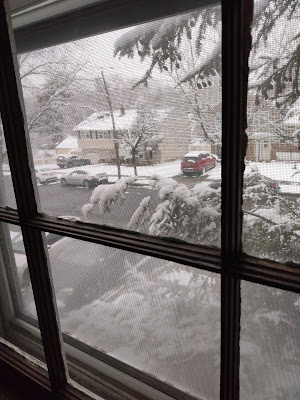
This a not a vacation view.
New York City is four miles away from us in New Jersey but we have yet to cross the bridge. This is because we are staying with my Dad, who is a few years short of a century. And we don't want him (or us) exposed to Mr. Covid, so we have been avoiding the city like, well, "the plague." We arrived on the crest of the Omicron wave in December, so no crowded subways for us, no Christmas shopping crowds, no packed Chinese food courts on this trip. I don't, however, feel like we are missing very much. Manhattan has changed over the years into a playground for the very rich and very infected, and apart from a few neighborhoods like Chinatown and Washington Heights, there is little on the island to attract me beyond its museums. Gone are the bookstores, CD shops, weird musical instrument stores, replaced by Starbucks and office space and hot yoga studios. If you are looking for New York ethnic neighborhoods where you can find a decent meal for ten bucks, you have to head out to the boroughs or the suburbs. 

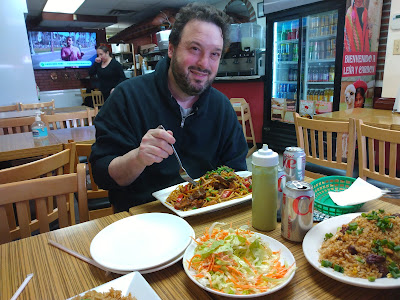
Pete and a lomo saltado the size of a Chevy station wagon. He finished it. 
So we did. We went to Paterson, New Jersey, with folklorist and klezmer cimbalom player Pete Rushevsky, who had never been to the fabled Silk city. Paterson is roughly fifteen minutes drive from my folk's home, and yet nobody I grew up with ever visited the place, and it maintains an air of mystery and menace among New Jerseyites roughly equivalent to the way Italians view northern Albania. 

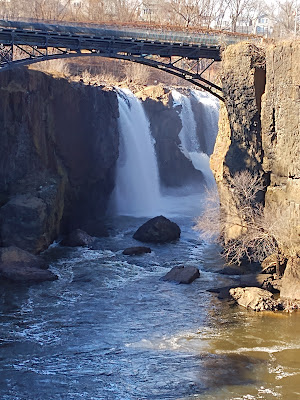
Albania or the Passaic River? 
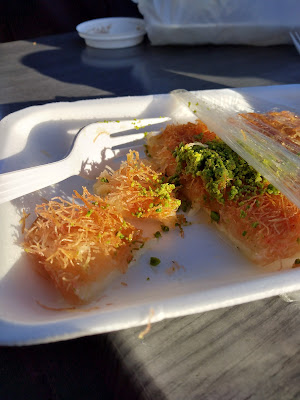
Paterson is the uncut urban gem of the New York area. It is one of my favorite places, also: Nobody visits there. It boasts the America's first industrialized city, complete with a waterfall in the middle of downtown, the second biggest east of the Mississippi behind Niagara Falls. The Falls impressed Alexander Hamilton so much he encouraged the growth of heavy Industry, eventually making Paterson the "Silk City" a center of the silk and textile trade which attracted the first Turkish and Syrian merchants to settle in the USA, and now South Paterson has the largest Turkish and Arab community in the New York area, and America's second largest Muslim community percentagewise. We visited the amazing Fatal Bakery - now a mega supermarket of Middle Eastern foods, and had some killer kunefe at a bakery on the corner of Crook's ave.

Kunefe: if baklava and cheesecake had a baby. 
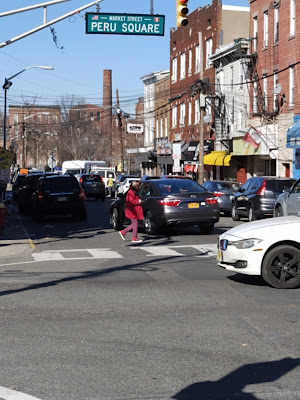
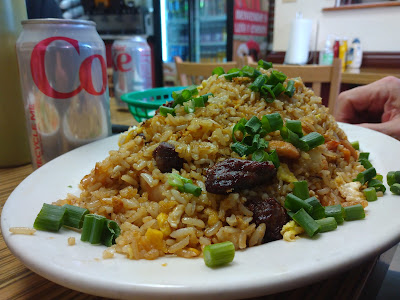
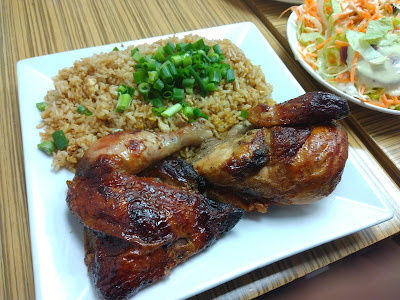
Downtown Paterson is home to Little Lima, a large Peruvian community with the largest community of Quechua languge speakers in the USA. We had lunch at the Market Street Lena y Carbon to satisfy Fumie's need for a rotisserie chicken and fried rice, two things Peruvians have pefected to a science. Peruvian food is the ultimate Creole mix. Home to one of Latin America's larger Chinese emmigrant populations, Chinese food has become fully integrated into Peruvian cuisine, with the classic dish being "chaufa" fried rice (from Cantonese chow fan) The general term for Peruvian Chinese food is "Chifa" and you can find specialized Chifa joints all over the Paterson area, alongside regular Peruvian eateries all of which will serve chaufa fried rice, at the least.
Chaufa Mixto at Lena Y Carbon
While New Jersey has a lot of great ethnic food, Chinese food is not one of them. I have been dragged out to some of the most miserable Chinese restaurants in New Jersey (Tenafly? Englewood? Fort Lee? Teaneck? Just ask me and I will name names!) where my safe go-to is to order fried rice. I love fried rice. It is a simple, almost canonical Cantonese dish that comprised about 75% of the things I ate for lunch before I moved to Europe decades ago. Over the last few years, however, I have seen so many strange concoctions posing as "fried rice" that I have lost count. Weird tumeric yellow grainy stuff with kale bits, bowls of wet rice floating on salad, leftover rice doused with miso... all horrible art projects on the theme of fried rice by cooks with no idea of what fried rice is or should be. 

Pollo braso con chaufa
So when Fumie's order of chicken and fried rice chaufa arrived I almost fainted: it has literally been years since I saw a proper plate of fried rice in New Jersey. I ordered the mixed meat chaufa, and it arrived as a monstrously huge portion of perfect fried rice loaded with beef and chicken. My surprise is not so much that the Peruvian style of chaufa is so amazingly good... it is just fried rice, after all, but I am surprised at how amazingly bad the fried rice from the average NJ Chinese take-out has become. 

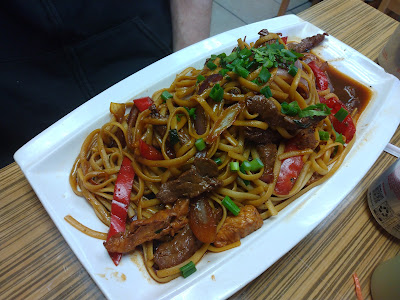
Lomo Salatado: Beef Lo Mein on Steroids
The portions at Lena y Carbon were huge... Pete finished off his Lomo Saltado with tallarin noodles - basically a beef lo mein on steroids - in a few seconds but we had to ask for boxes to take home the leftovers of our orders. We had also ordered a parihuela, a fish and seafood soup originating from the seaport of Callao that came stuffed with shrimp, fish fillets, mussels, and even a couple of crabs for good measure. This made the Tokyo half of our marriage very, very happy, but it was enough to serve a small family so it went home with us as well. Now we are obsessed with finding more Peruvian food before we return to Budapest, where it can safely be said, no Peruvian food can be found. 
Parihuela


Friday, December 31, 2021

2021: Tempura For New Jersey New Year!

A new look for the New Year!

It has been a heck of a ride, 2021 has. Rarely has a year been held in so little esteem as this last one, So I am not sad to see it go. 2021 set a pretty low bar for 2022 to pass, so I am heartily looking forward to a year that lives up to its reputation as being "sometime in the future." By the future I mean a mixture of hope, progress, and no more of this damned covid pandemic... although Dr. F says to expect that the pandemic will probably fade sometime in 2024. This is what we call a "dystopic future" if you ask me. (Actually, somebody out there is presently pregnant with George Jetson... George Jetson who will be born on August 22, 2022. At this rate we will never get to enjoy Spacely Sprockets during our lifetime!)

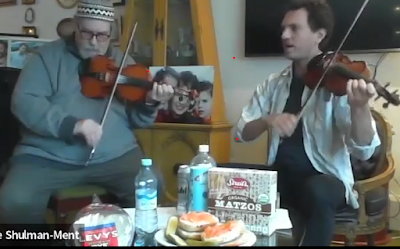
A newer look: with Jake Shulmen-Ment doing a zoom video concert

Presently I am located four miles west of New York City in a reclaimed swamp that was once the northern boundary of what the new Netherlands Dutch rulers of old New York called "The English Neighborhood" and today we call Teaneck New Jersey. My Dad and brother still live here so we are visiting for the holidays. Dad is now  a spry 95 and to keep him that way we have to be extremely careful not to track any virus into the house, and because of the Omicron variant we have not even gone on any trips across the Georgé Washington Bridge into the city a mere four miles away.

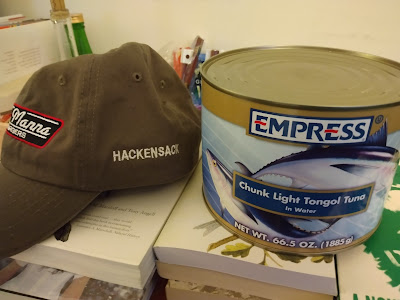
Cans of Tuna as big as your head!

On the other hand, New Jersey is more than the sprawling wasteland of suburbs, industrial zones and reeking foetid swampland that first greet the eye and nose of visitors. It is also the the place that everybody from the Bronx moves to when they get enough money. It is home to huge and varied ethnic communities seeking better schools and homes with gardens for their children after saving money for years in the Bronx. And within a ten minute drive of Teaneck we have the largest Korean neighborhood in the USA. We also have a lot - I believe the proper term is "fucktons" - of Turks who have opened bistros and kebaberies and baklava cafes that would not seem out of place on Istikklal Caddesi, Filipinos have entered into our sphere, bringing garlic pork and industrial sized cans of tuna into our lives. And Italians... And of course, my own people: Jews. Teaneck is full of 'em in all their Modern Orthodox, Beys Yaakov School Kosher splendor. Teaneck is also home to a large Muslim community, with a Medressah and mosque and lots of Halal pakistani grill houses. Teaneck is also famous as the first town in the USA to voluntarily desgregate its school system in 1965, and has always been a magnet community for Black musicians working out of New York. Jimi Hendrix lived here for a year while he was guitarist with the Isley Brothers - a Teaneck institution. When I first moved to NJ from the Bronx their son Riondo Isley was the first kid to beat me up on the school bus. 

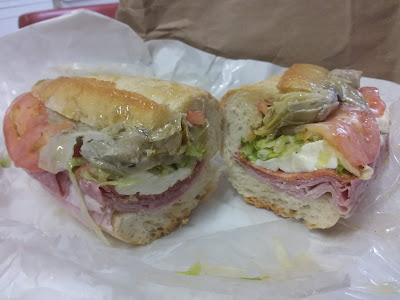
Later we will make a trip to the next town over, Englewood, which is home to the fabled Crispy Crust Pizza shop. In 1979 the world of pop music changed forever when the Sugarhill Gang released "Rappers Delight" - the first hip hop song to break into the top 40. The Sugarhill Gang were comprised of some of the guys who made pizza at Crispy Crust.Producer Sylvia robinson had heard rumors about a new kind of Black party music coming out of sound systems in the Bronx, and sombody tipped her off that the pizza guys at Crsipy Crust used to rap in the back while baking the extra large cheese with sausage. Personally, I haven't been eating much pizza these days. I tend to go for the Clemente's Special Italian sandwich from Clemente's Bakery in Hackensack, NJ. 

Ham, mozzarella, coppa, and sliced artichoke hearts. Oil and Vinegar. 

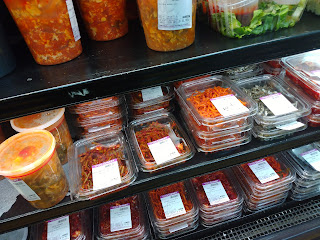
But the saving grace of being stuck in Teaneck is the proximity of so much incredible Korean food. First of all, we have H-Mart, the Korean mega-supermarkets that have fish and vegetable selections that we can only dream about in Hungary.

Kimchi everywhere. Not everybody loves this ubiquitous Korean pickled cabbage, but we do, and once you get the taste for it you dump it in everything. On our way home from Newark airport we were able to get to the Leonia H-mart before it closed. We picked up kimchi, some Korean seafood pancakes, some sushi rolls, and some noodles, thus saving us from having to arrive home to a dinner of cold Ball Park hot dogs my brother had left for us.


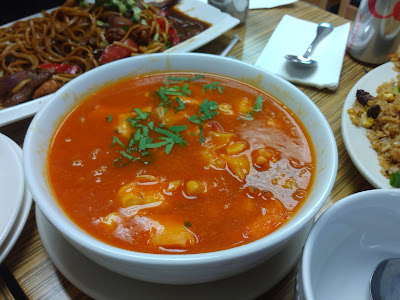
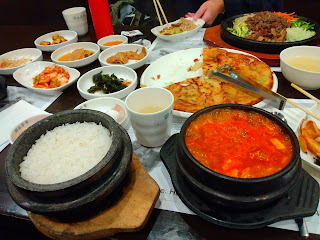
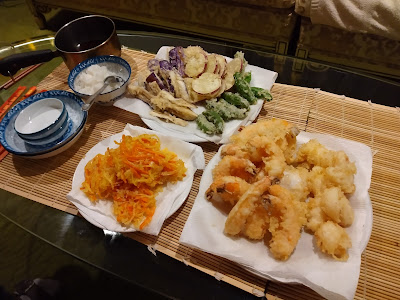
At SGD Dubu So Gong Dong restaurant in Hackensack, Korean Tofu soup. Kimchi beef tofu soup, to be precise.  Served with a tableful of banchan (small plates of kimchee, pickled radish, seaweed salad, and often a whole fried fish) with a seafood rice pancake on the side to top it off. This restaurant is located across the parking lot from 99 Ranch a humongous Chinese superstore that supplies anything H-Mart forgot. We're good for now... just finished our New Years eve Japanese tempura feast. tiger prawns, squid, Japanese sweet potato, shishito peppers, egglant, and onion fitters. At midnight we eat noodles. Don't ask why... I married a Japanese woman and thus it shall always be on New Years for ever after, Its noodles from here on down.


Monday, October 04, 2021

Kabul Bufe: Afghan Lunch in Budapest

Pilav of our dreams
Hungary, if you read the news these days, is not a nation that is exactly welcoming to immigrants, especially refugees. Viktor Orban made a political career out of demonizing refugees as "migrants" since the 2015 refugee crisis, when thousands of mostly Syrian refugees faced a bottleneck at Budapest's Keleti Train Station. The crisis was handled in the worst possible way by Hungarian officials denying services to the encamped families and then intentionally misleading them about travel onward to Germany. It was not Hungary's proudest hour. The crisis has passed but the sour attitude remains. The government controlled media refer to all emigrants and refugees simply by the perjorative "migrants" - usually adding that they are being sent to Hungary by the demonic financier George Soros, because, you know, he can. The volunteer organization that helped feed the refugees during their brief stay in Budapest was treated as a subversive antigovernmental plot and many of its participants were harrassed out of the country. I was out on the street when thousands frustrated Syrians at Keleti finally decided to take their fate in their own hands and march on foot toward Vienna. As I watched them march towards the Danube bridge leading to Vienna, I actually felt a sadness. I had been hoping for some new neighbors. And now they were marching away, never to return, taking their Syrian culture and cuisine with them. And we are poorer for it. 
You have to look closely for the Kabul Bufe.  Népszínház u. 27,
If you visit Budapest, you will notice that Budapest, unlike most European cities, doesn't seem to have any real immigrant neighborhoods. The unfortunate truth is... people don't emigrate to poor countries. Hungary is not dirt poor, but it can't offer the wages and opportunities that its western neighbors can to families looking to resettle in Europe. And the anti-refugee rhetoric plays into the canard that Hungary is "protecting Europe" and by extension, Christianity, from the hordes of hummus eating, kebab grilling, and fatoush mixing Middle Easterners lining up to take up Evil Master Soros' command to move to the eighth district. The result is... very few immigrants and very little of the advantages that come with growing up in multicultural environments. Like immigrant food. 
The daily double: Kabuli beef pilav, and chicken pilav, both with kidney beans.
Presently, we are facing an unprecedented refugee crisis in Afghanistan. Hungary - a NATO member - was a military participant in the Afghan War since 2003, and it has flown in 540 Afghans who had connections with the Hungarian government and military during the conflict. Hungary already has an Afghan community of around 2000, but unless you stroll along Népszinház utca in Budapest's 8th district you would never know it. Népszinház has become the street which immigrant multiculturalism shines the brightest in Hungary. We bike up Népszinház utca about once a week to stock up at the Troya Turkish Supermarket, which offers a full selection of Turkish products including an onsite butcher selling the best and cheapest lamb in the city (but no longer stocks fresh fish...) . The big magnet along Népszinház utca for us, however, is the Kabul Bufé. This is a tiny hole in the wall lunch spot serving Halal Afghan food  open from 11AM to 10 PM. There are several Middle Eastern luncheterias along Népszinház utca offering the usual felafuls and shwarmas and Iraqi, Pakistani, and even Nigerian food, but we couldn't pass up the Kabul Bufe when we first found it. Now we are addicted. 
The choice: with or without.
The menu consists of what you see: a choice of two rice pilavs. One is Kabuli Pilav, a brown spicy beef or chicken and rice mix, and the other is usually meatless with some veg and raisins floating around in it, and some mildly spiced creamy chicken stew to spoon on top. There is usually a bean or lentil dhal of some kind to add on the side, my favorite being the kidney beans. And that's it. Both are good: I always order one of both to go, because there is hardly any space to dine inside beside a single table. Also: they are incredibly cheap. A Styrofoam container that can fill two normal people for lunch costs about the same as a Big Mac. Also, as soon as we finish we want more.
Two pilavs... with string beans and spud-filled samosa on the side.

The real fast food of Afghanistan are bolani, supple stuffed flatbreads filled with spiced leeks, potato, or chicken. these are worthy of a meal in themselves, so I usually take a few home, and later dry fry them up in a frying pan for a quick evening meal. The samosas are a bit more substantial than ones you might find in an Indian restaurant: the potato filled ones are some of the best vegetarian food available in Budapest. And again: you can afford them. Several of them. 

Bolani
One last suggestion: if you see plastic cups with some kind of creamy dessert in the cooler... get them. I have no idea what they call them... and I don't usually eat dessert, but The Queen Who Rules My Existence loves any kind of flan or cream dessert with sweet spices and She loves them. The last one was some kind of creamy mango with cardamom flan... She also took the photos, at least the ones that are in focus...
Two cups of cardamom mango flan next to our usual order.