Thursday, September 14, 2023

Romania Part 1: Trumpet Fiddles and Goulash


Pictured above is a plate of iahnie de fasole cu ciolan afumat. Stewed white beans with smoked pork hock. It is one of the most radically non-kosher foods existing in the universe. It is also one of the most delicious. Similar dishes may exist elsewhere in the world, but iahnie de fasole with smoked pork is decidedly Romanian. You can't get this in Hungary, or in Serbia, or even in pig loving Austria or the Czech republic, which boasts the highest per capita consumption of pork in the world. Only in Romania. And in Romania, you can get it in nearly every restaurant, where it is usually the most expensive dish on offer, and still clocks in at under USD $10. It had been too long since I had been to Romania to enjoy its swiney delights... so this summer we made plans to meet up with Zoe Aqua and Jake Shulman-Ment, two of my close associates in the world of old style Jewish fiddling, to drive around the porkier parts of Romania visiting some of the older fiddlers. As fate would have it, our small party expanded into a small safari as six other friends joined the caravan, but somehow we managed. 

Neolog Synagogue, Oradea, Romania

We started out just across the border from Hungary in the city of Oradea, (known as Nagyvarád in Hungarian.) Once a grey and dusty border outpost, Oradea has spent the last few years using its European Union funding to spruce up and attract foreign investment. I was literally shocked at how magnificent the city had become, with several pedestrian streets lined with carefully restored old buildings filled with outdoor cafes and shops. But we were in Oradea to hop out to its suburban villages. In nearby Cihei lives Marius Mihuț, a maker of the vioara cu goarne, a resonator fiddle unique to the Bihor region of northern Transylvania.

Zoe was there to purchase a vioara from Marius, and every time we visit him he and his sister like to make a party of it. First, there was wild boar goulash made over an open fire in the backyard, followed by home made salami and home brewed palinka de prune, plum brandy. This is the reality of doing ethnomusicological "field collecting." You end up with wonderful, insanely generous new friends in places you would never expect. Also, amazingly great fiddle music.

Vioara cu goarne remain a popular instrument for weddings and celebrations around Bihor county, because it is loud enough to be heard over crowds at events such as football matches, where the local identity of the instrument dovetails perfectly with the local Oradea football team (by which I mean soccer for all you Americans...) 

The demand is such that Marius keeps quite busy churning out these hand made fiddles. The horn is attached to the body through a small reonator device set beneath the bridge and strings, rather like the metal resonator on a National Steel or dobro guitar, but in miniature. A more developed tone can be made by using the resonating device cannibalised from old phonograph players, particularly the Czech Suprahon brand, which Marius collects by being in touch with antique phonegraph collectors on ebay.

"Bobby" the deer with Fumie and Zoe

Did I metion that Marius keeps a pair of tame deer as house pets? Yes he does. Bobby and Bambina. He's raised them since they were orphans found by some local hunters. They walk around the farm in back and seem to think they are just another one of the goats. He also has a couple of baby wild boar. I'm pretty sure those will not end up as house pets, though. The goulash is just too tempting.

The Status Quo Ante Synagogue in Marosvásárhely

With a few days to spend before we traveled to Maramures, Fumie and I decided to see Tărgu Mureș, (Marosvásárhely in Hungarian.) For some reason, I have never actually stayed in this traditionally Hungarian speaking city, (today about about 50% use Hungarian and the language has official status) although a lot of my acquaintances in Budapest hail from here. I, personally, base myself in Cluj (Kolozsvár) when I am in Transylvania, and for some reason I haven't ever had a big reason to spend any time in Marosvásárhely. It is, however, off the tourist circuit and that meant hotel prices were cheap, and so was the food pictured above, the iahnie de fasole cu ciolan afumat from the Laci Csarda around the corner from our pensiune.

Herbal teas, fresh berries, and jams

The thing to do in any town in Romania is to visit the local open market. We were there in time for summer produce to be piled up in small mountains. People will preserve fruit and make huge amounts of  vineta and zakuska eggplant spread for use later in the year.

Mountains of egplant
Usually there are people setting up to sell locally made products like carved spoons, basketwork, and custom farm tools. Fumie found a 90 year old woman selling thick woolen socks she herself knitted, perfect for Fumie's mom and sis back in Tokyo, so she began to ask about them and the woman was utterly charmed by the existance of a Japanese woman who can chat in basic Romanian with a markedly Maramures accent.

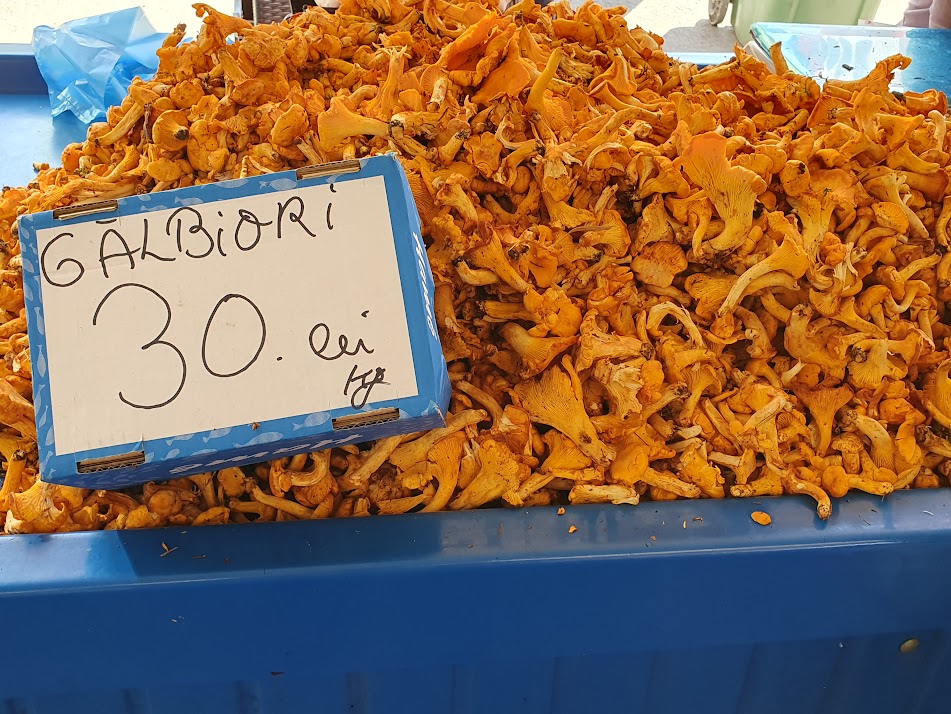
Also, it has been a good year from wild mushrooms. These are fresh chanterelles going for about USD $6.50 a kilogram. Not a pound. A kilo. I don't really want to slag on any of the places I have visited in Romania, but honestly? These mushrooms were the most exciting thing I saw during my time in Marosvásárhely. It is a pretty town, in a stunning location. Don't miss the mushrooms!
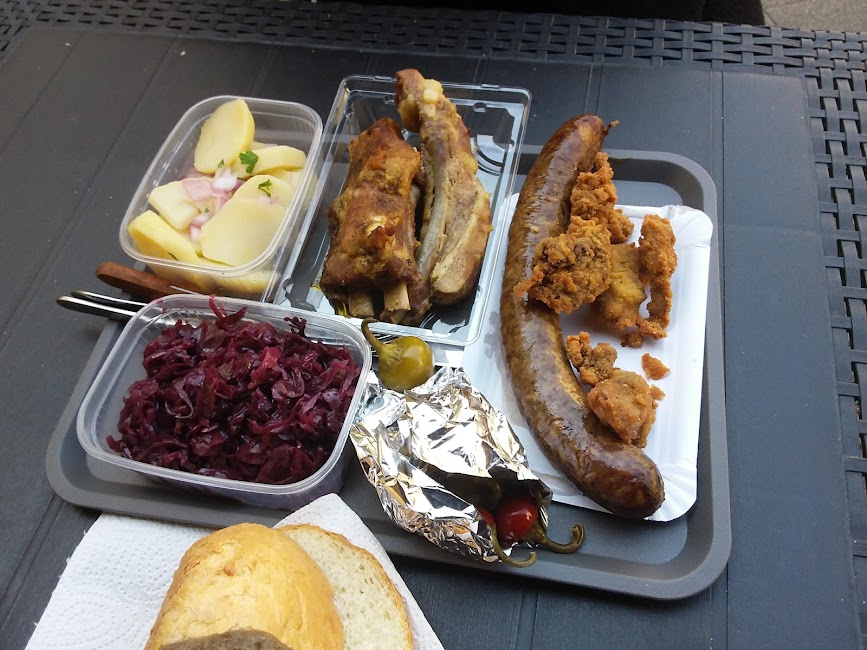
After a day in Székélyland, we were off to visit fiddlers in Maramureș, a few hours drive to the north. I will post more on that later. Pictured below is what greeted us when we arrived. Home made sausage with stewed sour cabbage. No. It was not kosher. It was, however, wonderful. 


You may well ask about my obsession with pork. Well... for most of my young life I did not eat pork. Although my family did, I avoided pork for a variety of reasons from the time I hit my teens until after I moved to Hungary. That all changed for me in Hungary and the Balkans. You have to be pretty effing hardcore to avoid pork in Hungary, or anywhere else  in Central Europe for that matter.  Pork is simply what is for dinner, lunch, breakfast, snacks, and in the intravenous feeding tube that hangs over you as you take your last breath. The amount and variety of pork available here was so overwhelming that I used to write a regular column for the English language newspaper in Budapest - Budapest Week - bylined by "the Prince of Pork." Its easier now - there are halal butchers and kosher markets, and vegetarians are no longer slaughtered as mass entertainment in the town squares, but after that first bite of kolbasz so many years ago, there was no going back for me.)


Thursday, June 15, 2023

We Become Peasants


After going dormant for the longest spell in its long history, the blog is back. I'm sorry about the delay. thanks to the readers who took the effort to reach out to me and inquire whether I was still alive or had been incarcerated or just gone off my meds and become a Republican. I'm fine. Life has been a bit less adventurous in the last year... we spent a lot of it (well, too much of it) in the USA getting surgical things stuck into various bits and parts and getting squeezed through MRI tubes and other such nonsense (playing Klezmer music around NY, eating Turkish food in Paterson and Yemeni food in the Bronx with the near-legendary Bob Godfried...) but finally we are back in our Budapest home and happily finding our true selves. We have become peasants. We are now people of the soil, as they say in nationalist circles. 
Our little plot of Heaven
Usually I write posts about our visits to various peasants around East Europe, but we finally decided to take the leap and become peasants ourselves! For years we have been using our huge living room window to grow basil, peppers, and other kitchen herbs, while Fumie has turned our inner courtyard walkway into a minor botanical garden of flowers. I used to have a garden when I lived in a rundown slum tenement in Allston, Massachusetts in the 1980s - growing in soil I composted from horse manure I trucked in from the Boston Police stables on the back of my bicycle.

Allston, Mass. 1982, with zuchinni
When we lived in Zuglo we had a balcony on which we grew a huge amount of herbs and peppers, and when we moved downtown that was supplanted by a huge living room window. Fumie set up a small mega-industrial scale window garden and soon our living room was being taken over by errant avocado plants, smelly muskatlis, and potted mints and basil. We needed more room. And luckily, the Kisdiofa Community Garden appeared on our horizon and we applied for a plot. 

our living room window nursery with community garden below.
The community garden is conveniently across the street from our building. When we first moved in it was a vacant lot with rubble from a demolished building, but a community organization (KEK) set about cleaning it up and trucking in organic soil to set up an urban garden in our densely developed old downtown Pest neighborhood, the seventh district Jewish Ghetto. The garden is strictly organic, and an entire compost system was built this year, so we can bring our kitchen scraps downstairs and recycle them into dinner for next year.
Cherry tomatoes and Japanese cucumbers
We got back to Budapest in March, so we were a bit late in getting started, but the folks running the garden were there with advice and guidance and soon we had turned over an abandoned plot, worked in organic compost and petrified alga-limestone, and we put in our early spring vegetables. One part of the plots is for flowers, including something Fumie found at Stop and Shop in Teaneck labeled "Grandma Flower Mix" that she swears by and we have no idea what is in it. Spring in Budapest this year was cold and wet and long, and the results were that our chinese yu-tsai greens didn't make it, our snow peas failed, and our radishes emerged as a lesson to other radishes to just say no to the Man pushing crack. On the other hand, once it warmed up we had a bumper crop of lettuce and we had an amazing crop of arugula, which we are still eating.


Since, we have put in tomatoes (cherry, black Krim, and yellow) Japanese cukes, peppers (Jalapeno, Japanese Shishito, and Romanian hot long pepper) two types of eggplant (Japanese and Italian) and okra. Okra is hot weather vegetable not often seen in Hungary.  We are almost too far north to grow it, so I am counting on late planting and global warming to see us through. It is also, without argument, my favorite vegetable. When I'm in the US I eat about a kilo of it a week, and with peppers and tomatoes I should be fed well into the fall.


OK. There was Yemeni food in the Bronx...


And Turkish Kunefe hot pastry with home made pistachio ice cream in Paterson...


And of course, nobody loves New Jersey diners more than my Dad, who will be 97 on June 20th:


But we are very happy to be home!


Tuesday, November 15, 2022

Maramureș: "A Sausage Every Day!"


In July I was up in Maramureș, the northern region of Romania which has become my second home-away-from-home-away-from-home over the last twenty five years or so. When I first began visiting Maramureș, it was one of the least developed regions of Romania. This was partly due to Ceaucescu's suspicion that Romania would have to sacrifice this slice of Transylvania if there was ever a Soviet invasion (Ceaucescu was paranoid, but in hindsight, not that paranoid.) Accordingly, Maramures was left a backwater region during communism, with no industrial developement beyond forestry and mining. As a result the peasant culture of Maramureș was able to maintain a sense of cultural continuity that was beaten out of most of East European peasants in the late twentieth century. 

The Moroșeni, as people of Maramureș are known, are famous for hard work. The mountain land is unforgiving, and it takes twice as much work to produce a crop of potatoes than it does in the lowlands.  Traditionally Moroșan men would travel to do farmwork or construction in order to send money home. Today that tradition continues with adults leaving to work in Italy, France, or England and returning in August for a family reunion. And they return with their earnings - western earnings - which they invest in weddings, home contruction, fine new embroidered folk costumes to wear to weddings and dances, and a growing investment in village status. It also means that during the year the children stay at home to be raised by their grandparents, which means that the traditional skills and values of the village are passed on and continued. 
Dancing in front of the church... these guys all work construction in Manchester...
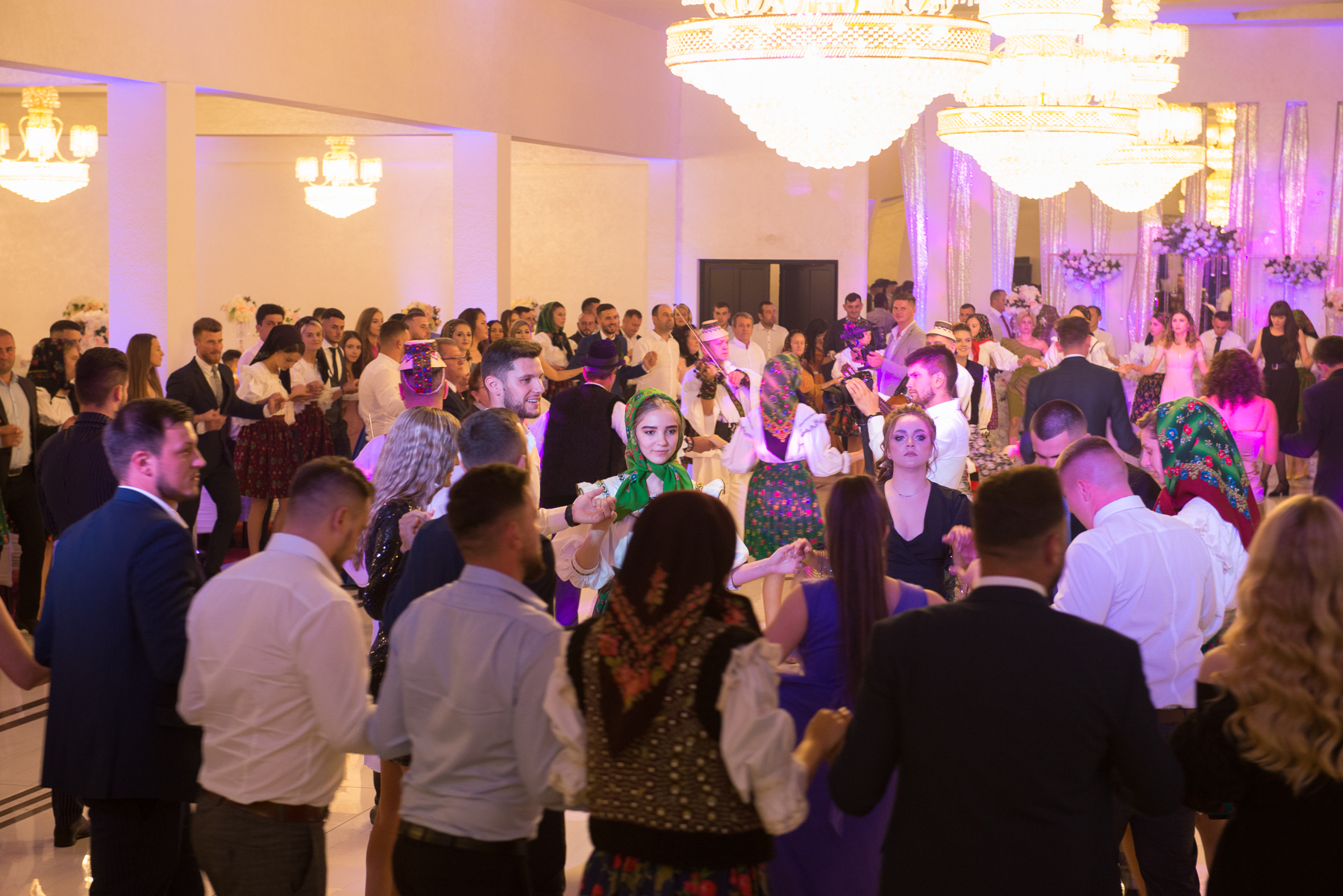
In August there are often four or five weddings going on in any village on any weekend day, complete with processions marching through the streets and house receptions where guests are greeted with music, food, and a glass of plum brandy horinca at the gateway. We usually stay in Ieud, a large village in the eastern Iza valley that was described by anthropologist Gail Kligman in her monograph The Wedding of the Dead. (google books link here.) 
Ion de la Cruce,
When we are there in August, we often get impromptu invites to weddding receptions, which means fiddle music, stuffed cabbage, and serial shots of plum brandy at 11 in the morning. The ceremonies involved receptions at the homes of various inlaws (cake, brandy shots, fiddle music) marching aroiund in the streets to and from churches and inlaws (cakes, brandy shots, fiddle music) and finally, at night, buses to transport the whole party to one of the new Wedding Halls - huge, kitsch modern catering halls with garish lights, pink tablecloths, and monstrous sound systems blaring... fiddle music.

We met Nița Dancuș, our host and good friend, back in 2001 when we went to Ieud to sepnd a few months immersing ourselves in the local dialect of Romanian language while I spent time with the late Gheorghe Ioannei Covaci, the eldest of a dynasty of fiddlers who, at the time, had a large repertoire of Jewish melodies learned in the 1940s from playing with members of the Shloimovici family of Klezmer musicians from thre neighboring village of Rozavlea. 

Nița is an encyclopdia of Iza Valley folklore, history, recipes and jokes. She is from one of the most high status families - the Iza valley had a strata of "noble" peasants during Austro-Hungarian rule - and was an activist on behalf of her beleagered Greco Catholic Orthodox Church during the Ceaucescu years. She is also a great cook, and her sarmale (stuffed cabbage) may well be the world's best. Her goat soup isn't bad either, and I particularly like her stuffed peppers.
The stuffed pepper that defines stuffed pepper.

Back in 2001, I wanted to record Gheorghe Ioannei and his family for a Cd to release to my friend's label in Germany, a mix of their local and Jewish repertoire. I backpacked into Ieud in the winter - transportation was bit more difficult back then, involving a freight train from Cluj to a lumber station on a mountain above a village and then hitchhiking and walking to get to Ieud, hauling a huge Marantz professional recorder and microphones stufffed into my backpack. My spine has never forgiven me. Ghorghe lived in a one room log house on the "gypsy" street along the river in Ieud, and he continued working as farm labor into his late 80s. He once told me about his time as a Hungarian Army POW in an American Prisoner camp in Germany after WWII. "It was wonderful... We ate so well!  They gave us a sausage every day! Imagine that! A sausage every day!" The imagined title of the CD I had hoped to produce was, of course "A Sausage Every Day!"
Gheorghe Ionnei Covaci and wife.

I arrrived just in time to find Gheorghe's son and designated accordion player Ion, sick with an abscess that looked an eggplant growing out the side of his cheek. I paid for the transport and doctor bills and we sent Ion off to the hostpital in Sighet, followed in true Romani style by his entire family - the family band I had hoped to record. I was left alone with the old man. Hoping to salvage the recording, I still went ot visit him every day, but he insisted his wife accompany him on guitar. Mrs. Covaci was not a great guitarist... A lot of older Maramureș fiddlers heard on field recordings are accompanied on guitar  by a single chord rythymically droning on behind them without any chord changes... this is a clue that the guitarist is, in fact, the wife of the fiddler. Instead of hiring a guitar player (usually a brother or neighbor) the fiddler saves money... and so... we never released a CD of one of the most amazing fiddlers ever to pick up a bow in Romania.
Nicolae Covaci from Dragomiresti, MM.
Gheorghe Ionnei Covaci passed away at the age of 88 almost two decades ago, but since then I have been tracking down his brothers, all of whom are fiddlers, to record more of this older repertoire of Maramureș fiddle music., along with other older generation fiddlers, most of whom had never been recorded for commercial or even folkloric purposes before. Gheorghe's brother Nicolae and Viktor lived in the neighboring village of Dragomirești, and for the next few years I visited them regularly until Nicolare passed on some years ago... Nicolae was as poor as a proverbial churchmouse, but he lived next door to his daughter and her husband who worked as a miner. We always make sure to pay village fiddlers for sessions - they are professional musicians, after all - and we always bring a shopping bag for the fiddler's wife: coffee, chocolates, salami, cooking oil, juice, cigarettes, and violin strings. (Cash gifts you pay directly to the primás lead fiddler.) Seeing the treasures we gave the old couple, Nicolae's neighbor was convinced we were making millions of dollars from our recordings of the old man. There is nothing quite like a drunken Romanian miner screaming at you while you adjust your microphones to start a day of field recording.

Most people identify Maramureș with the fiddle, guitar and drum sound that was made popular on Electrecord records by the Frații Petruș (Petruș brothers) in the 1960s. The success of those recordings caused Romanian State Radio to declare that all music from Mramureș would thenceforth be broadcast or recorded only as a fiddle and guitar style. This ignored and pushed out an older style of music that was predomonant in the Iza valley, music played with fiddle, three stringed kontra viola, and bass, the classic Transylvanian string trio ensemble. This was the style of orchestra heard up into the 1970s, and was the preferred style for playing Jewish music. This is a recording made by Romanian ethnomusicologists Ghisela Sulițeanu and Anca Ghircescu around 1970 of the left handed fiddler from Borșa, Gheorghe Covaci known as Stingaci ("Lefty") playing a set of Jewish wedding dances. (Yes... everybody is named Gheorghe Covaci... you get used to it.)

 This older style of Maramureș fiddle music has become increasingly rare as the older generation of fiddlers passes away and the slow, odd metered Transylvanian and Jewish repertoire was replaced by more popular local neo-folkloric music spread through popular recordings and video channels. At this point, there may be only one older fildder who remembers having played with Jewish musicians in Maramureș and maybe four who still keep up any of this repertoire. I once asked Ion Pop, the acknowledged curator of Maramures musical tradition, who was left playing the old style music if Maramureș. "You and me... maybe only you and me." that is not entirely true, but that's a blog post for another time.
The late Gheorghe Ioannu Covaci from Saliște, known as "Paganini"


Sunday, August 21, 2022

Transylvania: Mera World Music Festival


Mera is a village about 15 km west of Cluj (Kolozsvár in Hungarian) in the Kalotaszeg region of Transylvania. Mera - whose population is almost entirely Hungarian speaking - is famous in folk music circles due to the role it played in the revival of Transylvanian Hungarian folk music and dance in the 1970s Hungarian Dance House music movement (táncházmozgalom) Young Hungarians from Budapest seeking to learn Transylvanian traditional fiddle style and dance gravitated to Mera, which famous for its Gypsy musicians, the Berki family, also known as the "Árus" family. "Old Árus" died in 1975 and his son, Ferenc, moved from playing bass in the family band to playing lead fiddle as "primás" He was also considered the best dancer in the region and during the early years of the dance house revival dancers flocked to him to pick up tips on his amazing rendition of the verbunk, the men's  virtuoso dance of the Kalotaszeg.

In 1970 National Geographic published a photo book called "Gypsies: Wanderers of the World" by photographer Bruce Dale. Dale accompanied British Romany Clifford Lee on a journey from England to India, producing some of the most striking photos of Roma people I have ever seen. I was around 14 years old when I stumbled across it in the school library and was entranced by one photo of a couple dancing to an older fiddler on a hillside in a village named "Mera." 

Clifford Lee dancing with Rozineni and Feribacsi in Mera, 1969.

That photo told me that someplace out there in the world (i.e., not in Teaneck, New Jersey) there were communities of people for whom traditional music and dance were a vital part of life, a life I needed to know more about. Around that time I first began to play the fiddle. In  Budapest in1973 my Uncle Jozsi bought me a Czech violin for the equivalent of $14 and a boxed set of Hungarian folk music from field recordings. I spent the next fifteen years becoming a fiddler of sorts: I mostly played Appalachian and old-time American fiddle, but driving me all the while was a passion for the thick, ancient sounds of the Transylvanian fiddle music I had heard from that boxed set. In the pre-internet world Transylvanian music was not easy to come by in the USA. I found mine from LPs in Hungarian language bookstores and in the archives of the NY Public library research division. It was this music that drew me when I moved to Budapest in 1988, and it was in October of that year that I first got to travel to Mera, After Ceaucescu fell in 1989 the musicians from Mera were allowed to travel to Budapest, and I began a deep  friendship with Berki 'Árus' Ferenc - Árus Feri - that lasted until his passing in 1996, which I have written about here. 

The Berki "Árus" brothers: Feri on violin, Béla on accordion. Mera 1994

In Mera I basically apprenticed with Feri, who was 30 years my senior, but I never mastered the full virtuosic Kalotaszeg style. When I began looking for specifically Jewish music repertoire, Feri accompanied me to visit all the older fiddlers around Cluj who had played weddings with his father - "Old Árus" - before World War II. Mostly I hung with the family and learned to speak their local dialect of Romany. And it dawned on me for the first time: Feri and his wife, Rozinéni were the couple dancing with Clifford Lee in that 1969 photograph taken by Bruce Dale

With Bruce Dale, Mera, 2022

That made this summer's Mera World Music Festival even more interesting: Bruce Dale was invited to exhibit his photos in the village during the festival. (Dale has been revisiting communities that he had photographed in 1969 and connecting with some of the people he met fifty years ago.) I was there to play Jewish music with Craig Judelman's Klezmer Kapelye, the band I had played with in Germany in June. Its an interesting concept: Craig sings a lot of Hasidic material and rare Litvak Yiddish songs, but the band uses a classic old lautar rhythm section, with the cobza (me) standing in for the bass alongside cimbalom, played by Shaun Williams - the American ethnomusicologist widely known in Bucharest music circles as the lautar accordionist Jean Americanu. 

Zoe, me, and Shaun onstage with Judelman's Klezmer Kapelye

Craig shared fiddle duties with Zoe Aqua, who by now counts as a local Transylvanian musician. Zoe has been doing a Fullbright research fellowship in Cluj studying the ways in which Transylvanian music is passed onto younger generations, and she has been learning from some of the old and not so old masters like Ioan "Nuku" Harlet and Florin Kodoban. 

Zoe also just released her own CD, "In Vald Arayn" in which she mixes what she has learned about Transylvanian band playing styles with old style traditional Klezmer and comes out with something amazingly new. It officially came out just as we were driving around in Transylvania so we had it on the car stereo all the way to Mera. While we were in Mera I checked in with some of my old acquaintances from the Berki family. 

Berki Jeno and Árpi, 1999 [Photo: Fumie Suzuki]

Feribacsi's grandson Árpi was the apple of his eye: Árpi's mom had left to work in Hungary, basically abandoning him as a child and he was raised by his Grandparents. Feri had hoped Árpi would take command of the Mera band, but between the stiff competition among fiddlers and Árpi's need to work as a shepherd in the high pasture stana outside of the village, combined with a passion for women, partying and shitty tattoos...  his musical talent was never quite tamed. 


Back in the summer of 1999 I bought an old fiddle at the Cluj flea market and gave it to Árpi in hopes that he had the stuff to become a primas.  Unfortunately, Árpád, known as Pipi - never rose to the level of leading the village band, and suffered from a series of misfortunes in his life, the most recent of which was a pit bull terrier attack this summer that chewed up his leg and his butt so bad he nearly died.

Every time I meet Pipi my heart breaks - I remind him of his Grandfather and he starts tearing up and turns to me for advice he never takes on how to get his life in order. One of the reasons I stopped visiting Mera after Feribácsi passed away was the simple fact that even as a quasi-adoptive family member, there were expectations that I could preform economic miracles. While Rozinéni was alive we tried to take good care of her - taking her to doctor visits in Cluj, trying to get her eyes fixed, helping out with the bills. 

Rozinéni singing in 1999. (Foto: Fumie Suzuki)

But after she passed I didn't return to Mera for nearly 20 years. Until the Mera World Music festival called.  It is an impressive event. Held in a former barn turned into a stage, it features not only local traditional music but also a wide spectrum of names on the world music circuit - I had to miss  a few on the final day of the festival, including Craig's Old Time American band Interstate Express and the Ghanaian Alostmen, featuring the half Romanian half Ghanaian Wanlov the Kubelor. And I missed the set by Erdofu, by far my favorite Hungarian traditional band right now. And my legs are no longer quite enough to get me up the mountain to the cemetery where Erdőfú plays a memorial set to honor the memory of the great Árus musicians at their burial site. A wooden "kopjafa" memorial marker (top photo) was erected this year, but three years ago I did get the chance to haul up to the cemetery to pay my respects to Árus Feri and Rozinéni while at the festival. Erdőfú and the local musicians of Mera:  Berki Béla on accordion, his son Béla on kontra, "Kis Netti Sányi" on violin) did the honors.


Sunday, July 24, 2022

Hurka: The Tastiest Turd in Hungary

Blood and guts and oh so good!

East Europe doesn't offer a lot in the way of extrémé foods. We don't eat bugs, we don't find grubs and worms very tasty, and we do not to eat anything alive. This makes us a bit boring for the TV food travel shows - like Tony Bourdain's No Reservations - which tend to dwell on the portion sizes (case in point: the Pleh Csarda) and the exciting blood and gore of a countryside pig killing feast. But there is one food most visitors to Hungary and its neighbors will probably miss out on: hurka. Hurka is the dark underside of Hungarian sausage. Hurka is the lunch which dare not speak its name. Hurka haunts the nightmares of small children and vegans. Hurka is neither a polite nor a dainty food. Hurka is a culinary afterthought stuffed into a pig's ass. Unless you are invited to a pig killing feast, you are not likely to taste hurka outside of a butcher shop lunch counter. No restaurant offers it - none - and most home cooks avoid it due to its tendency to explode while cooking, splattering grease and guts around the kitchen and reacting exactly like a garden slug that has just been sprinkled in salt. Hurka is a problem food. Also, it tastes really good. 

Blood sausage and liver sausage, in action.

Hurka is a kind of sausage made out of spiced ground pork liver or blood mixed with rice as a filler. Hurka is not really that strange except for one thing: it really looks like pooh. This is a point not lost on Hungarians, for whom the term hurka is a polite alternative term for "turd". Hurka was the first food I discovered that could also be used as a psychological weapon against my sister. When I was growing up in New York my Mom used to take us down to the -now vanished - Hungarian neighborhood in Yorkville, on Manhattan's upper east side, to stock up on essentials like poppy seeds and paprika at the famous Paprikas Weiss Hungarian delicatessen on 2nd Avenue. 


The next stop stop was at the aptly named "Valodi Magyar Hentes" butcher shop to pick up some kolbász and hurka and the wonderous thing sold there which was actual Magyar bread. The bread was unlike anything available in the USA in the 20th century... which is to say it was real bread. At home my Mom would cook up a family favorite - lecsós kolbász -  and a couple of hurkas on the side. Nobody except me and my Mom would eat the hurka. It elicited groans and cries of "ewwwww gross!" from my brother and sister, who couldn't bring themselves to taste the turdlike mix of organs and blood. The mere idea of eating a tube of congealed blood and ground pig weenie was enough to send my sister running from the table. (Update: she has since become a respected and world renowned Oncologist.) You know the saying "don't ask how the sausage is made"?  The stuff they don't use to make the sausage is what goes into the hurka

Hurka, fried liver, ribs at Brunch at Ica Mama Meatshop

You may ask yourself "Why were these otherwise traditional Yiddish speaking New York Jews happily eating pig privates ground with pig blood in casing made of pig intestines?" Simple: my mom was born in Hungary, and we are not orthodox Jewish, kosher, or otherwise bound for glory on tkies hameysin when the souls fly up to find their reward in heaven. When I was nine my Dad took me to City Island in the Bronx to introduce me to eating live clams on the half shell, which is about as unkosher as anything you can put in your mouth except maybe for rabbit. It was a rite of manhood, but also a guarantee that I would not adopt the ritualized eating disorders of my more observant mates... I mean, dude, you ate a living clam, for pete's sake! As for my Mom... Hungarian Jews split into orthodox and Neolog (reform) a long time before that was an issue with the rest of East European Jews, and part of the social assimilation of Hungarian Jews was the acceptance that virtually everything ever eaten in Hungary is made out of a pig. Pushing boundaries is just what we do. The origin of the Neolog movement in Hungary started in 1798 when Rabbi Aaron Chorin chose to make a foodie argument about whether or not sturgeon was a kosher fish. Today many Orthodox Jews won't eat sturgeon, yet it features in the less rigid Jewish tradition of the New York smoked fish "appetizing" shops like Barney Greengrass and Russ and Daughters. 

Poland: Kiszka or kaszanka at a restaurant in Krakow

You can go into virtually any Budapest hentesbolt - a butcher shop serving hot foods - and there will almost always be a steaming tray of grey liver majás hurka or black veres blood hurka. Most are made from ground mystery meats mixed with rice, but you may see some labeled "Svab hurka". For some reason, the German speaking Schwabians of Hungary - most of whom were deported to Stuttgart after WWII - preferred to mix their mystery meat with bread crumbs. Those crafty Svabs... what will they do next? Either way, most commercially made hurka is insipid, oversalted, and usually dried out by the time it gets served. Never buy hurka from a supermarket meat refrigerator. Most of the hurka available today is made in factories, and is a rather banal and usually too dry and salty ghost of what a good guts'n'organs'n'blood sausage should be. Worst of all they are often kept warm under infared lamps which dries them out into a sandy, dry, unpalatable bit of pooh in stick form. 

The butcher at Klauzal Piac. Hurka on the lower left...

The search for a good, locally made artisanal hurka is never ending. The best was once found at the lunch stand run by an old guy named Palibacsi who made his own organic meats on a farm north of Budapest and for a couple of years his lunch counter at the Klauzal market was easily the best place to experience Hungarian food in Budapest besides the also now defunct Kadar Etkezde, located four doors down from the market. Today, seek out private butcher shops and look for misshapen, odd looking, and juicy hurkas that defy commercial sizing and try your luck. Hurka and other meat products sold by peasant stands at big markets or smaller farmers markets like the one at the Sunday Szimpla Piac or the Czako kert are a good bet. The lady who brings homemade bacon and smoked meats to the Klauzal market on weekends has good hurka, but it sells out fast. At home you can bake them in an oven (in a tray with a bit of water) or fry them at low heat in a pan, but either way they tend to explode while cooking. If you have the time, try soaking them in water for an hour or two before cooking: it helps the skin resist exploding.


Sunday, July 10, 2022

Germany: It Gets Würst...

June found us traveling around the Berlin vortex of the European Klezmer music world, a world in which Jewish traditional music comes in contact with two of my favorite things: Turkish food and Würst. Berlin has two iconic street foods: the Berlin doner kebab and the curry wurst. I managed to not eat either of them. I have eaten curry wurst, many curry wursts... and I don't like curry wurst, which is basically a wurst with ketchup and curry powder or some hausgemakht version of the same. I like my bratwursts clean, hot, and straight off the grill. 

Bratwurst, Leipzig, Mozart ate these.

I especially do not enjoy the post WWII east German invention of the "ohne darm" skinless bratwurst such as those served by the famous Konnopke's Imbiss in Prenslauerberg. One stop up the Ubahn at Schönhauser Allee is the nostalgic East German Alain Snack kiosk, which provided the classic bratwurst and mustard seen above. It was so good I tried to get a bockwurst (more like a fat Katz's Deli frankfurter that went to heaven) in a bun with mustard but the chef objected to the mere thought: the Ketwurst was designed by the East German State Gastronomical Research Center to provide the communist workers of Berlin with a convenient snack. 

The stupidest food I have ever posted.

A Ketwurst is basically a hot dog (in this case a pretty darn good bockwurst) stuck in a bun heated on a toaster spike which has been filled with "special sauce" (i.e., ketchup.) It is an unmistakably East Berlin nostalgia flavor and it is an incredibly stupid food in a country known for incredibly stupid food. East Germans didn't simply melt into a post 1990 German" identity: a lot of them cling fiercely to the small things that once defined them as Ossies... like Ketwurst! 

Bockwurst is the one item I always bring home with me after visiting Berlin. For some odd reason, Hungarians - who love German sausages - do not produce anything nearly as good. Only the Czech and Slovak supermarket parky rivals the Hungarian virsli for lowest place on the frankfurter quality index (as defined by snap of skin, texture of mystery meat filling, and rate at which it dries out into a wrinkled turd in your fridge.) So all available space in my home bound luggage is filled with bockwurst. Did I mention that Berlin is probably also the most vegan -friendly city in Europe? Yes, it indeed is. As if I could give a shit.

The other thing I bring home is mustard. The mustard available in Hungary does almost nothing beyond stain your white T-shirt yellow. Somehow people in Eastern Europe fucked up mustard. I don't know how, they just did. So I bring it back from my trips to Germany, in particular the Dusseldorf brand Lowensenf, which beats any French Dijon mustard for making sauces or just dipping hot dogs into. We picked up a bit of the Bautz'ner brand, which we tried in Leipzig, and while in Erfurt we picked up some of their local "Born" brand, which is good but definately a classic "Ostbloc" mustard. Erfurt has a beautiful old town that seems to go a bit overboard about their mustard industry. There is a Mustard Museum downtown, and I was even given a gift bottle of "Born Mustard Brandy". It was truly vile, but it is the thought that counts. 

Berlin is easily the city where a visitor can spend less and eat better than almost any other European capitol. There are other things to eat in Berlin besides Turkish food and sausage, but trust me: they suck. I don't use the term "suck" to simply indicate lesser quality... I mean "Whoa! That sucks!" Most of the nicer places specialize in what we ex-kitchen staff know as "pretentious tweezer food". Another problem is that Germans can not eat spicy food. That is not a stereotype." If a German unexpectedly encounters a blast of hot pepper they can - and sometimes do - sue the restaurant. So the smart chef dumbs everything down: watery stocks pass as pho, bland plates of noodles with peanuts sprinkled on top are labeled "pad thai" alongside menu categories identified as "Asia Wok" and of course, "China Box".  There are hundreds of these "pan-asian" monstrosities all over Germany. The late Ed Ward - one of the best American expat writers ever to set foot in Europe took umbrage at the easy racism that powers this perception that all "Asian" food is the same  It's undeniable, though, that this sort of racism -- Orientalism, to give it its proper name -- is acceptable here. There's a snack food that comes in "Thailandische süss-scharf" (sweet-hot) flavor, and features a "Thai" on the package wearing a coolie hat, slanty eyes, a pigtail, and those kind of Japanese wooden shoes with the two platforms, the kind that geishas wear. It's an offensive stereotype, but it isn't even a remotely accurate offensive stererotype.

Köfte

On the other hand, Berlin has glorious Turkish food. Most of the Turks living in Germany today have Anatolian roots, and also something very few people in Anatolia have: a decent income. And it shows in the restaurants in neighborhoods like Wedding. Wedding has the lowest income level and the highest percentage of foreign born residents in all of Berlin. That may sound like something out of a Viktor Orban fever dream, but it is one of the more pleasant parts of Berlin, especially if you have an appetite. We randomly chose Köyluoglu Turkish Restaurant in Wedding and it was one of the best restaurant meals we've had in years. I was converted to köfte (roughly: meatwads) years ago in Istanbul: Fumie always goes for Adana kebab. Either way, nobody understands ground meat better than a Turkish kitchen. I have spent decades trying to make a decent Turkish style köfte in my home, and only recently had any success in producing something that does not resemble a small dried hamburger. Good köfte  proves the rule that simplicity can be deceiving. Köfte is rapidly replacing doner as the King of Turkish street meat on Berlin's streets. 

Köfte sandwich at Gel Gö

Later, after rehearsing in Neukölln, I had late lunch at Gel Gör, a grill famous for its inegol köfte and that stays open all night long and is famous for impromptu street dancing at 4 AM on weekends. This rates as the best sandwich of the year so far, considering that I have not been able to visit Katz' Deli this year.  And just down Kottbusser Damm on the next corner was La Femme, specializing in Turkish breakfast. There is a saying in Turkish (I am not making this up) that "lunch is for your friends, dinner is for your family, but breakfast is just for you." Omelets, cheese and olive plates, perfect for wasting a morning outside with your friends. I even ordered a breakfast to go on a travel day, only to offer it in sacrifice it to our unfed cimbalom player who was driving us to our next gig. 

Su burek: think non-tomato lasagna for breakfast. 

On the upside, the music - with Craig Judelman's Klezmer Kompanye - was great. With Craig and Zoe Aqua on fiddle, Shaun Williams on accordion and cimbalom, and Dasha Fomina on flute. We played the Panda Platform in P-berg, Berlin, and it was like a homecoming for all kinds of Yiddish friends and klezmerei... Michael Wex, Shane Baker, Tamas Wormser were all in the house. The road always leads home.