One can never get away from the flavors one grows up with. I was raised in the east Bronx, and while our household was an Ugrian-semitic island of Hungarian food mixed with matzoh ball soup and chopped liver, the east Bronx was - and is - one of New York City's strongest Italian neighborhoods, alongside a healthy dollop of Irish and Plattsdeutsch speaking Germans. But in my nabe off of East Tremont Avenue, we ate Italian food. The neighbors were all Italians from Calabria and Abruzzi, my Dad's best buddy (and NYPD patrol car partner) was Sicilian, and I was essentially raised on Italian American home cooking, a style my immigrant Hungarian mother came to know as "American" cooking since she learned it from the neighboring wives in a place called "America." Even today, the east Bronx is full of Italian bakeries and butcher shops and some of the best pizza to be found in the entire city. It was there that I defined my taste in sausages: Italian sausages, southern style, flavored simply with fennel and hot peppers. My Mom sometimes took us shopping in Yorkville, Manhatten's old Hungarian neighborhood which used to be lined with Hungarian cafes, restaurants, and grocery shops. It was the place where we could stock up on paprika and buy Hungarian debreceni kolbász and hurka (liver or blood sausages) and "real" bread.Yorkville's Hungarians have pretty much disappeared these days, except for the Hungarian church and a couple of newer Hungarian restaurants, mostly pushed out by rising rents and the lure of the "Hungarian" suburbs like New Brunswick, NJ and Bridgeport, Conn. But when I visited Hungary and finally moved here I was a sausage demon. In Hungary, you won't often find sausage on any menu - you eat it at home or standing up in a butcher shop. And it used to be, in my opinion, a lot better. Today, most kolbász seems to be an industrially produced cheap meat tube with a rubbery consistency and an over salted spicing of low grade paprika. Sausages made for grilling - the ones that are "raw" and not intended for a long refrigerator life - tend to be so stuffed with paprika that they end up dry with an almost almost sandy consistency. After a decade or so, I grew strangely tired of the Hungarian grilled kolbász. And so... I learned to make my own. The sausages of my youth. Italian sausages. It really isn’t that hard, although I would need a full meat grinder to do it right. I have one, an old crank handle model I picked up at a junk market, but the blades are wrong, although it does a decent job of churning out the sausages with already ground meat.But for smaller amounts I just use a plastic sausage nozzle attachment and push the kolbász through with my thumb. It leaves air bubbles in the sausages, but since I am not going to smoke or store these babies, I can simply prick the skin with a toothpick and carry on without worry of food poisoning. . Most butchers here sell kolbász bél, cleaned intestines for stuffing kolbász, so after rinsing a meter long section by running water through it in my sink, I mix up the meat and spices. To get the right mix of meatiness and juiciness, I take two thirds measure of somewhat fatty ground pork, and add to it a third measure of hand chopped pork belly meat. This is a fatty bacon cut called "nyérs csaszár" sold cheaply for home bacon hobbyists and emigre chinese home cooks, who seems to be the main customers for pork belly at the Bosznyak ter market where we shop. The spices are insane amounts of black pepper, fennel seeds, and nutmeg, with some chopped parsley for good measure.In the summer I might add chopped fresh basil from the “garden” as well. Half of the batch gets a palmful of crushed dried hot pepper flakes, the other goes without. Fried or grilled, these are a pretty close approximation of a New York Italian sausage. I’ve also experimented with other combinations including fresh Portuguese chourizo sausage (hot paprika and garlic) and German bratwurst (nutmeg, black pepper, and coriander.) Under normal conditions I would eat this with a hunk of crusty bread or a plate of pasta, but since I am under a self imposed regimen forbidding those wonderful things it usually gets served with a salad or my old friend , Mr. Zucchini.I’m gonna hate Mr. Zucchini pretty soon. Fumie is not a stranger to the odd hunger pangs of home, in her case, Tokyo. You might think that recreatring Japanese local specialties would be harder to satisfy than simple Calabrian food, but she does pretty well, what with cans of smoked eel and seaweed sent to her from home and local Chinese groceries and the occasional trip to Vienna. But Edokko people (people really native to Tokyo) like Fumie are crazy for natto. Natto is rotten soybeans, fermented by a special bacteria until they turn sour and emit a gummy stringy slime that Edokko love.Most other Japanese won’t eat natto, and it is one of those foods that foreign food writers always highlight as examples of weird cuisine in Japan, after fried bees and poisonous fugu sashimi. This is the dish that brought Anthony Bourdain to his knees, and he described it as "an unbelievably foul, rank, slimy, glutinous, and stringy goop of fermented soybeans... Given a choice between eating natto and digging up my old dog Pucci (dead thirty-five years) and making rillettes out of him? Sorry, Pucci." Fumie makes natto at home, on top of the living room heater, in fact. It is not that bad, actually. Stirred into a stringy mush with hot mustard and soy sauce, eaten on rice for breakfast?
Maybe natto takes some getting used to, but I’d say it is a big improvement on Pucci. You can buy natto in Japanese grocery shops in small styrofoam cntainers, but the closest to us is in Vienna, and thus we have been forced to produce natto ourselves. And we only produce enough for ourselves. So don't even ask... On the other hand, Fumie has to have kimchi, the Korean pickled cabbage that has become to Japanese cuisine what Pizza is to New York cuisine. To make decent kimchi, you need napa cabbages (which are easy to get here - although I wonder what, exactly, Hungarians do with them) and red pepper paste - which we can get at the chinese grocery. And also fish sauce, various spices, and glutinous rice flour, all of which we keep stocked in our pantry.The amount you see here lasted about a month, only long enough for it to ferment and get really tangy. Kimchi is something you make in the winter months - while you can store a few pots of it outside on the terrace where it can ferment into stinky perfection. With March coming up... guess we will have to make another batch real soon.
When I moved to Hungary in the 1980s, I was already a bagpipe fanatic. I had first heard the Hungarian bagpipe - the duda - on recordings in the 1970s, and it simply grabbed me by the neck and changed what I thought about music. Between the sound of the Hungarian duda and the raw power of the Transylvanian fiddle bands that I heard on Hungarian field recordingsI was hooked. Although I played fiddle in all kinds of bands – bluegrass, country, Greek, Irish and Cajun – I never gave up trying to get that Transylvanian sound, and the search for that sound eventually was the thing that brought me to Hungary in the 1980s. And since I couldn’t get my hands on a Hungarian bagpipe, I wound up playing the somewhat different, but still raw and riveting, Balkan gaida. I actually once put together a Transylvanian string band with some band mates from an African band I played in – a Ghanaian on the kontra fiddle and a Senegalese on the bass. It is a pity we never recorded. By the time I got here in 1980s, the Hungarian bagpipe – the duda – had largely died out, due in part because the shepherds who played it were replaced by electric sheep fences and the simple fact that society preferred more pleasant sounding instruments than the lowly duda.In the 1970s, however, Hungarian folk musicians such as Sándor Csoóri, Juhász Zoltán and Ferenc Tobak (shown above researching Moldavian bagpipes in the 1980s) sought out the last active duda players and learned the technique and most importantly, the manufacture of these instruments. But most of us were convinced that there were no older Hungarian duda players left in Hungary (except for a handful of Croatian ethnic players of the Croatian bagpipes in south Hungary.) Then, in the 1990s, while inquiring about the survival of any memories of duda traditions anthropologist Gergély Agocs and musicologist Juhász Zoltán found Pál Pista, a retired shepherd who had played duda – as well as shepherd’s flute - in his youth but had given up playing.Alone after the death of his wife and son, Uncle Pista was surprised to find that anybody would be interested in him, but encouraged by the younger musicians and armed with a new and functional bagpipe made for him, Pál Pista became an active performer at folk festivals and dance houses. The “discovery” of Uncle Pista was also important in that it gave a whole generation of young Hungarian bagpipe enthusiasts a living link to the old traditions, a face to face teacher and transmitter of the old aesthetic of the shepherd. And Uncle Pista took to his new role avidly – he still loves to give performances to schools and cultural clubs, but he is now 91 and over the last few years he has been slowing down a bit. His hearing is going, but he will still rise to the occasion if asked to appear to play his pipe and tell a few stories to the students and schoolchildren he adores so much.And now it gets ugly. Surfing around the net I came across this clip from Hungary’s “who’s got talent” reality show ‘Megasztar.’ Last May the show contacted Uncle Pal Pista, and asked him to appear on their “talent show.” Uncle Pista had no idea what the Megasztar show is, and thought he was being asked to demonstrate his traditional bagpipes for TV, which the only reason he ever gets called in by any TV station. Dressed in his traditional clothes – which appear funny and outlandish in the Megasztar context, especially with a ridiculous contestant number attached to his hat, Pal wanted to play his bagpipe. But backstage the show’s assistants asked him to play his flute, and then onstage they asked him to just sing a song for them. Onstage, however, celebrity talk show host and contest judge Sandor Frederikusz requested that Uncle Pista play a cowherd’s song (called a ‘gulyas nota’ – these are usually known to be obscene ditties.) And Uncle Pisti refuses and wants to sing a patriotic Hussar song instead.This clip takes the cake for bad taste – trying to get cheap laughs from an old man who just happens to be a cultural icon of Hungarian culture. The other contestants know what they are in for when they go on a cheap Gong Show knock off like Megasztar – Uncle Pista did not. Watching this, I can feel my stomach churning. I can understand why people talk of the need to protect “dignity” in broadcast media. I can’t understand the need, however, to legislate it.Which brings us to the new Media law and the concept of decency in broadcasting. Hungary is in the international spotlight these days because of its adoption of a new law governing press and media freedom and regulating fines for broadcast or published “assaults on human dignity” and “public morals.” What one must understand is that Hungarian TV offers some of the most invasive, hideous and downright scratch-my-eyeballs-out horrible television to be seen anywhere west of Azerbaijan (which has some truly unique bad TV of its own.) The best protection from such assaults is to simply turn the damn TV off. We had our cable company shut our TV off two years ago because of all the 50 or so channels, we were reduced to watching the Animal Channel, the desperate Hungarian cooking channel PaprikaTV, and BBC news until they took it off the cable service as well. Instead we chose to repurpose our TV more productively as a stand for potted plants. In truth, the new media law won’t be used to protect people like Uncle Pista from the indignities of broadcasting. It will be used to protect governing politicians when their mouths move and – as so often happens when their mouths move – lies and fabrications come out. It will be used to go after the media and press that report that simple fact and cause embarrassment to those politicians. The law is not there to protect us, but to control us.
Amid the international froofrah that Hungary has stepped in since taking the rotating presidency of the European Union, one burning question has been pushed aside in the tumult: what’s for dinner? Yes, at our house that is the burning daily issue, a struggle between what we can get in the market and what we actually would like to eat in a pleasant and perfect world. Winter in Hungary means… cabbage, carrots, and very expensive imported vegetables. Meat narrows to a choice between pork or chicken. And in our home, we simply get tired of the traditional Hungarian round of stews, soups and veggies-in-sour-cream that make up the winter Magyar diet. And the worst time is around Christmas, when Hungarians go beserk with overproducing the really good stuff, and everybody ends up sending beiglis to each other and sharing wheelbarrows of leftovers, like our friend Judit’s stuffed cabbage cooked by her Mom.The sad fact is that during the winter I tend to put on weight, happy to chow down on a default diet heavy on pasta carbonara and chicken paprikas ladled over mamaliga until, sometime around May, green veggies return to the market. This year I said a firm No! I have basically cut out 95% of all those tasty carbohydrates and have halved the portions I eat. And this gives Fumie an advantage to our daily dinner debate: Hungarian, Italian, or Asian? With Italian food knocked out of the picture, and Hungarian cuisine hobbled by a wintertime starch glut, we eat a lot of Chinese and Japanese food.
The secret to keeping a Japanese garufurendo happy is basically the same as keeping a pet seal happy: they need fish. A lot of fish. Fresh fish, dried fish, canned fish, powdered fish, cute fish, ugly fish, fish, fish, fish. And Hungary is a landlocked country where ‘fish’ usually means one thing: carp. I do not like carp. I agree with the Romanians whose word for carp is the much more indicative “crap.”But somehow we manage. We can occaisonally get frozen sardines. We have learned how to home process frozen fish from the supermarket so that it almost resembles fish again. Fumie makes her own kimchee, (the Korean cabbage and pepper pickle that conquered the world.) We grow fresh herbs like shiso and Thai basil on our terrace. When we returned from the US last fall half of our luggage consisted of canned fish and sauces from the gigantic Mitsuwa Japanese supermarket in Edgewater New Jersey. Luckily, we have some Chinese groceries in Budapest, and Fumie manages to create some semblance of an Asian cuisine in a uniquely McGyverish way. Shrimp wonton soup a la Budapest, anyone?Not everything the Japanese eat is fresh and healthy and prepared with Zen-like sense of purity and balance. The Japanese have an amazing appetite for snacks and junk foods and glow-in-the-dark candies and weird soft drinks like the fabled "Cowpiss." These are stored in big boxes in our Budapest pantry for days when the garufurendo has a nostalgic snack attack. And most of you have not eaten Japanese school food. Fumie gets very nostalgic for school lunch menus, and then it is time for the dreaded Japanese curry! She's stocked enough boxes of Japanese karē sauce in our pantry to survive anything short of a nuclear attack. Now, if you haven't tried it, Japanese curry is a sweet, curry powder flavored glop that is an acquired taste at best. I have simply never acquired it.Japanese love to see how far westerners will go with heir food: can you eat sushi? Seaweed? I have gone as far as eating raw sea squirts and sea cucumbers, and I have even munched on a bit of TV snack package jellyfish. But for me karē is my Japanese Maginot line. No problem... but it means I do not get to warm up any shnitzel leftovers. Katsu karē for lunch! But the most significant event of the last half decade in Hungary has been the arrival of shrimp. Since Hungary entered the EU imported foods became a bit more widespread: shrimp appeared. Once only available at five star hotel buffets, Hungarians have acquired enough of a taste for shrimp so that one can now find relatively affordable frozen shrimp. I have absolutely no idea what Hungarians do with shrimp – batter-fry them with mayonnaise sauce Orly modra? Stew with paprika and sour cream? Crush them with poppy seeds and sugar and serve on noodles? But as long as we can wrap them in rice skins with a little ground meat, cellophane noodles, and mint we are happy with Vietnamese chả giò.This isn’t to say we have sworn off western food entirely. No way! One lucky side effect of the Hungarian holiday feast-a-thon is that butchers still have a glut of leftover duck and goose. Duck breast is actually easy to prepare, and given the absence of decent beef in Hungary, duck breast is the closest thing we have to steak, albeit with feathers.Served with a nice Hungarian sweet and sour red cabbage (I use apples for the sweetness) and some cauliflower gratin, this actually fits into the diet plan quite well. Now, if I could only stop dreaming about spaghetti carbonara…
On December 31, did we worry ourselves about the state of the Hungarian economy, the wretched new press law that had just come into being administered by a state secretary whose only former publishing experience consisted of publishing the Hungarian franchise edition of Penthouse magazine? Did we stay awake agonizing over the next moves of our pugnacious Great Leader as Hungary prepared to take its revolving seat as President of the EU? Did we watch the new President of Hungary make a travesty of the words to the Hungarian National Anthem as he gave his New Year’s speech? No we most certainly did not. We did what thousands of Hungarians do on December 31. We went to the horse track.I don’t know when the trotting races became a New Year tradition in Budapest, but it is an invisible, almost unnoticed ritual that stays largely hidden from the view of foreigners – which is kind of like Rio de Janeiro keeping Carnival hidden from outsiders. This used to held at the old race track just behind Keleti railway station, but the new park, located in outer Zuglo, suits the crowd just fine as a way of reminding us of the snowy Siberian steppes from which our ancient Ugric-Magyar ancestors fled so many millenia ago to find a brighter future sitting atop horses, a trend that eventually led to horsing our way into the Pannonian plains and eventual membership in the EU and lots of very tasty pastries and cakes.
Thousands of Hungarians bundle up and descend on Budapest’ Kincsem Park in the afternoon to freeze their butts outside while ducking inside every half hour to warm up while making bets and glugging hot spiced wine. It is a sea of Magyars in funny hats, downing all manner of Hungary’s wide selection of cheaper and less delectable liquors in a vain attempt to party in the snow.And Party they did. This was a long-needed antidote to the stereotype of the sad, dour, pessimistic Magyar. If you have never seen a few thousands of Hungarians out for some serious Hungarian fun, try it sometimes. It doesn't happen everyday, and when it does, looks out! We stayed for a few races but I don’t gamble and so it was more a chance to watch Hungarians having fun – something you don’t see very much outside of the Croatian coast these days. Families with kids, teenagers, old grizzled denizens of the horse track life, Chinese immigrants, Gypsy familes, they were all here. And we got a chance to see… Lagzi Lajcsi!
The king of Hungarian Wedding Rock! Singing in full playback mode – a common form of entertainment in these partst in which a performer jumps around stage while a tape of them plays, giving them the chance to talk over their own singing. The crowd loved it and sang along. My own tastes in music allow me only so much Lagzi Lajcsi, so later we were off to the Instant Bar downtown for New Years with the Kocani Orkestar.
About a decade ago, when a lot of cool young Serbs chose to find refuge from the Kosovo War by moving to Budapest, Budapest started to import live music by the simple expedient of calling in Balkan Gypsy brass bands. I mean, after all, they are not located very far away and they have a knack of getting a party going for a lot less of an investment than hiring some name reggae band or risking your party on some local folkies. If you want a party, you hire a Balkan Brass band. This pretty much guaranteed that our New Year's Eve party would not suck. Our Croatian Contingent (Captain and Madame Squid) was along for the party, and Captain Squid hadn’t heard the program specifics beyond “some Macedonian band will be playing.” He was in Yugo-heaven when he saw it would be Kocani – he could never afford to go to see them when he was a kid in the old Yugoslavia. For FT2000 (about $9 USD) that’s not a bad way to go out for some insane Macedonian Gypsy Brass band party music. Of course, it was “a version” of Kocani… apparently, the band had become so successful that they can appear simultaneously in several forms at any given time… but we were fully satisfied with the version we got, full of dented tubas and screaming Gypsy trumpets and a lot more Turkish influence than you usually get from Serbian based Gypsy brass bands. After a midnight set we headed off to be with our friends at the Sixtus Kapolna, one of the seventh districts smaller watering holes where we are “inner circle” and thus we got in for the closed party.And lo and behold, there was a nice warm cauldron of Lentil soup waiting for us - Hungarians, along with Italians, believe that starting the New Year off with a bowl of lentils (which resemble little coins, get it?) ensures that you will see wealth in the upcoming new year. With explanations like that it also explains a lot in terms of economic failure in these two nations as well.
The New York Times, which rarely takes notice of anything happening in our little corner of the Carpathian basin, ran a story today that just about tells it all: Hungary Waves Off Criticism Over Media Law. “Prime Minister Viktor Orban, poised to take over presidency of the European Union is fighting back against criticism from Germany and other countries over a new Hungarian law that some fear could be used to curb press freedom.” That’s putting it very, very lightly. As of January 1, Hungary’s new media law goes into effect, which literally means that the State – embodied in the Ruling Party, FIDESZ – has carte blanche to fine any media reporting that it deems “unbalanced” or offensive to “human dignity.” Particularly the dignity of politicians.
And our new FIDESZ overlords are likely to use it in precisely the Orwellian manner we expect, with statements warning bloggers of the dangers of “unlicensed and irresponsible journalism” and calls for more Hungarian-only content in the Hungarian broadcast media. The Washington Post put it grimly today in an editorial entitled “The Putinization of Hungary: “The right-wing Fidesz party of Prime Minister Viktor Orban won 53 percent of the popular vote in an election this year but gained 66 percent of the seats in parliament - enough to change the constitution. It proceeded to take over or attack the authority of every institution it did not control, including the presidency, the Supreme Court and the state audit office; the central bank is now under its assault… Meanwhile, Mr. Orban has overseen passage of two media laws that will put Hungary in a league with Russia and Belarus on press freedom. One puts FIDESZ in control of all state television channels and other public media outlets. The second approved by Parliament on Tuesday creates a powerful Media Council with the authority to regulate newspapers, television, radio and the Internet. The council may issue decrees and impose heavy fines - up to $950,000 - for news coverage it considers "unbalanced" or offensive to "human dignity." Journalists can be forced to reveal their sources, and the council can search editorial offices and require that publishers reveal confidential business information”Now, my little corner of the blogosphere is hardly the kind of publication that I expect will attract much attention from our Illustrious Leaders. First of all, it is in English, and devotes a lot of focus on pastrami sandwiches, Gypsies playing Maramures Jewish music, and Turkish grilled meat. Secondly I already censor myself severely. If any of you know me you know that I also write about Hungarian and regional political matters for publication. Just not here. Why? Others do that better and more efficiently. And others often pay me for it, something I never do for myself. And I sincerely do not want to be identified as somebody who writes only about Hungarian issues. The crux of the media law is that 75% of Hungarians are monolingual. If a party can control the information reaching them, you can forget about the impact that foreign news and opinion have on the 25% who can and do use the internet and foreign sources of info. And now we have MTI - the old centralized News Agency of Commnist times - once agin delegated as the State official news agency, who will compose all the major TV evening news broadcasts centrally so that all us little Magyars can recieve news carefully vetted and positive and devoid of all possible embrassment to our Beloved Leaders. MTI has already begin self censoring international news. Today over at Hungarian Spectrum, Eva Balogh looks at how a news story can be re-translated and edited by MTI to mean something very different from what the original intended. And for all those Hungarians who live as writers and journalists this is a time traveling journey back into the days of Goulash Communism. An essay a few days ago by Imre Para-Kovacs in the online news portal Hírszerző: Egy hatalmas, szocialista segget látunk, barátaim, a tökéletes kádárizmus Kádár nélküli valagát, és nem lehet hibázni: vagy nyaljuk, vagy éhen halunk, nincs középút, hiába vagyunk tehetségesek, hiába vagyunk zsenik, akkor is itt kell élnünk, mert Magyarország a szeretett hazánk, a hely, ahol szívhatunk “We’re seeing a giant, socialist ass, my friends, a form of perfect Kadarism without Kadar, and make no mistake: either we kiss that ass or we starve to death. There is no middle of the road, our talents are worthless, our genius in vain. Because we still have to live here, since Hungary is our beloved homeland, the place where we can suck on it.”The new law takes effect on January 1. I'll still be here. Sucking on it.
(Above: parody of the poster anouncing "National Unity" which FIDESZ requested be posted in all public places in Hungary. The text of the original can be found here in PDF form in English. Hurry up, the lines for your quarter loaf of black bread is starting...)
Looks like we are staying in Budapest for Christmas this year. Somehow I have managed to be out of Hungary for most of the last few years at this time of year, and I am pretty grateful for it. Hungary shuts down for Christmas like no other country I have ever seen – although I have heard this is true of other Central European countries like Austria and the Czech Republic.
Starting on Dec. 24th families cocoon themselves at home, speaking to no outside, making no telephone calls, going to no parties. They stuff themselves on carp (yes, carp) and light actual candles in desiccating fir trees in their living rooms. And on Christmas Eve Hungarian children open their gifts, which do not come from Santa's workshops at the North Pole. They come straight from the Baby Jesus his own self! Contact with anybody outside of the family is strictly off limits in the home for at least three days. If you are not a participating member of a Hungarian family, you get to wander empty streets that look like a scene from some post-apocalyptic movie … where are all the people? What happened here?… The options are narrow – the traditional Jewish Christmas at a Chinese Restaurant (some stay open, and I'm not telling which) or dinner at Uncle Tom’s Annual Orphan Xmas Dinner.
Since there is no public transport on Christmas Eve in Budapest, and very few taxis, we are hoping for mild weather so we can bike to the Annual Ex-Pat Orphan’s Xmas Dinner, but Budapest has been covered in snow for the last few weeks and Christmas is no time for extreme sports. And to think that a few weeks ago I suggested to Fumie that we spend Christmas in… Yambol, Bulgaria.Yes, Yambol. Why? Because they have the most vibrant koledar tradtion in the Balkans. The Koledar are dancers who perform publicly at Christmas – their name, Koleda, is synonymous with Christmas carol – but they have roots in even more ancient martial dance traditions closely related to Morris dance.
The term “Morris” dance refers to “Moorish” and throughout Europe there are dance traditions of men performing with swords and figures of the Fool, the Mute, and the “troupe.” Usually there is one per town or village, but in Bulgaria you can find several in any area, and in Yambol it resembles something like the social organization of New Orleans Mardi Gras Indian tribes, in which very macho guys get together during the year to sew costumes and practice their precision steps.
And in Yambol, a good proportion of the guys are Gypsy, albeit Gypsies who no longer speak Romani. But the macho thing is there in good dose, especially when expressed as a willingness to perform the most erotic possible belly dances “cocek” for admiring women. there is a part during one of the Koleda dance routines in which two guys face off inside the circle of marching Koledars and do a pantomime fight dance based on belly dance moves.Every now and then the guys shout out short verses to which the amswer is "YAMBOL!" so I can pretty closely guess what the questions are - Who is the coolest?YAMBOL!Who is the slickest?YAMBOL! And these guys wear some pretty serious bayonets in their boots and also sport spurs for the clinking effect as the dance. You don't want to mess with these guys.The groups portrayed here were Yambol groups who performed last summer in Koprivshitisa, during the festival. We hung out with them for several hours, since they were the ones with the best gaida bagpipe players and they were in constant party mode before their scheduled stage performances, guzzling beer and dancing in the fields and generally having a good time. I found a few videos on Youtube, including this one of some the dancers pictured here - in fact, if you know my straw hat you can see me for a second in the audience. The good stuff starts around 2:30.To get an idea of what the Yambol Koleda looks like while marching around the streets of a provincial Bulgarian town, try this out. Sure beats singing for figgy pudding,anyday.Ah, to be in Yambol at Christmas time!
Chanukah is on this year in Budapest, with much spinning of dreydles, lighting of candles, and a pretty extensive culture festival in Budapest’s 7th and 6th districts (the historical Jewish Ghetto) sponsored by the city council and the alternative Jewish culture club Siraly. No, my band isn’t playing – foreign based bands are on the menu this year. But that raises a good question: where is all the good Chanukah music? Answer: there isn’t much. Compared to other Jewish holidays, Chanukah lacks any catchy musical traditions (heck, we get to play percussion at Purim!) The few songs we use at this time of year are either recent compositions or songs we borrow from other Jewish musical traditions (everybody sings “La Nonya” Flory Jagoda’s Bosnian Ladino Chanukah song “Ocho Candelikas.” Which is cool in the USA where you have bands like Hip Hop Judeos, but here in Hungary it means it is just another song that nobody understands the lyrics to.)If there was any special Chanukah music tradition, my guess is that it should have mandolins in it. Chanukah is probably the most publicly visible Jewish celebration, the one known to non Jewish communities the best, probably because it falls close to Christmas and has developed into a kind of “Jewish Christmas.” That is kind of natural – as Jews assimilated and found acceptance in the secular worlds of the 20th century, Chanukah became the holiday focused on children. The custom of giving “Chanukah gelt” morphed into a tradition of giving children gifts (and the pseudo theological challenges faced by eight year olds debating with their parents whether the Talmud demands a new gift for each of the eight nights of Chanukah.) The fact is that Chanukah is a relatively low level holiday on the Jewish calendar. The Big Fun One is Purim, which usually pops up around March – Purim is the one with parties, costume plays, fun music, and tasty food. And mandolin orchestras!A post at Tablet Magazine about Avner Yonai's discovery of the Ger Mandolin Orchestra and his attempts to revive their sound and repetoire inspired me to poke around the archives. While I have almost 100 90 minute casettes of recorded Jewish music almost none of it is mandolin, yet mandolin orchestras were ubiquitous in Jewish communities. Like a lot of the music we play in Di Nayes, this was music that was outside of the realm of commercial recordings. And, although the idea is wonderful, the experience of a large mandoln orchestra is, as any jaunt through the possibilites offered at youtube will show... somewhat underwhelming. A dozen eager string tremolos is only as good as the weakest mandolin player, and there are always a few of those wherever mandolins come out. Most people identify Ashkenazic Jewish music with Klezmer bands. Mandolin orchestras, however, were a part of Jewish musical life throughout the twentieth century in both east Europe and the diasporas.Mandolins were often the instrument of choice in Jewish schools and among Jewish fraternal organizations. Cheap, easy to play, and not given to virtuosity, the Socialists and Unionists who founded the Yiddish school systems considered the humble mandolin to be the perfect “Instrument of the People.” Whenever I play mandolin with my band on stage in cities where the audience includes and significant number of Jews, there are usually a couple of seventy year olds who approach me after the show to say that they or their parents were members of a Jewish mandolin orchestra. There is a lot of nostalgia for the mandolin. A lot of Jewish families had a mandolin lying around – they were the kind of instrument you could play indoors in a Brooklyn tenement without disturbing the neighbors.In Hungary there really is no tradition of mandolin playing. Audiences at our gigs often ask me if I am playing a banjo. (No, I am playing a 1934 Gibson A40, dammit! That was the first year they put F-holes on the A models.) Mandolins are used by Roma bands but usually these are just substituting for the more common tamburica. The tamburica has a string tradition in Serbia and Croatia, and is still quite alive in the southeast of Hungary around Pecs and Mohacs, mostly among Gypsy musicians playing for Gypsy, Sokac, and Bunyevac minorities – you don’t see the tamburica bands outside of local ethnic festivals anymore.Romania has a bit more mandolin mostly along the Black Sea coastal towns for urban music – I have heard it played by a Tatar hotel band in Constanta, and Electrecord records put out an LP of Dobrudja Tatar Grigore Kazim playing classic lautar pieces on mandolin around 1970. The Czech Republic has a strong mando culture – a result of the Czech adoption of American country music as the musical culture of their own “Tramping Hobo” culture in which guys dress up in camo and carry big knives backpacks and go tramping around the fields and roads of Bohemia, stopping at “Hobo Bars” where everybody sings Czech language “tramp songs” that sound suspiciously like reworked Jimmy Rogers ballads. That led to a full blown Czech Bluegrass music scene, and eventually the Czechs produced virtuoso mandolin wizards like Radim Zenkl, who now makes his living on the somewhat more lucrative American mandolin scene.For Jewish mandolin in the US, we have Andy Statman. Andy is a force of nature – without him there would have been no Klezmer revival. I knew Andy through the old time and Appalachian music jam sessions at the Eagle Tavern on 14th street in New York during the 1970s, where every Thursday the overwhelmingly Jewish folk music scene would gather for Jam sessions – fiddles, banjos, and mandolins. Statman was the first musician of the younger generation to work with the great Klezmer clarinetist Dave Tarras, who was retired at the time and living in Coney Island, Brooklyn. Statman absorbed not only the klezmer music of Tarras but also a deep respect and faith for the Jewish tradition – he went from being a bushy haired jazz mandolinist to being a pious Orthodox Jewish jazz mandolinist.With ethnomusicologist and cimbalom player Zev Feldman, they recorded one of the first well researched traditional Klezmer LPs “Jewish Klezmer Music” on Shanachie records. Subsequently, Staman went on to record some classic Jewish music with David Grisman (whose indefinable mix of mandolin styles he terms “Dawg music”) producing one of the most ethereal collections of Jewish music for mandolin, 1995’s “Songs of Our Fathers” and the more recent “New Shabbos Waltz” (2006.) My personal favorite is a cassette Statman made in 1991 in Israel with Breslover Rabbi Yaakov Klein and his choir: “Songs of the Breslover Chassidim Today” that is, apparently still available. And all of that is mainly inspired by an interview with Andy Statman at the Mandolin Café web site. Most surprisingly, Andy has traded in his trusty old Gibson oval holed A model mandolin for an F-5 style.Statman opened up a whole field of mandolin music to North American Jewish musicians. Jeff Warschauer started out in Boston as a bluegrass mandolin player who moved into the world of country swing, and eventually took a scholarship to study Yiddish and polished up with the Klezmer Conservatory Band on mandolin and guitar. Although he mostly performs on guitar accompanying his wife, Klezmer violinist and dance teacher Deborah Strauss, he has one of the most distinctive styles in Klezmer mandolin today, not to mention he leads Jewish mandolin orchestras at Klez Camp and occasionally at the New York Arbeiter Ring, making him one of the last of the long chain of mandolin orchestra leaders.Up in Canada, mandolinist Eric Stein leads the Toronto based Beyond the Pale, a klezmer and East European folk band, which just won the Instrumental Group of the Year and the Pushing Boundaries awards from the Canadian Folk Music Association for their third album Postcards. Eric is an old buddy of mine as well as director of the Ashkenaz Festival in Toronto, and a monster on the cimbalom as well as the mandolin.
Tomorrow is Thanksgiving, that particularly American holiday during which millions of cooks attempt to roast a turkey, a notoriously tasteless industrially refined bird that tastes a lot like textured cardboard. Everybody loves thanksgiving turkey. Well almost everybody. If I had had my way with history, the dour Pilgrims would have stayed stuck in Leiden, and adventurous and far more amenable Bessarabian Jews would have gone in their stead. They would have had far more peaceful relations with the local Wampanoag Indians, and we would all be sitting down to a nice Thanksgiving meal of hot steamed pastrami today instead. With sweet potato latkes, maybe, and definately pickles. There is no holiday that can not be improved by the addition of pastrami. It has been a very good year for pastrami. Last summer I got to meet and translate for Toronto born writer David Sax, author of the great book about delicatessens and the people who love them: “Save the Deli: In Search of Perfect Pastrami, Crusty Rye, and the Heart of Jewish Delicatessen” (and the blog of the same name) who was on assignment in Budapest doing a story for Saveur magazine on Jewish food in Bucharest and Budapest. That article is now on line for all to see, illustrated by Landon’s Nordeman’s great photos. I got to spend a morning hanging around the Kazinczy utca Orthodox Synagogue with them sampling kosher cold cuts and watching the butchers reduce a cow into kosher sausage and salami in about a half hour of furious knife work.
And I also got to spend some time in Canada, sampling some of the smoked meat that stands in for deli meat in the Great Neighbor to the North. I had read about smoked meat for a long time – I traveled through the Ukraine with Barry Lazar and the film crew that had done the documentary Chez Schwartz about this legendary Montreal eatery. I had sat through several showing of the film to audiences of Canadian Jews all loudly moaning and making nyom-nyom sounds during the hard core pastrami-porn segments of the film. So when Geoff Berner invited me to lend a hand (or at least a vocal chord) on his new recording project, I was glad to be whisked up to Montreal and ready to try some smoked meat.Specifically at Chez Schwartz Charcuterie Hebraique in Montreal. The question has since arisen: which do you prefer, Schwartz’s or Katz’s? It’s a tough one to answer. So much rides on the decision. And for the winner of the 2010 Deli Meat of the year the award has to go to… Chez Schwartz. What? Is this not blasphemy? Is this not the equivalent of me turning my back on a half century of pastrami loyalty to Katz’s sandwiches? No. I’m just having a strange year. For one thing, on the last trip to Katz’s, I got stuck with a younger sandwich cutter, who inadvertently made me a sandwich fit for tourists: thinly sliced, lean mixed with lightly fatty meat, it kind of melted in the mouth instead of putting up any of the uneven, chunky resistance I like in pastrami.It was good… hell, it was fantastic…. But not as good as the sandwich I had eaten at Schwartz’s in September. And it was $16. That’s right. In Save the Deli David Saxe writes about the combination of evil influences – rising rents, loss of the kosher lunch crowd, the influx of tourists seeking a taste of New York – that have driven New York pastrami and corned beef sandwich prices into the heavens. Schwartz's sandwich is five bucks, Canadian. Yes, five loonies.
If you want more you can order a straight plate of smoked meat which comes with a stack of rye bread so you can make your own sandwiches or just cram the meat into your mouth as you wish. It may not look alike a lot, but our waiter warned us it might not be the right thing to go with on ones first trip. And he was right. At the next table a couple of beefy Quebecois men – the kind of guys who eat caribou smothered in maple syrup for breakfast – surrendered far short of a full plate of meat.
As for the pickles… excellent, but I still like the half sours at Katz’s better. So, we end the Year in Pastrami with a win for Schwartz’s. Hopefully, I will be back for a rematch soon. Runner ups were Liebman’s Deli in the Bronx and Caplansky’s in Toronto coming in a strong fourth. So enjoy your turkey, but things could have been so much different if only… And while you are at it, consider the real history of Thanksgiving on this annual Turkey day. First of all, there was no turkey. Nor pastrami. No friendly countermen at all.A bunch of absolutely incapable religious fundamentalists who had been driven out of England, the Pilgrims survived their first winter in 1621 by looting the stores of Indians who had died during a massive smallpox epidemic in the previous three years. Arriving at the Wampanoag village of Pautuxet, they were more or less parasitic on the good graces of the Indians there due to the political machinations of the local leader Massasoit and the incredible luck that there was one Pautuxet native – Tisquantum ( which translates as “Rage”) who became known as Squanto – who could translate for them. He had been kidnapped into slavery by English seamen five years earlier and managed to return. For a good antidote to the Thanksgiving mythology that we will all be swimming in, check out this article in Smithsonian Magazine by Charles Mann, which is essentially the first chapter of his book 1491: New Revelations of the Americas before Columbus. Rage indeed.
 One can never get away from the flavors one grows up with. I was raised in the east Bronx, and while our household was an Ugrian-semitic island of Hungarian food mixed with matzoh ball soup and chopped liver, the east Bronx was - and is - one of New York City's strongest Italian neighborhoods, alongside a healthy dollop of Irish and Plattsdeutsch speaking Germans. But in my nabe off of East Tremont Avenue, we ate Italian food. The neighbors were all Italians from Calabria and Abruzzi, my Dad's best buddy (and NYPD patrol car partner) was Sicilian, and I was essentially raised on Italian American home cooking, a style my immigrant Hungarian mother came to know as "American" cooking since she learned it from the neighboring wives in a place called "America." Even today, the east Bronx is full of Italian bakeries and butcher shops and some of the best pizza to be found in the entire city. It was there that I defined my taste in sausages: Italian sausages, southern style, flavored simply with fennel and hot peppers. My Mom sometimes took us shopping in Yorkville, Manhatten's old Hungarian neighborhood which used to be lined with Hungarian cafes, restaurants, and grocery shops. It was the place where we could stock up on paprika and buy Hungarian debreceni kolbász and hurka (liver or blood sausages) and "real" bread.
 Yorkville's Hungarians have pretty much disappeared these days, except for the Hungarian church and a couple of newer Hungarian restaurants, mostly pushed out by rising rents and the lure of the "Hungarian" suburbs like New Brunswick, NJ and Bridgeport, Conn. But when I visited Hungary and finally moved here I was a sausage demon. In Hungary, you won't often find sausage on any menu - you eat it at home or standing up in a butcher shop. And it used to be, in my opinion, a lot better. Today, most kolbász seems to be an industrially produced cheap meat tube with a rubbery consistency and an over salted spicing of low grade paprika. Sausages made for grilling - the ones that are "raw" and not intended for a long refrigerator life - tend to be so stuffed with paprika that they end up dry with an almost almost sandy consistency. After a decade or so, I grew strangely tired of the Hungarian grilled kolbász. And so... I learned to make my own. The sausages of my youth. Italian sausages. It really isn’t that hard, although I would need a full meat grinder to do it right. I have one, an old crank handle model I picked up at a junk market, but the blades are wrong, although it does a decent job of churning out the sausages with already ground meat.
 But for smaller amounts I just use a plastic sausage nozzle attachment and push the kolbász through with my thumb. It leaves air bubbles in the sausages, but since I am not going to smoke or store these babies, I can simply prick the skin with a toothpick and carry on without worry of food poisoning. . Most butchers here sell kolbász bél, cleaned intestines for stuffing kolbász, so after rinsing a meter long section by running water through it in my sink, I mix up the meat and spices. To get the right mix of meatiness and juiciness, I take two thirds measure of somewhat fatty ground pork, and add to it a third measure of hand chopped pork belly meat. This is a fatty bacon cut called "nyérs csaszár" sold cheaply for home bacon hobbyists and emigre chinese home cooks, who seems to be the main customers for pork belly at the Bosznyak ter market where we shop. The spices are insane amounts of black pepper, fennel seeds, and nutmeg, with some chopped parsley for good measure.
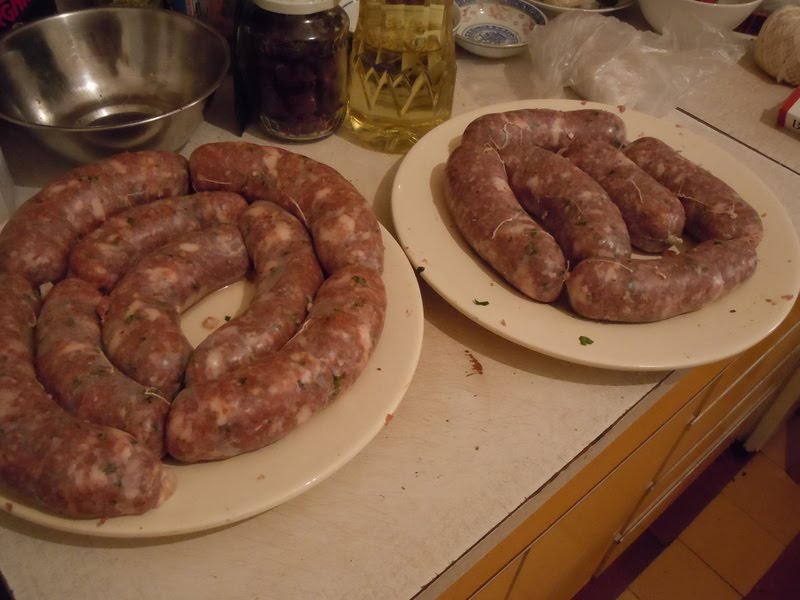 In the summer I might add chopped fresh basil from the “garden” as well. Half of the batch gets a palmful of crushed dried hot pepper flakes, the other goes without. Fried or grilled, these are a pretty close approximation of a New York Italian sausage. I’ve also experimented with other combinations including fresh Portuguese chourizo sausage (hot paprika and garlic) and German bratwurst (nutmeg, black pepper, and coriander.) Under normal conditions I would eat this with a hunk of crusty bread or a plate of pasta, but since I am under a self imposed regimen forbidding those wonderful things it usually gets served with a salad or my old friend , Mr. Zucchini.
 I’m gonna hate Mr. Zucchini pretty soon. Fumie is not a stranger to the odd hunger pangs of home, in her case, Tokyo. You might think that recreatring Japanese local specialties would be harder to satisfy than simple Calabrian food, but she does pretty well, what with cans of smoked eel and seaweed sent to her from home and local Chinese groceries and the occasional trip to Vienna. But Edokko people (people really native to Tokyo) like Fumie are crazy for natto. Natto is rotten soybeans, fermented by a special bacteria until they turn sour and emit a gummy stringy slime that Edokko love.
 Most other Japanese won’t eat natto, and it is one of those foods that foreign food writers always highlight as examples of weird cuisine in Japan, after fried bees and poisonous fugu sashimi. This is the dish that brought Anthony Bourdain to his knees, and he described it as "an unbelievably foul, rank, slimy, glutinous, and stringy goop of fermented soybeans... Given a choice between eating natto and digging up my old dog Pucci (dead thirty-five years) and making rillettes out of him? Sorry, Pucci." Fumie makes natto at home, on top of the living room heater, in fact. It is not that bad, actually. Stirred into a stringy mush with hot mustard and soy sauce, eaten on rice for breakfast?
  Maybe natto takes some getting used to, but I’d say it is a big improvement on Pucci. You can buy natto in Japanese grocery shops in small styrofoam cntainers, but the closest to us is in Vienna, and thus we have been forced to produce natto ourselves. And we only produce enough for ourselves. So don't even ask... On the other hand, Fumie has to have kimchi, the Korean pickled cabbage that has become to Japanese cuisine what Pizza is to New York cuisine. To make decent kimchi, you need napa cabbages (which are easy to get here - although I wonder what, exactly, Hungarians do with them) and red pepper paste - which we can get at the chinese grocery. And also fish sauce, various spices, and glutinous rice flour, all of which we keep stocked in our pantry.
 The amount you see here lasted about a month, only long enough for it to ferment and get really tangy. Kimchi is something you make in the winter months - while you can store a few pots of it outside on the terrace where it can ferment into stinky perfection. With March coming up... guess we will have to make another batch real soon.


