Dorel Codoban, the master folk fiddler and instrument
builder from the village of Lazuri de Rosia, who was well known as the best
builder of the enigmatic Romanian folk violin known as vioara cu goarne, passed
away on
February 7 at the age of 67. Dorel was more than a simple folk fiddler. He was the center of a cultural scene that represented his region – the Transylvanian
region of Bihor – and the unique regional culture that still thrives in the
mountains there. Dorel not only built these unique instruments, he played them
and encouraged other to play them, and he made sure that if you played one
yours would be in working order. He walked around with his coat pockets full of
spare resonators, tiny HO size screws, gramophone stylus jacks, ready for
anything and everything that could go wrong with a metal fiddle resonator.
 |
| Playing at Negreni around 1999. |
Dorel was good friend of mine, and I looked forward to meeting him each year at
either folk festivals in Hungary or at the sprawling peasant market that
convenes
every second weekend in October in Negreni. I first met him and his
family in 1990, at the Budapest Dance House Festival. His group of Bihor folk
dancers had been invited to represent Transylvanian Romanian culture, and I
wound up recording some of his music in the basement of a sports stadium at an impromptu
session that lasted at least two hours, during which we finished a two liter
bottle of his famed home brewed Bihor palinka. Later, when his son-in-law Dan and wife
Florica came to Budapest to buy auto parts they would stay at my flat. But the
best memories of him were always at the Negreni fair.
 |
| Dorel and Florica Codoban. |
Dorel and Florica would be busy selling shepherd goods out of the trunk of their car – the coarse sheepskin
capes worn by shepherds, thick homespun wool winter coats, and, of course, the
vioara cu goarne fiddles that drew the most interest from curious foreigners.Pretty soon a knot of fiddlers would gather around, a drummer would appear, and
Dorel would lead the band around the fairgrounds to the beer tents. Vioara cu
goarne are extremely loud instruments, and you could hear the thin metallic outpour
of sixteenth notes from a half kilometer away. They are also very focused
instruments – since the metal resonator is directed into a bugle bell, it is
loud only in the direction you point the trumpet at.

Fiddlers habitually swing around while playing, creating a kind of Doppler effect, a natural wah-wah
pedal depending on where the bell is aimed at. To counter this, fiddlers often
played in pairs or trios, pointing their fiddle horns in different directions. Like
other resonator instruments, such as National guitars, they are loud but their
sonic profile is extremely hard to mike correctly – they are natural feedback
machines near a microphone. And if you
are playing one, the trumpet is pointed away from you, so you can hardly hear
what it sounds like when you play it, making it frustrating to record in a
studio. I know – I have tried many times. Dorel was well known as a craftsman
who dared to take chances designing his fiddles.
 |
| Dorel's fiddles. I own the older one pictured here. |
At the request of a French musician, he began making fiddles with two horns (Pom Collins actually has one of these monstrosities)and fiddles using mica sheets for the resonator (instead of the usual sheet of
beer can stamped flat using one of his specially made brass hammer presses.
Some builders also liked to use the sheet metal from energy drink cans, claiming
the tone is more
energetic .) Dorel
was constantly on the lookout for old gramophone Victrolas to scavenge for
parts used in the making of the resonator mechanism, as well as old bugles
dating from the era when Communist boy scout troops always employed a bugler.
No more communists meant no new bugles, so Dorel experimented with sheet metal
horns, used horns from camion trucks, and eventually, bugles ordered directly
from a factory in China. When I first moved to this part of the world in the
late 1980s, I was anxious to collect and learn the local traditions before the
modern world swept in and replaced all this homemade traditional music with the
commercial barking of globalized pop. Luckily, some of the tradtions are still
strong, particularly in Bihor, where the trumpet fiddle has been adopted as the
acoustic symbol of the regional obsession with the Oradea football team. Because of this, Youtube
videos I have put up of Dorel and other Bihor fiddlers have immense viewer statistics
that would make any indie pop band jealous. But with Dorel’s passing I know of
only one other reliable maker of vioara cu goarne:
Mircea Rostas and his son Adi in Bratca. There are lots of players, to be sure, but fewer makers.
One of
my fondest memories of Dorel was the trip we took from
Negreni to Oradea, with Camille and Dejan in tow. During the trip we played the unsold fiddles that Dorel had brought to the fair as a fairly large group of Gypsies and peasants gathered in the hallway of the train, drinking beer and dancing. As you can tell in the video, we were pretty well though a Pepsi bottle of the good stuff as well. The next morning in Oradea Dorel was tremedously hungover, but that changed the moment he got in his folk costume. Dorel and Florica led the Rosia dance troupe in the annual Bihor folk parade through the streets
on their way to a folk festival in one of the city parks.
 |
| Florica leading the parade in Oradea |
You can see the pride
in place that these people have, something Romanians really treasure, a sense of
home and hearth and continuity that transcends a single lifetime. Dorel gave us something, he gave his culture something, and he gave his family something very special. He was a good man. And I will remember him everytime I hear those tunes. And Although Dorel has passed on, I will go back, because it
is not just music that draws me to Transylvania, but the people. The ones I can
proudly call my friends.
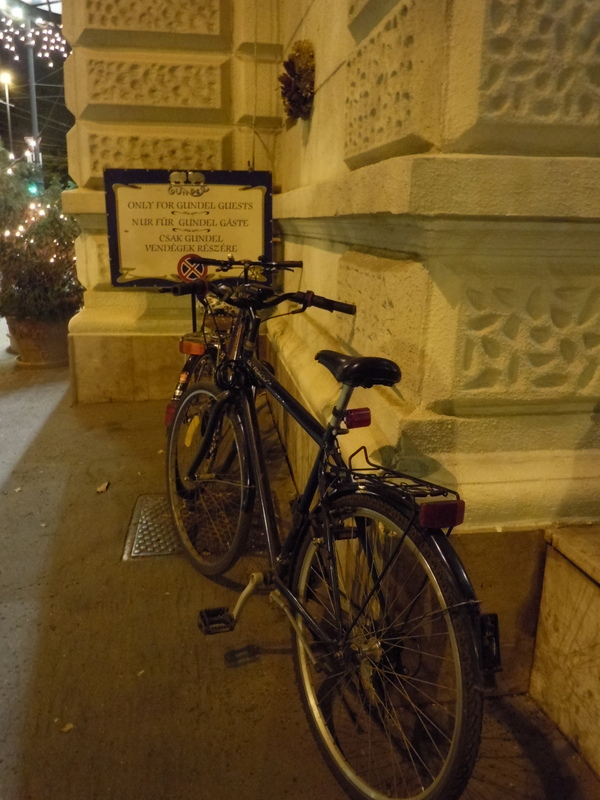 I had this bike - an old junker rebuilt by a bike messenger friend - for almost a decade and it was nearly indestructable. Perfect for Budapest's streets. It was so unspeakably ugly that I had actually seen bike thieves look at it and walk away. But bike theft is big business and Budapest is not immune. Most bikes are broken down and the parts shipped out to the third world where bikes are what the car is to the first world. Thieves strolled into the building yard and wire clippped through the cable lock that had worked for so many years. I will miss the Maschina, but it has finally been replaced by the hybrid trek bike of my dreams from Bikebase in Budapest.
 I can now cruise Budapest shifting gears to my heart’s content. And yes – Budapest has some funky corners that even locals know virtually nothing about. I have written about the sprawling Four Tigers Chinese Market years ago. It is a world unto itself, part souk, part suburb of Beijing, hardly regulated by any local Hungarian law, but nevertheless it is an orderly place following its own rules. It is where all of the small shop owners of East Europe go to buy cheap underwear, discount toys, bad fishing equipment, cheap DVDs, and odd plastic hair clips and where Fumie and I go to find decent cheap Chinese and Vietnamese food hidden within the alleys and warrens of the back rows. Usually we go to the Vietnamese vegetable markets where you can get the cheapest frozen shrimp (Big frozen shrimp) and squid in Budapest, alongside Asian greens, sauces, rice noodles, and fish sauce.
 The Dang Muoi Bufe and Asian market is here (I will deal at length with the Dang Muoi Bufe in a separate post. It serves Vietnamese food - a world class noodle cuisine all on its own right - and deserves some in depth attention.) which I have noted is the Best Restaurant in Budapest. Sure it may not lok like much, but the food is the best deal in town. Located inside a small Vietnamese food market, they serve some of the most authentic Vietnamese lunches in Europe on picnic tables located inside the shop. Friends (the Cluj/Kolozsvar posse again) pester me to take them there, and nobody goes home unimpressed. They make not only the classic Vietnamese Soup of The Heavens Pho (Pho bo, beef, and pho ga chicken) but about a dozen other great Viet meals in a bowl of broth as well, like the excellent spicy bún bò Huế.
 If you are from Budapest, however, go find it yourself. (Back of the retail side of the market from the middle entrance, called gate 3 – across Kobanyai ut) The Four Tigers Market is merely the retail face of a whole world of Chinese business activity. On the other side of Kobanyai ut are a series of huge, dilapidated old warehouses and factories that have gradually been transformed into business centers called things like “Asia Center” or “Europa Center.” Set aside for large scale wholesale distribution, these shops are rarely visited by people strolling for bargains – they don’t sell single items. Trucks and vans with lisence plates from Romania, Poland, and Serbia load up on goods as porters wheel around on odd looking Chinese motorcycle trucks.
 But if you go into the back nobody stops you from browsing. Hell, nobody even notices you. Which is good, because signs at the entrances – manned by beefy Hungarian “secuity” guards with tattoos and shaved heads – expressly forbid photography, and if you are lucky a shop keeper may warn you about the rule before the security goons confiscate your camera. Of course, we have been coming here for years so we are experts at surreptitious photography. The best way to cruise around this teeming urban market landscape in seeming invisibility is simply to ride a bicycle through it.
 It is, basically, an industrial suburb of some Chinese city, so everybody gets around on bikes. Some parts of the market are fashioned into malls, some parts look like Turkish shopping centers, and bikes are parked everywhere. You can, literally, ride your bike through the malls. Everybody does, and nobody seems to be bothered by it. Different rules apply here. The streets back here are named “Shanghai ut” and “Wenzhou ut” and “Kinai ut.” As if you need to be reminded. We were here cruising for lunch, and we found it hidden among the kolbasz stands and trucks serving regional fried bread things from China.
 When we were here a few weeks ago exploring with my old friend Rick and his wife, Xioarong (who is a sophisticated Szechuan woman) we came across a small lunch place advertising itself in Chinese as “Lunch. Shan.” Xiaorong poked her head in the doorway and asked the family there what kind of food they served. "Food from Shan county in Fujien province."
 If you ever ate around East Broadway in Manhatten's Chinatown - noodle soups and spicy fish at rock bottom prices - you will understand our addiction to Fujienese cuisine. But here? In the Budapest wholesale market? It was a bit early, and we had already eaten our breakfast soup at the Dang Muoi across the street, so we took note of the place and made a mental promise to return. A couple of tables, a cash register, and a family making dumplings. What more could you ask for? This time Fumie and I went straight for it (address: K-8. Apparently, the buildings are named K, D, B, etc. Live and learn, right?)
 We walked in, checked out the menu. Noodles. Soups. Dumplings. Nobody spoke much Hungarian or English. Excellent! The partons took no notice of us at all and all chatted in Chinese. the market is full of wei lo folks from Hungary and Romania, porters and workers and buyers who have picked up a taste for Chinese lunch - and even some who have learned to speak Chinese as well. Fumie pointed at the steam dish full of dumplings and expertly miscommunicated enough to get a dozen for FT 800. I simply said “Give me something good” And presto!
 Out comes a bowl of some of the best Chinese noodle soup with pork ribs and vegetables this side of the Danube. This is a real winner - a deep delicious broth with real Chinese noodles, not the spaghetti some places use as a substitute. Sometimes there is nothing that beats a good Chinese noodle soup. I grew up with them as the cheapest good meal you could get in New York. The lack of chinese noodle soups used to be one of my biggest complaints about living in Budapest, but with a bit of faith, perseverance, and the world's fastest growing economy, Chinese noodles have come to me.
 And dumplings. these were hand made, filled with meat that may have come from some kind of animal and oddly, carrots. Served with soy sauce and vinegar. They made Tokyo born Fumie happy, as did half of my soup. If Budapest ever gets a decent Japanese ramen noodle shop, these soup stands in the market may get a run for their money, but until then, they are safe. Now when the weather gets a bit colder and we need something more substantial, there are the traditional hand pulled Langzhou noodles you can find in another Chinese soup joint in a different part of the wholesale side of the street market.
 This is an unnammed hole in the wall lunch spot with one table located in a warehouse across the street from the main gate of the Four Tigers Market. This little unmarked hole in the wall is run by folks who really don't care about anything except perfect noodles - atmosphere? Service? Nope. Just noodles. Tell me: is this not the most evocative bistro in all of Budapest? No? Well, they may well serve the best soup in town.
 Service with a smile? Who needs all that extra stuff. They stretch the noodles by hand. If you want them, you will sit at a cramped picnic bench beneath a warehouse of cardboard crates and enjoy it anyway. To find it go to the doorway below the sign that says "Kapu" (gate) behind the sign that says "CHANGE" next to the Rong Rong market vegetable market, which is now just a guy hawking bitter melons and bok choy from boxes on the street. Its on your left about 25 meters before you get to the Hungarian sandwich/lunch stand where all the Romanian Gypsies and Syrian moneychangers hang out. Bon Appetit!