 Mark Rubin said it best in his blog Chasing The Fat Man when he wrote that Klezmer is the vernacular music of the Yiddish world. "Klezmer" is a term only genuinely applied to the recent revival of Yiddish dance music. It's a construct, a re-imagination, made up in some cases whole up cloth from people who have only a tangential relationship to the culture that the music originally sprang from… there is no “klezmer” music, there is simply a Yiddish vernacular performance style. Thus, any tune can conceivably be played in a Yiddish style and thus made Yiddish, when filtered through the experience of the Yiddish vernacular speaking Jews of Eastern Europe. With an opinion like that coming from one of the best Klez musicians, it is easy to see why the Krakow festival works so well. It allows the different strains of Jewish music to stretch out and grow. By bringing in some of the best musicians in the Jewish music world (notice I didn't narrow that down to just “Yiddish”) the Krakow festival becomes a fertile ground for new ideas among the musicians, for new cooperation between bands, for meeting people, jamming, and just the general “hang”, which Rubin says is one of the three pillars for accepting any gigs (the other being pay and quality of music.) And the hang at Krakow was excellent.
 First of all, it gives us a chance to hang with our singing clarinetist (and cantor) Jack “Yankl” Falk, who lives far away on the other side of the planet and only gets to Europe when the stars are aligned correctly and there is something like the Krakow festival or a major tour for the band.
 And why not stick Yankl alongside the legendary Bobov cantor Benzion Miller for some otherworldly scat nigun singing on the basis of Dave Tarras and Moishe Oyser's “Stanton Street / Chassidic In America” arrangement. Hey, and let's throw in cantorical world music wonder boy Jeremiah Lockwood of the Sway Machinery for good measure? Now are we satisfied? Michael Alpert is another friend who I actually hang with more on the road at festivals than at home in New York.
 He was presenting a program of music reflecting his decades of working with Julian Ktasty, the New York Ukrainian American bandurist who is one of the leaders in the revival of the bandura tradition (Stalin murdered all the existing Ukrainian bards in the 1930s in his effort to destroy Ukrainian identity.) And where there is an Alpert, it is not unlikely to find Stu Brotman playing bass.
 Stu – whose roots go back to the psychedelic 1960s in Los Angeles (he was in the original Canned Heat and the band Kaleidescope) is always welcome to any jam session since he carries his specially setup folk bass (basy) designed for portability (just look for the little man with a bath tub strapped to his back.) Stu was one of the silent masterminds behind the whole Klezmer revival, producing early LPs by the Klezmorim and Maxwell Street bands, as well as holding down the bass clef in Brave Old World. I caught up with him at the dance workshops led by Steve Weintraub.
 Steve is a professional Broadway choreographer as well as a dance ethnologist, and his first love is to get ordinary people up and dancing, and let them get fussy about the ethnography later. So he teaches small sets of fun dances with a vocabulary of hand movements and short figures that allow even the most club-footed of dancers participate. Yes, people have fun at Steve’s workshops. Hmmm… maybe we should all learn from that. And of course, Le Roi de Brass Klezmer Hizzonner Frank London - seen here beside Latvian songbird Sasha Lurje.
 I know frank from way back in Boston in the last century, when the Klezmer Conservatory band was starting out and we used to meet at latin jazz sessions in Alston’s sprawling hippy ranches for jam sessions. When Frank moved to New York he roomed with my buddy, drummer Samm Bennett for a while and we stayed in touch over the years as the Klezmatics took off and brought them regularly to Budapest (Frank would occasionally bring me vacu-packed pastrami from Katz’s when he was on tour.)
 Frank met me after our gig at the big Synagogue with a bottle of home brewed Polish Jewish slivovitz that he scored and we were off to dinner at the Kura Japanese Restaurant with Roger Davidson and some of the other musicians. The Kura is the only Japanese restaurant in Krakow with a Japanese chef and so Fumie and I ate there as often as possible. Which was a lot. And what Chinese food was to earlier generations of New York Jewish musicians, Japanese food is today.
 Yes, it was good. And when you compare the prices to Japanese food in Western Europe or the USA (or even Tokyo) it was excellent value for the quality and service. Of course, we were in Poland... and as soon as we got into our Hotel Painted Birdster Dan Kahn turned us onto a tiny pierogi bar - the Vincent - just around the corner where we could load up on excellent lamb-stuffed dumplings in garlic sauce for only four Euros.
 Bewteen fruit peirogis and home style real ramen noodles and sushi, Kazimierz is the perfect spot for the perfect Klezmer hang.
Tuesday, July 19, 2011
Krakow Festival of Jewish Culture: The "Hang"

Monday, July 04, 2011
The Festival of Jewish Culture, Krakow.
 The 21st Festival of Jewish Culture in Krakow, Poland took place last week and I was honored and excited to take part as a performer with Di Nayes. It is a festival like no other – ‘festival’ hardly describes how the entire city quarter of Kazimierz is transformed for a week into a center for Jewish and Yiddish culture including concerts, workshops, gallery exhibits, museum presentations, dance, and food. It is pure nakhes to be there, not the least because it gives us Klezmer musicians a chance to spend some real quality time hanging with each other, hatching new musical projects, and meeting the people who actually listen to us and sipping coffee with them in the many cafes that have sprung up in Kazimierz. A lot of writers have mentioned the supposed irony of the Jewish revival in Kazimierz since the release of the film “Schindler’s List” but to visit Krakow during the festival is to see how a small but dedicated group of people – Poles trying to recover the multicultural heritage of their country – can make an annual festival the cornerstone of a cultural movement that ensures that the Jewish culture of Krakow endures all year long. The founder of the festival, Janusz Makuch, is well known to all of us dealing in East European Jewish culture. Janusz embraces the old multicultural heritage of Galicia – the southern Polish region that anchors itself to the urban center of Krakow.
 Not born as a Jew, as a young man Janusz learned that half of his town was once Jewish, which lead him to learn Hebrew and Yiddish and study the works of Polish Jewish literature and folklore. Janusz introduced himself to an audience in Israel a few years ago this way: “My name is Janusz Makuch and I come from Poland. I come from a country of rabbis and tzaddikim, gaons and melameds, from a country of Jewish sages, writers, bankers, architects, painters, doctors, shoemakers and tailors, physicians and politicians, scientists and Jewish soldiers, from a country of devout, good people… I come from a country of anti-Semites and goodhearted people and the greatest number of Righteous among the Nations… from a country of countless shtetls, yeshivas and Hassidic courts, from a country of Jewish autonomy and pluralism and I come from a country of pogroms and murder. I come from a country whose greatness was co-created by Jews who were Polish citizens. And I come from a country that after the war kicked out Polish citizens who were Jews. I come from a country of anti-Semitic madness where they burned Jews in barns. And I come from a country of Christian mercy where they hid Jews in barns. My name is Janusz Makuch. I come from Poland and I am a goy, and at the same time for more than 20 years I have created and run the largest Jewish culture festival in the world. I'm a Jewish Pole - and I'm proud of it." That is about as cogent a sense of Janusz as I could find, and it shows the depth of commitment and understanding that motivates the Krakow Jewish Culture festival and sets it head and shoulders above so many other festvals working with a similar theme.
 A festival has to be more than a charismatic organizer – and Janusz leads an office of organizers unlike any other festival I have been to. Patient, efficient, with an endless well of good humor, Kasia, Robert, and a small army of young volunteers guarantee that everything flows smoothly, no small task when dealing with dozens of musicians and artists’ bruised egos and lost luggage. While there are other good Jewish music frestivals in Europe – London comes to mind, as well as the projects coming via Paris’ Medem – Krakow is the Big One. (This makes me more than a little ashamed to even think about the ridiculous schmutzerei that is Budapest’s idea of a Summer Jewish Festival – a festival that can’t ever seem to find any decent Jewish music or arts even with a budget large enough to float the Titanic. But then Hungary is not Poland.)
 And then there are the venues – especially the glorious Tempel Synagogue where we played our big concert. A classic 19th century Moorish Revival style synagogue restored to a fully functional state with excellent acoustics and room for a large audience, this was a place that could serve performers as intimate as Lauren Sklamberg and Frank London’s Tsuker Zis Project, and as big and party happy as the amazing show by Jeremiah Lockwood and The Sway Machinery with guest Sarahwi singer from Mali, Khaira Arby.
 Lockwood has done amazing things using cantorical music and has also done some amazing work that has been documented on the Nigun Project via New York's The Forward web site, but he has deep roots in country blues and with a lineup including alumni from the New York Afrobeat band Antibalas they simply blew me away. Late at night the crowd gathered at the funky Alchemia Club next to the old market for late night jams led by Paul Brody with a changing cast of musicians. And then there is the big closing concert at Szeroka Square – the Mother of All Jewish Music concerts, ever. From Israel came the stunning and innovative Yemen Blues. This year the special guest – nobody can be said to be the ‘headliners’ here – was Abraham Inc., a project that and… Fred Wesly, the trombone player from the legendary James Brown Band in teams clarinetist David Krakauer with DJ Socalled Josh Dolgin the 1960s and 70s.
 Yes, the driving sound behind “Hot Pants” and “Say it loud, I’m Black and Proud” before joining my all time favorite funk band Parliament-Funkadelic and leading their offshoot The Horny Horns. Yes, that Fred Wesly, pumping out funky horn lines behind Yiddish samples mixed by Socalled and held up by one of the best lineups of contemporary funk I have seen in years. And that's just the finale. Dan Kahn and Painted Bird had to leave early, but their show was one of the most memorable of the concert series - most of the shows are available on the festival website – including ours (Scroll down for Di Naye Kapelye.) I could go on and on… which it already seems that I have… but I will save it for a post later this week. There is so much to talk about… and I still have to go through my photos and unpack my bags and put all the instruments away… Serdecznie dziękuję, Krakow!
Thursday, June 16, 2011
The Mansions of Oaş, the Trout of Mara.

In the time since I last posted about the wonderous Maramureş region of Romania,, a call came in, a gig was secured, and within days I was back in a 1983 Toyota coughing its way across the border and back to Maramureş. So, yes, there will be a lot of Romaniacentric posts in the next few weeks, and yes, I urge all of you readers to visit Romania this summer and enjoy the hospitality offered by the people of this amazing country. One of the reasons Maramureş is so stubbornly unique is simple: it is damn hard to get there. Sure, you can take a bus from Cluj or Satu Mare, and there is a train line, a long, inconvenient one, but coming from Hungary by car means a choice of two roads: either the northern approach driving from Satu Mare through the Oaş region (through Negreşte-Oaş, Certeze, and the mountain pass at Huta) or the southern approach (via Baia Mare and Cavnic.) We did both so you don’t have to. First we crossed the border into Satu Mare (Szatmar in Hungarian, and Satmar in Yiddish.) Satu Mare is the town from which the numerous Satmar Hassidic Jews of Brooklyn get their name, and although there are very few Jews (and no Hasids) left, we did see this surprising license plate (The SM stands for “Satu Mare.") Man, I’d love to cruise down Division Street in Williamsburg with those plates. Driving east from Satu Mare we hit Livada, and took the road north through the Oaş country. It was strawberry time in Satu Mare and we stopped several times to buy buckets of delicious sweet strawbs from Gypsies along the side of the road.
 These were some of the best berries I ever tasted, and Fumie easily “drank” down a kilo and a half before we hit Maramures. The Oaş country is lowland Maramureş, and until 1990 was one of the poorest regions of Transylvania, known to most people for a screaming fiddle music accompanied by asymmetric howling vocals. Like a lot of Maramureş farmers, the Oaşeni began to go abroad for jobs, especially construction jobs in Italy. Back in the 1990s a lot of the Oaş villages still looked like this:
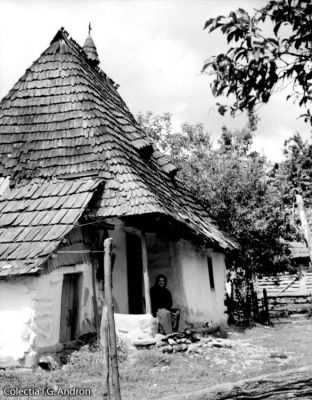 Today, after nearly everyone has spent the last decade working on construction sites in France and Italy - to the point where you are likely to hear Italian spoken on the streets of the village as the "cool" language - they look like this:
 Especially in the village of Certeze – which is called ‘the richest village in Romania - the locals came home and began building immense, modernistic Mediterranean mansions like the ones they had worked on in the suburbs of Milan, competing with the neighbors for the most ornate and impressive. This house, though, takes the cake.
 Apparently this house is famous throughout Maramureş – the guy built it to impress a woman to marry him, but, as it goes, just as he finished it she divorced him. So sad. And onward to the Huta pass, at which point the county line passes into Maramureş and the road deteriorates into a mess of potholes. Not just any pothole. These are axle-shattering, rim bending, tire destroying mountain road craters that lie in wait for any unsuspecting vehicle. Do not even think of driving this road at night.
 The fifty kms between Huta and the main town of Sighet becomes a tiresome stretch of pothole dancing and avoiding trucks and cars veering into your lane to avoid their potholes. On the way out of Maramureş we decided to try a different route: south from Sighet towards Baia Mare aqnd then up towards Satu Mare again. And guess what? No potholes, at least none of the Mother of all Asphalt Craters we met on the way in.
 And the added bonus was we got to have lunch in the village of Mara at the Alex Pastravaria, a trout farm and restaurant that lies along the road just before the mountain pass at Cavnic. Now, I like trout. I like to fish for them, and I like to eat them, particularly rainbow trout, which are about as perfectly synthetic a fish as can ever be devised.
 Originally a localized species of trout from California, the rainbow trout has been bred and fish farmed into the genetic equivalent of Wonder Bread, and spread throughout the world as an easy to stock alternative to brown tout, with the added advantage that it rarely adapts to its introduced environments enough to breed on its own, making it the perfect put-and-take fish. Rainbows can live in slightly warmer waters than wild brown trout, and can tolerate pollution better, and quite honestly, they taste better than wild trout, which is a good reason to release any wild brown you catch and feast on farm fresh rainbows instead. Which we did.
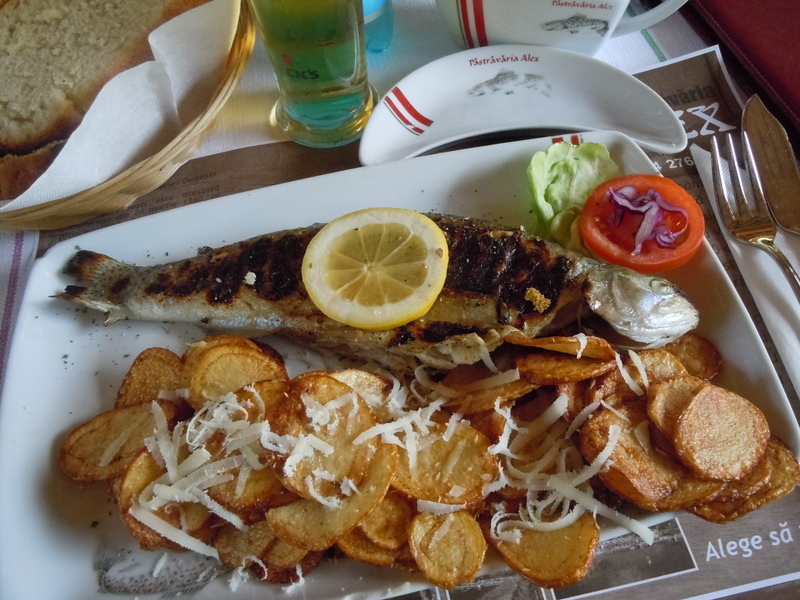 For the insane price of about EU 3 (US$5) you get a hefty grilled or fried trout with crispy fried potatoes and their signature sauce of sour cream and garlic. And you can eat it sitting on a wooden bridge watching trout swim past you as you chow down on their brethren.
 Driving south, we threaded through the hairpin curves along the Cavnic pass and finally reached the dusty industrial plain around Baia Mare, and headed north to the Hungarian border. Guess what? No potholes. Slightly longer route, but we could drive it faster than the northern route to Maramureş. So it looks like the next time I cross through the Oaş country I will probably be there on a new mission: I need to record more of their crazed, wild fiddle music.
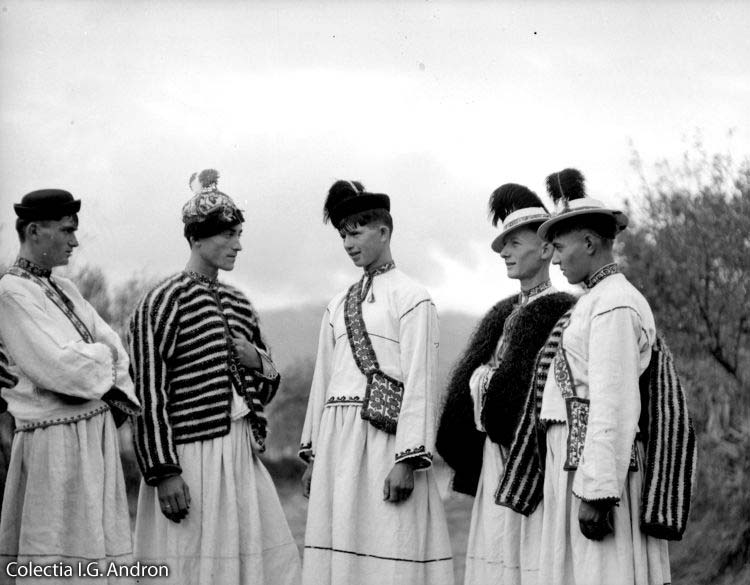 The Oaşeni like to scream their lyrics above the melody played on a modified violin. In order to get the higher pitch, they tune the fiddle string nearly to the breaking point, and then push the violin bridge nearly up to the fiddle neck itself, thus shortening the scale of the strings. Rather like capoing a fiddle. The result is a clear, bell like shimmering sound that is unique to the region. Master musician Ion Pop of Hoteni had a fiddle set up in Oaş fashion and played us a few tunes.
Sunday, May 29, 2011
Maramures: Fiddles, Song, and Food for the Dead
 In the summer of 2001 I had made plans to travel back to New York with Fumie to work a few months (probably as ignoble temp Christmas warehouse help) as I had the year before. It’s the expat version of Romanian migrant labor, only it requires a US passport and knowledge of Windows Excel. But the attacks on September 11, 2001, changed all that. After a few weeks of overdosing on news (Anthrax! Sleeper cells! Weapons of Mass Destruction!) and faced with several months of no work and no gigs while stuck in Budapest, I decided it would be best to get as far away from the news as possible. We decided to go back to Ieud, one of Maramures’ most isolated and traditional villages, and spend a month hanging with the late Gheorghe Ioannei Covaci, who at that time was the oldest living Maramures fiddler, and one of the few still alive who had actively played for Jewish dances before the second world war. On the second day my crank-operated wind-up survival shortwave radio died and after that we had no news at all. The local peasants all wanted to know what we thought of the terror attacks (Razboie! Boom! Boom!) but were genuinely nonplussed about the anthrax attacks. After all, in a village where everybody lives with sheep and cows anthrax was anything but an exotic weapon. While there we met the amazing Nitsa, who offered to rent us a room in her home. I spent the days fiddling with Georghe Ioannei while Fumie learned Romanian from Nitsa and temporarily became the village mortuary photographer, snapping portraits of people to be used on their grave markers.
 Today, the Greek-Catholic cemetery in Ieud is Fumie’s most enduring gallery presence. It is hard to forget a Japanese woman living in your village and everybody asked about Fumie… and Nitsa announced to her friends “I taught Fumie to speak Romanian!” by pointing to objects and shouting out their names. She also taught Fumie to make stuffed cabbage and mamaliga, skills every Japanese housewife should master. We’ve been back to Ieud a few times since then, including one visit with Canadian singer songwriter Geoff Berner (“The Whiskey Rabbi”) and his band (fiddling Dione Davies and drumming Dwayne Adams) Geoff eventually incorporated a lot of Maramures energy in his re-imagined take on Klezmer music which culminated in his most recent release “Victory Party” (which was recorded in Montreal last year and included Klezmer major leaguers Mike Winograd, Benjy Fox-Rosen, Josh Dolgin, and Brigitte Dajczer as well as myself on vioara cu goarne and insane screaming.)
 Geoff also used an image of Nitsa on the cover of his 2007 CD The Wedding Dance of the Widow Bride and last year asked me to deliver a few copies. She was delighted. Nitsa housed us in her huge wooden house up the street a bit, and she used to wake the band up in the morning by standing over the bed with a bottle of 110 proof horinca and booming "Goooooddd Moooorning! IT'S HORINCA TIME!" She has become something of a legend out there in western Canada.
 She was also delighted to grab Eleonore and dress her up in proper Maramures costume, and when I asked her if she would sing for us she demurred just long enough to fill a bottle of horinca brandy and then… she sang like an angel.Nitsa is often sought out by Romanian folklorists because of her vast knowledge of Maramures folklore, especially the singing of colinda (Christmas carols) and ritual music. In Ieud the religious traditions are more conservatively guarded than in other villages, and special regard is given to the presence of the dead in daily village life. When we arrived we found Nitsa with some neighbors making a prodigious batch of sarmale (stuffed cabbage.) When asked who it was for, she answered “For the dead!”
 The next day they would take it to the pauper’s cemetery in Sighet to be blessed by a priest and distributed to the poor. Ieud attracted the attention of American ethnographer Gail Kligman in the 1980s, a time when it was especially difficult to work as a field anthropologist in Ceausescu’s harsh communist era. Her monograph "The Wedding of the Dead" describes how the Ieudeni resisted the collectivization of the communist era by withdrawing into a maze of traditional custom and ritual, including the tradition that any young person who dies unmarried will be symbolically “wed” at their funeral. American ethnomusicologist and fiddler Maimon Miller also worked in Ieud in the 1970s at the time when Gheorghe Ionnei was more active.
 Gheorghe’s brother Nicolae Covaci, however, is still alive and fiddling two villages over in Dragomiresti, though. At ninety years of age he was actually playing better than I have ever heard him. Both Jake Shulman-Ment and myself have learned Maramures Jewish music from Nicolae over the years. As they say in Maramures, you don’t learn fiddle…. You steal it.
 Like so many folk traditions, the fiddle style is not directly taught, but learned by generations of younger fiddlers immersing themselves in it. I have sat in a bar in the nearby village of Botiza, which is known for its fiddlers, and watched as a series of peasant men passed my fiddle from hand to hand around to play tunes. And over the years we have stolen quite a lot, so it is proper when visiting a musician to bring a bag of gifts (coffee, chocolate, fiddle strings) and pay the musician for his trouble.
 Remember folks – when you visit a Gypsy musician (as opposed to peasant musicians) these guys live off of tips for playing, not for “sharing” their wonderful music for you, so if you do visit cough up a hundred lei for the fiddler and bring his wife a kilo of coffee, at least. Not that Nicolae is feeble at his age, though. When I arrived he said he had been to Israel four years ago. Why I asked? To work on a farm. Now, a lot of Romanians go abroad for work, but usually to western EU countries – Israelis used to hire a lot of Romanian peasants for agricultural labor after the Intifada made imported foreign labor necessary in Israel. Think about this. Who the hell would have hired him? A tiny 86 year old toothless Romanian Gypsy musician? What were they thinking?
  But work he did, and he made enough money to fix up his house and buy a watch. Nicolae is probably the last of the oldest style fiddlers of Maramures – comparable to an old time fiddler in the USA as opposed to a modern Bluegrass fiddler. Most Maramures fiddlers today are influenced by recordings and videos of other famous musicians like the Petreus Brothers and the late Gheorghe Covaci of Vadu Izei. Nicolae still plays in a less ornamented, highly rythymic style unchanged from the recordings he made in the 1970s when he and his brother were recorded on a Radio France Ocora label LP of Maramures folk music. There, the two fiddles played against a single guitar, strummed to produce a drone without any of the distinctive chord changes that usually distinguish Maramures songs. And that means one thing: when the ethnomusicologists arrive, there is no need to hire (and pay) extra band members. Just have your wife play!And whenever the wife plays, you don’t hear any chord changes. The guitar here is called a zongora (which is the Hungarian word for piano, oddly enough) tuned to a re-entrant open 'A' chord. This was probably the same guitar used on the Ocora recordings, and it was held together by some stiff wire to counter the fact that the home made wire strings had easily pulled the neck off of the body years ago. Check out the high action of the strings - about an inch above the neck.
 No matter, because it basically morphed into a percussion instrument. The tail bridge was also a bit of masterful jerry rigging. And the funny thing is it absolutely worked. The old time Maramures fiddlers also liked to cut as much of their violin bridge out as possible, to increase the volume of the instrument.
 Nowadays they tend to simply switch to playing the $150 electric violins manufactured at the insidious Hora instrument factory in Reghin. Nicolae - for those of us interested in the Jewish and other multiethnic traditions of Transylvania – is like a Rosetta stone of folk music, a unique yet modest musician bridging the lore of the past with the practice of the present. Ninety years old and still kicking strong. Sa traiste, Domnu’ Nicolae!
Tuesday, May 24, 2011
Asa bea' oamenii buni: How the Good Folk Drink
 Some people think “European Vacation” and dream of the canals of Venice, the boulevards of Paris, the coffee shops of Amsterdam. I however, dream about Maramures. This northern region of Romania, remote and mountainous, preserves a Europe most of us can only wonder about, a slice of history preserved in vague memories from our grandparents, cloudy ideas about the “old country” and the accounts of ethnographers plainly surprised that anyone in modern Europe still lives in log houses, uses horse wagons, and wears home spun folk costumes in the 21st century.
 Maramures is all that, a starkly conservative culture that survived the communist era by withdrawing into a domestic fortress of folk ritual and custom, rendered virtually impenetrable to outsiders by a lucky combo of wretchedly bad roads, a thick dialect, a tradition of class and economy based on barter rather than cash, and the inability of visitors to live for months on end on nothing but corn meal mush mamaliga and sheep cheese. But change has definitely come to Maramures. Since Romania entered the EU in 2007, Romanians have gone abroad in droves to work in agriculture and construction in countries like Italy, Spain and France. The local mountaineers – Morosani in the local dialect – have an international reputation as hard workers, earned by farming the poor soils of the Carpathians where it takes double the work to produce half the potatoes of any other region. The money they sent home is evident in the building of new homes and the sprouting of new small businesses in villages that used to have nothing but a bar and a general store (usually in the same location.)
 Add to that the growth of a well developed agro tourism industry and one can feel the sea change in the local culture. Maramures is heart-stoppingly picturesque, and and until recently only the most adventurous tourist would cross the mountain passes to visit, but about a decade ago the region became a magnet for French eco-tourists and one transplanted Frenchman, Bernhard Houlihat (now the director of the Institute Francaise in Cluj) began working locally with village mayors and peasants to set up a network of local homes that could accommodate the flood of tourists.
 The results are an open secret to informed tourists: where else can you stay and be fed for about EU 25 a day? Agrotourism pensions have sprouted everywhere in Marsamures. For a culture that, until very recently, lived on almost no cash the sight of tourists is welcome indeed. We stayed at the home of a fiddler I had met previously in the village of Poenile Izei named Ion Ilieş, well known as a musician by the name of Ion de la Cruce.
 For no extra charge, Ion also gets dressed up in his local folk costume, calls over a neighbor to play the zungora (the local version of a cross tuned guitar) and presents an after dinner fiddle party with his wife singing and pouring out copious shots of the local home brew. Thinking of making fun of the funny little hats? Don't. The "clop" is a symbol of Maramures male identity, and until about a decade ago it was still everyday wear for huge, beefy, easily antagonized truck drivers and lumberjacks. No, you do not make fun of the funny hats around here. Ion’s house has been set up with spotlessly clean guest rooms and modern bathrooms, and his wife cooks local Maramures food from the produce of Ion’s own farm and animals.
 Now, I have been on a pretty stern diet for the last half year, but there was no way I was going to refuse my host’s meals. No. I did not eat the cute bunnies. I wanted to - cuteness always tastes good - but my hosts had other things in mind. Pancakes. Donuts. Fried bread. All the things I have avoided for the last half year. And you know what? Carbohydrates taste really, really good. After a half year of nibbling on the occasional Wasa rye cracker I got to wake up to this.
 Home made clatita (thin pancakes) served with home made plum jam. Everything was served with fried bread, called placinta, which was like a Hungarian langos but less greasy and filled with a light cheese, green onion and dill mixture (just to add to the confusion, in Hungarian the pancakes would be called palacsinta.)
 Later there would be dinner of ciorba de perisoare (sour soup with meatballs) and the ever present mamaliga. Mamaliga is one of my favorite foods, often described a “polenta” but in fact much more robust and filling. My father grew up eating this during the depression in the USA, when my Moldavian born Grandmother had to feed four kids while my Grandfather was ill and unable to work. We called it "Jewish cement."
 The Romanian version here is usually layered with cheese and fried bacon bits, it is something I dreamed about and will probably obsess about while I go back on my weight loss regimen, but I am glad I got to slake my hunger on a bowl nevertheless. But wait! There is oh so much more! Homemade donuts! Yes!
 Called pancovi in Maramures, gogoaşa in most of Romania, these were just what the diet doctor did not order. You could split one open and fill it with a spoonful of jam or just eat them plain, cramming them into my mouth as fast as my greedy hands could manage. For months I had been dreaming about donuts, waiting for a visit to Cluj, Transylvania’s capital city, to get my hands on a Gogoasa Infuriata (“The Angry Donut”) at the city’s signature donut stand, only to find that my beloved Cluj donut has disappeared. Either gone out of business or going into some kind of franchise hell, I considered myself lucky to jump on a donut feast in Maramures rather than pin all my hopes on the now lost fried dough of the lowlands. Of course, all this eating can create a thirst. In Maramures, this is easily solved by drinking horinca – which astute readers will know from the URL of this very same blog. Horinca, the nectar of the Gods, or at least of their Romanian speaking lumberjacks and shepherds is thrice distilled fruit brandy. Ţuica is single distilled, palinka is brandy that has gone through the still twice, but horinca cashes in well over the 100 proof mark and is usually so clear and pure that it is more like fruit vodka than brandy. Which means less of a hangover to worry about, a good thing since the Morosani here drink quite a lot of the stuff on a very regular basis, poured fresh into the ubiquitous plastic Coca Cola bottles from two gallon plastic jugs.
 Most homes make their own from their own fruit trees, although by EU laws they are supposed to have it distilled for them in a village EU designated still. I had promised Fumie a bottle of horinca (with strict instruction by her not to accept any inferior twice distilled palinka) and had let it slip my mind until we were actually on the road out of Maramures. I asked Jake to stop in the village of Sacel, where there is a weekly market, and walked around looking for a suitable underground moonshine contact. Walking up to a big Maramures peasant guy selling axes and other lumberjack tools, I asked if he know where we could get any horinca. “Yes. From me.” Five minutes later his wife was pouring 110 proof goodness out of a blue plastic vat into one liter cola bottles.
 So if you haven’t made any summer plans for travel, consider Maramures. Heading into Maramures is best done by car, but there are now a lot more village bus services that can get you from the main town of Sighet Marmatei and into the countryside on a regular schedule. Just about every village offers “cazare” (accommodation) in both official guest houses as well as in regular village family homes. Certain web sites such as can make reservations for you, but I actually just called Ion from the outdated website that started the rural tourism business, and got his information right here.