The vıew from the rooftop of our digs in Istanbul. I shall be forever grateful to our host, the editor of the great Istanbul Eats blog (and now book, advertised on every wall in the Beyoglu area) and a great place to unwind at the end of a day of kebab hunting and bazaar shopping (or non-shopping as the case may be.) I had been hoping to post daily about our travels here in Istanbul, but alas, that was not to be. A few days ago thieves broke into our flat at dawn and within 30 seconds ran off with everything they could grab off the kitchen table: laptop, digital cameras, cell phone. We are OK - passports safe, cash accounted for... but millions of pixels of photos and videos of local music, gone, lost, yok, yok, yok... So descriptıon and comparison of the inner world of kebabland will be delayed until İ get back to Budapest this weekend. Luckily Fumie's photos are safe... and so we will have to wait a bit for some of the food porn and kilim pictures. At least by then I won't have to struggle with these devilish turkish computer keyboards.
One of the harder things to bear if you live a traveling life is that when something happens back at “home” you are not there. In fact, I am almost never at “home” – in Budapest, in New York, or wherever my backpack is parked, “home” is more of a state of mind. But someplace out there one has family who keep track of you and whom you love and tend to take for granted as a constant. And now one of my constants is gone. Since I arrived in Istanbul I received the news that my brother in law, Alec Wittek, passed away suddenly in New York at the age of 59. My family in the USA immediately rallied to my sister’s side, but I had to deal with the tragedy from afar, via email and skype. Alec was a patient and loving father, a good husband to my sister, a son to my parents, uno amigo para todos, and – like me – a Yiddish language loving fisherman. He and I spent hours at the seaside in Delaware (or “Delfer” as it is called in Yiddish) not catching fish while chatting about how stupid President Bush was in in broad Galizianer Yiddish. Fish were not important. Friendship was. Alec was one of the last of the generation of Brooklyn Jews who really understood and cared about the old time Yiddish aesthetic, like a living bridge between the 1920s and the 2000s, and he was one of the only guys in my family who really understood what exactly it is that I am doing with old style Yiddish music and why. Alec was what we call a mensch. I will miss him, not the least because he was one of the two Yids (“yud’ yud”) that I could make a l’chayim with who understood the irony – it takes two yids (the Hebrew alphabet for “yah” and “weh”) to make the name of God. Now half my l’chaim is gone. My sister is in mourning, but my nephew Max has really stepped up to take the man’s role in the family, and … sin nuestra hermana Mexicana, no podríamos manejar todo el esto.
If I were anywhere else in the world – including Budapest – at a time like this I would feel terribly alienated, alone, and simply wrong for being away from home. But not here, at least, and not now. I am in Istanbul, Turkey during Ramadan. All around me people are fasting during the sweltering and long summer days without complaint and waiting for that moment after 8 pm when they can indulge in the pleasure of life for a night before taking on their fast again. All around me people are focused on the value of their lives. I scratch through the language barriers and talk to them in a mix of my terrible Turkish or their fluent English, which so many speak. I am surrounded by people in a state of contemplative grace, people spending a fasting month considering the worth of their lives and their moral values and personal responsibilities. I sometimes ask the local people how it is during their fast, and what it means to them. And every person so far has taken the time to answer carefully that it is hard but good. Like life. “We are people. We can do this.” It makes me grateful to be where I am at a time when my family has experienced a loss. During Ramadan nobody feels alone.
This evening Fumie and I decided to venture into the staunchly Islamic conservative neighborhood of Fatih to experience the ending of the fast and the iftar feast which follows. We went to the Siirt Bazar Market, which is the center of a community of internal immigrants from the area of Southern Turkey bordering on Syria, and Arabic is heard in the Market as often as Turkish. Outside the market the Fatih Municipal city council had set up a free feast tent for those who had no money for the feast. Of course, while taking photos we were invited to take part.But we want the amazing roast lamb that is sold by about a dozen Siirt “Buryan Kebab” restaurants located around the market. We sat down at one about fifteen minutes before the final call from the Mosque ending the fast. All around us people were fiddling with their food – squeezing water bottles, playing with salads. Each restaurant sets out the tables in a pre set iftar feast, just ready for the minute when the faithful can finally break their fast.
And just about 8:10 pm, in the middle of the call… everybody simultaneously peeled open their plastic cups of water and drank… and drank… and drank. Cig kebabs (raw spiced lamb wrapped in lettuce) were popped into mouths, chilled salty iced yoghurt ayran was drunk… cigarettes were lit. Life begins again.Afterwards we sat in the tea tent and listened to an ashik play the saz and sing Anatolian songs of devotion. I could not ask for a more proper atmosphere than the one I am in now to contemplate the passing of my brother in law. It makes me grateful to the people opf Turkey that they can welcome us during the month of their fast in such a warm and accepting manner.
Alec would have loved it here. But he’ll always be here with us in our memories and in how we take actions in the world. Alec... legn zol in Gan Eden. May you lie in the Garden of Eden. There are good people out there in the world, people of many religions, of many cultures. We are honored to have shared it in your presence. And everyone, take the advice of Alec’s son Max, who posted a facebook message the evening his father passed: everyone, go out and hug your parents. If you can. While you can.
I wake up each moring and this is my view out the window of the flat my good friend Yigal has allowed us to use. Pull head off of pillow to the right and I see Asia... to the left, Europe... and all around me... I'm in Istanbul, a city that is plagued by cliches that can never come close to describing it. I've been waking up rather refreshed these days, granted that at three in the morning some kids run through the back alleys beating drums.It happens to be Ramadan (Ramazan in Turkish) and the drummers are waking people to eat before the fast begins at sunrise. Istanbul is a city that too often gets more than its share of cliches. East vs. West, Europe meets Islam, Old meets New, you name it and some hack writer has applied it to Istanbul. And some of those cliches may be valid, but they get packed into nearly every Sunday magazine supplement ever written about the place.
For me, Istanbul is one of my favorite cities in the world for a simple reason. It is a History Sandwich. Take two slices of Empire, add a generous smear of social history, mix in a salad of religion, sprinkle with politics, and the pile on some nice spicy ethnicities. Serve on a twin peninsula straddling Asia and Europe. Now, that's what I call lunch.
This blog started back in 2006 as a chronicle of one of my trips to Istanbul, and it seems only reasonable that I retrace some of my steps during this trip. Of course, back then I was here a lot longer - two months - and had a fresher command of the Turkish language than I do now, but I am excited to be back, even though Istanbul is undergoing a heat wave that is nasty even by Anatolian standards. But Istanbullites know how to deal with the heat - almost every indoor space is air conditioned in either modern or Byzantine style: ancient thick stone walls that keep places like the covered bazaar comfortable even in the miserable baking heat.
The heat has another consequence: a lot of shops and markets are closed for Ramadan. In most of Istanbul this isn't a problem - in Beyoglu, Sultanahmet, and other areas everything is open as usual. Turkey remains stubbornly secularist, and about a third of Turkey are not strict muslims or are Alevi who do not fast during Ramadan, but in conservative neighborhoods like Fatih the city is almost deserted in the afternoon.\Folks can't drink, smoke, or eat so their is little action. And you don't want to be rude and walk among the more pious fasters sipping cold water or slugging down mojitos in the burning heat. Traditionally, Ramadan is a time when restaurants do renovations and shops take inventory. And then, at night, canons mark the end of the fast time and the city goes on an eating binge.
The iftar is thhe feast that follows the day of fasting and there are special iftar set menus advertised at every restaurant in town.
Tents are put up serving specialty foods, and Ramadan is a time when money is no object and the family goes all out for fancy sweets, intricate baked goods, and quality snacks each evening.There are even free food tents set up in Fatih to feed the pious poor. But prices in Istanbul are extremely reasonable - you can eat quality food served with care at low end kebab shops as well as in posh restaurants. In fact, in most high end places you are paying for the atmosphere and the snob status. For me, I'll be eating street meat for a few weeks. And posting about it. Afiyet olsun!
We are in Koprivshtitsa, a mountain village in the heart of the Balkan Mountains in central Bulgaria, and we are surrounded by music. Literally – music on every street corner, in every café, and music sprawling over the mountain slope behind us. Think of it as the Burning Man of Bulgarian folk music. Every five years Koprivshtitsa hosts a folk festival unlike any other, a weekend filled with folk musicians, dancers, and singers from all regions of Bulgaria, none of whom are professionals.None of the prancey, choreographed showbiz routines that usually plague national folk festivals. These are village folks, or representative regional groups that may meet weekly to practice singing or dance, competing in annual regional festivals and eventually reaching the level of being sponsored to perform in Koprivshtitsa every five years. The village fills up each evening as buses arrive to unload some of the best Bulgarian folk dancers and musicians in an army tent camp set about mile outside of the center. Some of the best music happens here, without an audience, around the tents and beer pavilions as the groups relax and visit and dance late into the night.
During the day the action moves uphill to seven stage areas on the mountain above town. The performer to audience ratio is something like 1:1, and for the Bulgarians it is as much a chance for them to meet foreigners and shower them with gracious Bulgarian hospitality, which means being offered drinks, food, and having a gaggle of grannies decked out in full Thracian folk costumes grabbing Fumie and her friend from Tokyo, Rieko, to have their picture taken with them (for some reason Rieko gets more attention than Fumie…)I’m amazed at how well these folks hold up in the heat, dressed head to toe in layers of heavy folk costumes, some part of which is always made of raw wool, but there were no casualties that I know of during the festival.I play Macedonian and Bulgarian music, although less these days, but I’ve been able to fight off my compulsive acquisition of folk instruments. It isn’t easy. There are gaida vendors up on the hill, and I was thinking of picking up a new bagpipe, but the instrument has been subtly changing over the last twenty years. Except for the players of the large Rhodope kaba gaida, almost nobody performs using the drone pipe anymore. Plugging the drone makes it easier to play with accordions and other orchestral instruments, but it’s a bagpipe, fer chrissake, you need a drone.Also, gaida reeds have become harder, making a much louder instrument better suited to playing for larger crowds, but the cost is a loss of the buzzy warmth that one hears on older gaida recordings. I bumped into UCLA ethnomusicologist Tim Rice last night, who has been studying Bulgarian folk music and its sociological dimensions for four decades. We commiserated about soulless composite gaida reeds a bit, but he pointed out that that is the way folk music adapts and changes. Nothing you can do ‘bout it.
Dr. Rice is the author of “May It Fill Your Soul” a fantastic book and CD set examing the development of Bulgarian folk music through the experiences of two master musicians – Ivan and Todora Varimezov – whose lives spanned the changes of the twentieth century. If you are interested in Balkan bagpipes, Bulgarian music, or how humans learn music, get this book. Rice focuses on the concept of how Bulgarians learn their devilishly complicated music, which traditionally was “learned but not taught.” It is an eye opener to anyone who has ever tried to learn a folk musical form or instrument from a culture other than their own.We’ve been to the last two Koprivshtitsa festivals, in 2000, and 2005, and at the last one we discovered a tradition that I had not known of before, the Koleda dancers of Yambol.These are troops (literally in Bulgarian “cheta”) of young men, often Gypsies, who do a marching and dancing routine each Christamas and New Year and compete against each other for the title of best of the year. The dances are related to the ancient ritual dance tradition in the Balkans such as that of the Calusar in Romania as well as the moresca dance of southern Europe and even the Morris dance of England.
And these are some heavy masculine dudes, tattooed up the wazoo, bayonets tucked in their boots, knocking back buckets of beer before each performance and dancing non-stop in between sets – often dancing in feminine belly dance styles. Really tough tattooed muscle guys are allowed to do that. The Koleda troops are so fascinating that I will write more about them later in the blog, but Koprivshtitsa has almost no internet access – there are a couple of hotels up the hill, but we can live without wifi for a week, can’t we? Can’t we?In fact, Bulgaria is pretty well wired and internet savvy – anybody who finds themselves with some time to spare in Europe should make the effort to take a detour to Bulgaria. For tourists, it is about the most affordable place in Europe. Face it – regarding tourism, Hungary is rip-off city, Romania has gotten expensive, leaving few places where one can just relax and spend time without feeling like you are being milked for cash. Bulgaria – which has a fantastic traditional culture, a beautiful Black sea coast, and lots of stunning mountain scenery – deserves more travel attention. Food, internal transport, lodgings are a fraction of the western or even Eastern European price and you will never feel ripped off ( except if you take a taxi that waits in front of the Sofia train station. Use the taxi stand in front of the neighboring bus station instead.)
Our next stop is Istanbul, the city that stole my heart and made me start this blog back in 2006. Music? Food? Tradition? Istanbul has it all in spades. I will miss Bulgaria, but the Ottoman influence pervades Bulgarian culture in many of its more positive ways – the hospitality, the pursuit of pleasure in food and music. I’ll be back. The next Koprivshtitsa Festival is only a half decade away.
Its been a busy July, and I'm finally due a vacation. In my part of the world, that means going south - and south of here is the deep Balkans. I'm off to the Koprivshtitsa festival in Bulgaria tomorrow. Every five years the historic village of Koprivshtitsa in central Bulgaria hosts a festival of folk music performed exclusively by non-professional village musicians. It's like the Burning Man of Bulgarian folk music. A weekend of Bulgarian geezers blowing their bagpipes, sawing away on gadulkas, singing in their tight village harmonies, amidst some of the most inedible crap festival food on this blessed earth. Ten years ago a kebab from Koprivshtitsa sent me to the emergency ward of Sofia hospital. I have since learned a thing or two about eating during Bulgarian heat waves. And I will be there. And posting. I have been to the last two festivals in Koprivshtitsa, and there is no way I would miss this, killer kebabche or no. After that I will spend a few weeks in Istanbul, the Best City in the Grilled Meat World. This blog actually began years ago as a document of my addiction to Turkish grilled meat in Istanbul, and grew from there.
Last week I played a gig with Muzsikas at the Artist's Valley Festival in Kapolcs, near Veszprém. Luckily, the festival food is a bit better in those parts. The The Técsői Banda from the Ukraine was busy playing at the Katlan Toni village-style catering area, growing fat on free gulyas and rooster ball stew.After leaving Kapolcs we headed back to Veszprém, my Mom's home town, to catch the train back to Budapest. I still have a lot of relatives living here, and it is certainly one of the prettiest towns in Hungary, if only because it isn't flat.
As soon as I get into Bulgaria I'll be posting more: truly disturbing food, flacid pastries, amazing peasant ladies, and those frightening bagpipes - the gaida - that I love almost as much as Transylvanian Gypsy music.
After playing the festival in Sighet we suffered an unpleasant surprise: we had no place to stay for the night after our concert, a day we had expected to be a free day with accomodations. When you are traveling with a band abroad, this is one of the worst nightmares - the local promoter who strands you with eight people on a shoestring budget. Luckily, when Di Nayes get into a pickle like this in Transylvania, we are covered. We have a safe haven. Puma made a call, we met fiddler Florin Codoba in Cluj, and an hour later we were at his uncle Lőrincz' house in in Palatka.
Palatka - written as Palatca in Romanian - is a village in the deep middle of the Transylvanian plains, the Mezőség, home to one of the most deeply stirring music and dance tradtions that I ever encountered anywhere. I have written about Palatka here, here, and here, but this is the music that I heard at the age of fifteen and something went click in my soul and I had found my sound for life. This is what made me buy my first fiddle. It is the sound that brought me to Europe twenty years ago, and is one of the main reasons I remain here.I can't live far from the persistant audial addiction I have to the music of the Palatka Gypsy Band. The Hungarian folk scene considers the Palatka band to be the most archaic of the Transylvanian string band traditions, and most of the best Hungarian fiddlers have spent time learning to play in the confoundingly asymetrical style. The unique sound of the Mezőség fiddle bands is the use of the three string kontra viola and the highly ornamented and often dissonant fiddle style.Modal melodies - ones that might be harmonized using minor chords - are harmonized using major chords on the kontra and bass. Like most Mezőség villages it is ethnically mixed, about 350 of its 1400 residents are Hungarian, with about as many Gypsy. The musicians tend to come from three or four musician Gypsy familes, the Codobas, the Macsingos, the Moldovans and the Radaks. The two Codoba brothers - Béla and Martón - led the band in its glory days between 1970 and 2000, when Béla died of a heart attack on stage at a concert in Veszprém and his place as second lead fiddle was taken over by cousin Lőrincz, who used to play kontra viola in the band. In this youtube video Béla is playing with a much younger Florin around 1996, when teenage Florin was just starting to learn to play. What is amazing is how closely Florin's bowing exactly matches that of his uncle. That is how the sound and style is inherited. People are always predicting the death of traditional music, a form which is fast losing ground in the modern, digitalized world, but among the Gypsy musician dynasties of Palatka, the younger generation still grows up in a world surrounded by music.
The latest example: the amazing two and a half year old Sebi. Sebi was with his parents at the general store that serves as the Gypsy bar in Palatka when we arrived. While we arranged for the musicians to come down to play, Sebi's uncle produced a tiny, unstrung 1/4 size fiddle and Sebi "played." This two and a half year old child has all the moves down - even the fiddle bowing hesitations - before he even makes any sound on the instrument. When somebody would enter the bar, Sebi would walk up to shake his hand. He already knows how to dance. Sebi gets to wear a real musician's hat when he plays. When the musicians play, Sebi comes into the circle and plays along. When the musicians take a break and have a shot of palinka, Sebi gets a shot of orange juice and toasts the musicians before knocking it back in one shot, just like the big folks do.He is absolutely the darling of the family and his grandparents dote on him. On this tour we had New York fiddler Jake Shulman-Ment with us. Jake is possibly the best klezmer fiddler on the scene today, but he also has played Hungarian trad fiddle for years and performs for most of the hungarian folk dance events around New York. He's especially attuned to the music of Palatka, and two years ago we were able to get him together with Florin Codoba at the Yiddish Summer workshops in Weimar when Alan Bern's Other Europeans project was in its infancy and the summer workshops theme was the interaction of Jews and Gypsies in European music. Rather than academically belabor the point, we brought along our own Gypsy musician. Florin and Jake just clicked, so it was a stroke of luck that we finally got Jake to Palatka.Right off the bat, Lőrincz handed him the fiddle and said "OK, kid, let's see what you can do." If you are a tradtional fiddler, this is as close as it gets to final exams. And Jake did pretty well. The locals were impressed. (Pardon the dark video, but if you watch closely you will see the amazing Sebi popping in and out of the musicians playing on his tiny fiddle.) One of the other fiddlers on hand was an old buddy of mine, Ignac Macsingo, whose nickname "Naci" is pronounced in English as "Nazi." I'll never be able to get Naci any gigs at Klezmer festivals. Its a shame - he's a great musician, stunning singer, and dancer.Naci's father, Gheorghe Macsingo - the fiddler in the nearby village of Barai - was the fiddler I first learned with when I came to Romania with Puma in 1988 during the worst times of the Ceaucescu period. We first went to Barai to find him, but Gheorghe wasn't home and the family spoke no Hungarian. Speaking in Romani, I asked his wife were we could find him, and she told us to drive back to Cluj where he would be catching a bus to the village later on after his factory job let out. We did, and met him at the bus station. He got in the car and said not a word until we got to Barai. When he saw his wife he was elated. Apparently, when we met him at the bus station he thought we were Romanian Securitate agents sent to arrest him. Gheorghe's wife, on the other hand, thought that we were rich Gypsies from Bucharest who wanted to hire him to play at a wedding. In any case, Nazi eventually left miniscule Barai and moved to Palatka where he leads the second tier band that plays in the village and also plays the regular weekend gigs at the Gypsy bar.
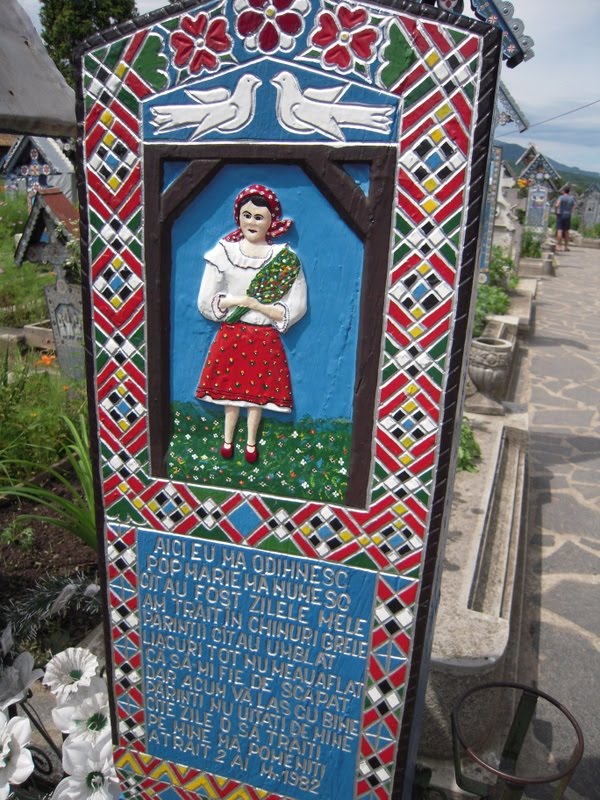
Săpânţa is a village about 15 kms west of Sighet, smack up against the Tisa river in the far north of Romania. When I first came to Maramureş in 1990, the streets in this village were lined with cearga - furry raw sheep wool blankets - for sale, hanging from every house' fence along the road that leads to Sighet. Within weeks of the end of Communism, these villagers were doing business big time. In 1990, right after the fall of Ceaucescu and the Communist Party in Romania, the peasants of Săpânţa had their own reading on freedom. After annoucement of a federal tax on home brewed brandy - the ţuica so central to Maramureş existence - the villagers of Săpânţa blockaded the main road to Sighet and effectively revolted in defense of their beloved tax-free home brew.After a couple of weeks the government backed down, and the villager's favorite hooch was safe. Yes, Maramureş folk - the moroşani - love to drink. And yes, they may even drink themselves to death, and how well they know it. Presently the most unique attraction in Săpânţa is the "Happy Cemetery." Originally begun by a peasant grave carver named Stan Petras in the 1930s, and carried on today by the Pop family, the cemetery has become one of the most popular tourism attractions in rural Romania, with tour buses pulling up and unloading foreigners hourly. We were lucky - we visited on a religious holiday just as the villagers were coming from a Church service.The grave markers in the cemetery in Săpânţa are carved and painted with scenes of the deceased accompanied by a poem describing their fate in Maramureş dialect. About half of them have two painted sides - one showing the deceased as they were in life, and the other showing either the way they died or illustrating some quirk that made them the talk of the village. A good woman is celebrated on side A:
But everybody in the village knows about her B side... she obviously made an impression on the village that would not go away even after she had left this mortal coil...
The most interesting of the carved grave markers celebrate the fickle nature of death: machines just happen to blow up, planes accidentally fall out of the sky, cars just naturally tend to hit people:
And drink. The poetry of the grave markers is wry and reflects the way village opinion saw the deceased during their lives. People in Maramureş drink a lot of home brew, and some drink more than others. It's a hard country with few pleasures, and from the few fruits they can coax from the poor mountain soil they brew plum and apple brandy.
Tavern keepers are also well represented in the other side. This one apparently drank himself to a deathly white paleness on his road to the afterlife. Or else the artist had run out of beige paint.Trains are a particular danger. After a walk around the cemetery you simply don't want to go near a train. They kill in all sorts of ways. You can get all dressed up to go out and still manage to find yourself slammed by a locomotive:
From the evidence on some of the grave markers it seems that Romanians have been experimenting with the notion of extreme sports long before the arrival of cable television. Note to self: definitely do not try roller skating along the railroad tracks. Ever.
Or you can simply be walking along the tracks and suddenly find yourself crushed to death. The look on this poor fellow's face says it all. Oops!The poem accompanying this gravestone said something along the lines "And now my children are in the hands of God / Which is probably better than being in my hands" The laws of Darwinsim are always a bitter pill to take. And speaking of bitter pills: the Romanian attitude towards visiting the hospital:Ever notice how many people go to the hospital and then die? Lesson: Don't go to the hospital! Some of the markers date back to earlier times and reflect historical realities. This one is of a shepherd cruelly killed and beheaded by Hungarian Gendarmes during WWII.
Friendly fire incidents among the Border Guards are also a nuisance.
And many of the graves show the happier moments of village life, with poems declaring sentiments like "In my life I loved to sing / And always bought a round / And paid the fiddler well/ But now i'm dead and gone"
In Maramureş the concept of being "oamnenii bunii" - good folks - is the motto for the approved behavior. And this means being a hard worker and a hard partier: drinking, singing, dancing, dying.
This is the soul of the Maramures region. The peasants up here have held off all of the twentieth century's interlopers - they maintain their Greek-Orthodox church traditions, their thick country dialect, their bewildering fiddle music, their hard drinking ways, and their tradition-bound ideas about life and death. They are some of the toughest, most moral people you will find in Europe today. Let them lift a glass or two in peace. Like the song says Aşa beau oamenii buni "That's how the good folk drink/ They drink from Saturday until Monday."
 The vıew from the rooftop of our digs in Istanbul. I shall be forever grateful to our host, the editor of the great Istanbul Eats blog (and now book, advertised on every wall in the Beyoglu area) and a great place to unwind at the end of a day of kebab hunting and bazaar shopping (or non-shopping as the case may be.)
 I had been hoping to post daily about our travels here in Istanbul, but alas, that was not to be. A few days ago thieves broke into our flat at dawn and within 30 seconds ran off with everything they could grab off the kitchen table: laptop, digital cameras, cell phone. We are OK - passports safe, cash accounted for... but millions of pixels of photos and videos of local music, gone, lost, yok, yok, yok... So descriptıon and comparison of the inner world of kebabland will be delayed until İ get back to Budapest this weekend. Luckily Fumie's photos are safe... and so we will have to wait a bit for some of the food porn and kilim pictures. At least by then I won't have to struggle with these devilish turkish computer keyboards.

 Alec was a patient and loving father, a good husband to my sister, a son to my parents, uno amigo para todos, and – like me – a Yiddish language loving fisherman. He and I spent hours at the seaside in Delaware (or “Delfer” as it is called in Yiddish) not catching fish while chatting about how stupid President Bush was in in broad Galizianer Yiddish. Fish were not important. Friendship was. Alec was one of the last of the generation of Brooklyn Jews who really understood and cared about the old time Yiddish aesthetic, like a living bridge between the 1920s and the 2000s, and he was one of the only guys in my family who really understood what exactly it is that I am doing with old style Yiddish music and why. Alec was what we call a mensch. I will miss him, not the least because he was one of the two Yids (“yud’ yud”) that I could make a l’chayim with who understood the irony – it takes two yids (the Hebrew alphabet for “yah” and “weh”) to make the name of God. Now half my l’chaim is gone. My sister is in mourning, but my nephew Max has really stepped up to take the man’s role in the family, and … sin nuestra hermana Mexicana, no podríamos manejar todo el esto.


 None of the prancey, choreographed showbiz routines that usually plague national folk festivals. These are village folks, or representative regional groups that may meet weekly to practice singing or dance, competing in annual regional festivals and eventually reaching the level of being sponsored to perform in Koprivshtitsa every five years. The village fills up each evening as buses arrive to unload some of the best Bulgarian folk dancers and musicians in an army tent camp set about mile outside of the center. Some of the best music happens here, without an audience, around the tents and beer pavilions as the groups relax and visit and dance late into the night.