It has now been just over a century since the tragic Kishinev Pogroms, an outbreak of antisemitic violence that shocked the world at the tiime and galvanized Jewish national identity into the modern era. In my family, my Grandfather was a witness to the pogroms, and when I was growing up listening to his stories it felt like the events had happened only recently: for most Moldavian Yidn, that still is the case. Sometimes it seems a bit anachronistic to be singing songs in Yiddish about the Cossacks in the 21st century, but the truth is that is exactly what I used to hear while sitting at a kitchen table in the Bronx when I was growing up. The Forward writer J.J. Goldberg wrote in 2003: Kishinev, the capital of the czarist province of Bessarabia, today's Republic of Moldova, was a town of some 125,000 residents, nearly half of them Jewish. Ethnic tensions were running high that spring, thanks to a noisy, months-long campaign of antisemitic incitement by local nationalists.The rioting began on Easter Sunday, after rumors spread through town that a Christian had been killed by Jews in a ritual murder. Mobs rampaged through Jewish neighborhoods for two days, burning, smashing, raping and killing. When it was over, 49 Jews were dead and 500 wounded, 1,300 homes and businesses were looted and destroyed and 2,000 families were left homeless.The brutality sent shock waves across Russia and around the world. Leo Tolstoy spoke out. Mass rallies were held in Paris, London and New York. Western governments protested the apparent complicity of the czar's police, who had refused repeated pleas to intervene. The Forward reported the news with a banner headline: "Rivers of Jewish Blood in Kishinev."The pogrom is generally remembered to have broken out at a house at number 13 Asia Street - seen below - which is still there today. Yiddish Poet Haim Nahman Bialik wote a long ode to the victims, The City of Slaughter. A Ukrainian journalist named Kholodenko visited Kishinev after the pogrom and wrote about the destuction: "House No. 13 is situated in the fourth district of Kishineff, in a by-street bearing the name of Asiasky, at its juncture with another by-street, Stavrisky; the names of these narrow and tortuous little streets are known but indifferently even to the inhabitants of Kishineff themselves. The Jewish cab-driver who drove us (many Jewish cab-drivers were among the killed and wounded) did not understand at first where we wanted to go. Thereupon my companion, who for the last three weeks had been breathing the air of Kishineff, and was able to find his way to all the principal places of interest connected with the massacres, explained to the driver, "House No. 13; where they killed!" " Ah! I know!" replied the driver, nodding his head and whipping up a horse as dejected, as miserable, and as half -starved as himself. I could not see the man's face, but I heard him mutter through his beard words that sounded like "Nisensen" and "the glazier." Nisensen and the glazier were a short time ago living men. Now they are but symbols, representing the concentrated horrors of recent massacres."House no. 13 as it stands today. Across the street lies the new Jewish Scool of Chisinau, but with business demands for real estate in the Moldovan capitol city a lot of the older Jewish neighborhood is being developed at a fast rate. Here's Asia St. 13 seen from a different angle...The Jewish community of Chisinau is about 15,000, very well organized, and well integraqted into the national life of the country. As in many post-Soviet countries, the main force behind religious education and community renewal is Chabad Lubavitch, who have done a nice job on the Synagogue.Sadly, today's news also brings reports of rioting and demonstrations in Moldova. The BBC reports that the riots are a result of a contested election, and my friends in Chisinau tell me that at least this time the unrest does not seem be marked by the ethnic tension between speakers of Russian and Romanian that marred the elections of a decade ago. I can only hope that things calm down over the next few days. And I wish a peaceful Peysakh for everyone this year.
For all the recent talk about Holocaust memorials being dedicated in Hungary, probably no better memorial to the Jewish victims of WWII can be found than at the Izraelita Temető (Israelite Cemetery) located out at the end of the 37 tram line (which leaves from Blaha Lujza ter in Pest. the 28 takes a similar route but only goes as far as the Kozma utca General Cemetery, which is about a kilometer away from the entrance to the Jewish cemetery. The Jewish Cemetery closes at 3 pm daily.) I was doing some research and decided to take the tram to the end stop: although I have seen dozens of old Jewish cemeteries in East Europe, I had never been to the main Jewish cemetery in Pest before.The grand families traditionally had mausoleums erected to house the earthly remains of the family. What stands out is the cozy Hungarianess of the place: many of the grave stones are inscribed in familiar, affectionate remembrances: "To Our Mama" "My Dear Life: Little Gyuszika." One stone identified the resting place of a musician. I've seen a lot of these: in Iasi the grave of Iosif Sava, a popular klezmer, composer and father of Romanian TV personality Gheorghe Sava had a harp marking the grave. In Cluj there is an entire marble piano carved to mark the grave of one popular composer. Violin shaped stones are not rare. I wonder if the stonemasons would be able to make a decent grave marker featuring a Moldavian bagpipe? But one stark fact emerges as you walk down the well kept rows of old stones: the sheer number of graves marked by deaths from 1944-1945, the year the Hungarian Arrow Cross and German SS colluded to destroy the Jewish community of Budapest, which had survived until then under the relatively tolerant Hungarian rule of the Regent Admiral Horthy.The piles of stones are a Jewish custom: instead of flowers we place stones on graves, to signify permanence. The cemetery is marked by several major monuments to local Jewish communities destroyed during the War, as well as graves symbolically marked for those who never returned from the concentration camps, such as the monument below, dedicated to "Our Grandparents who were killed in Auschwitz, and their children..."The main memorial to the victioms of the Shoah is a stark, empty memorial, incorporating walls on which thousands of names of those killed in the camps and deportations are etched in stone.Huge columns display the names of the slaughtered: from Bergen Belsen, Auschwitz, massacre sites in occupied Yugoslavia, the Forced Labor camps. The sheer number of names displayed here, in the cemetery, has an effect of remembrance which, I feel, is far more moving than many memorials built in the last decade. Here you feel you are among the victims, they are right below your feet, thousands of them. Present and never forgotten. So many of the victims were identified only after the war, as information trickled in, that the walls have become a kind of ongoing meta-project, as surviving family members add names by hand, notating dates and personal information about their loved ones.And finally, a testament to the bitterness felt by many of those who survived the destruction, only to return to a world without relatives, family, to return to di khurbes, the destruction... The inscription reads "As long as people live on the Earth, Let the Germans be cursed! Amen!"
Sad news came my way this month. Two of the New York City folk music scene's loudest and funniest personalities passed away, Richie Shulberg and Bob Giuda. Both were old buddies of mine from the Old Time music scene that used to congeal around the Eagle Taven jam sessions South Street Seaport Museum concert series back in the 1970s and 80s, when lower Manhattan had yet to gentrify and CBGB's still booked Appalachian string bands and blues acts.Richie Shulberg finally left the boundaries of New York City on 14 March 2009 of a heart attack, aged 61. Richie was the epitome of the New York Jewish bluegrass musician, a manic combination of Lenny Bruce and uncle Dave Macon wrapped in a New York Cantonese Egg Roll skin and deep fried until the result was beyond recognition as anything other than pure Brooklyn. Known to much of the world as Citizen Kafka, the persona he adopted while broadcasting his dadaist radio show on WBAI in New York, Richie was a man of too many doubtful skills: broadcaster, opal miner, Theremin player, junk dealer, music archivist, art collector, bookseller, and musician. Above all else, he was a great Old Time fiddler, the de facto leader of the bluegrass band "The Wretched Refuse String Band. Possbly known best for their blugrass adaption of the Danny Kaye hit "Thumbelina" sung in broad, Brooklyn Jewish accents, the Wretched Refuse under Richie's "direction" were a uniquly unemployable icon of New York musical expression:The band's name came from the Emma Lazarus poem inscribed at the foot of the Statue of Liberty: "Give me your tired, your poor/ Your wretched refuse yearning to breath free." Which, Ritchie once told me, was the more acceptable band name than "The Coney Island Whitefish" (you have to be from Brooklyn to appreciate that one.) Richie's stage presence was that of the ranting new York Jewish poetic genius riffing on sounds that clogged his brain from being raised in the late 1950s and 60s: sort of a Firesign theater Meets Allen Ginsburg at a Knish stand in West Virginia. As one commentor on his memorial Facebook page said: Shulberg never met a social convention he wasn’t compelled to violate. The more tightly wound the promoter or client, the greater was the potential for comic riot (Margaret Dumont syndrome). His radio show on WBAI included fiddler Kenny Kosek and a Missouri newcomer named John Goodman who would go on to make himself a bit better known in Hollywood as one of the Coen Brother's favorite character actors.Although we all played Appalachian music, the Wretched Refuse String Band were one of the first bands that dabbled in reviving klezmer music. Andy Statman played mandolin with them, and it was fiddler Alan Kaufmann who first gave me cassettes of Jewish wedding music from Brooklyn in trade for tapes of Transylvanian fiddle music from the Palatka Band that I had brought home from Hungary. The Wretched Refuse were The String Band in New York's folk scene. Like many of New York's folk bands, the members were mostly Jewish or Italian, and not the easily assimilated, suburban type of ethnoid that America feels comfy with, but crazed, cross pollenated, ranting and raving Judeo-Wops with a penchant for singing archaic Black Sanctified Church music on period vintage guitars bought for pennies in Brooklyn junk shops. Which meant we all ate Chinese food, all the time. Richie was famous in Chinatown - he was a true gourmand of the now archaic classic American Cantonese cuisine, and he knew all the waiters by name, and all the Chinese waiters knew him by name: Litchie! After a gig it was always Ritchie who chose the after party venue (Wo Hop) as well as the menu (orange flavored beef). Richie had been suffering from a variety of ailments over the last decade, and the annual “Thank God the Citizen is Still Alive” concert is still going booked, as the Wretcheds would say, with or without him, at Brooklyn’s Jalopy venue on 9 May 2009. The Here's a taste of Wretched Madness from their regular gigs at the Jalopy in Brooklyn last year.Another pillar of the New York Folk Scene was Bob Giuda, the massive (400 pound) Brooklyn mortician and Blues guitarist who formed one half of the semi-fictional Otis Brothers alongside Pat Conte. Bob passed on on March 11, 2009, while setting up a gig at a library, holding his favorite fender bass guitar. Probably just as he would have wished to go.Bob and Pat performed as the Otis Brothers, and like a lot of the best traditional acts in the US, they were virtually unknown outside of New York, their recordings virtual collectors items of music that reaches into genuine American folk and popular traditions that just never crossed into the territory of hit music. They didn't care one bit. Bob and Pat were (and in the case of Pat, is) true Brooklyn originals. Both were huge, hefty men who enjoyed eating in a world dominated by skinniness. Bob and Pat used to go into a Brooklyn diner for lunch, scarf down the all you can eat special and then split an entire chocolate cake for dessert.Bob was famous as one of the loudest acoustic singers to ever vibrate a vocal chord. I last saw him around 1988, singing blues with an electric guitar cranked up, outdoors, with no mike and no need for one. Once, at a private reception, a woman came up to him and asked if he could possibly turn his mike volume down a bit. Bob stared at her and answered "I'm sorry, Lady, but there is no mike."That's Bob Giuda, Pat Conte, and Richie Shulberg at a gig last year. Pat and Richie used to share the amazing radio show "The Secret Museum of the Air" on WFMU playing only rare 78 rpm gramophone recordings from their collections. The Otis Brothers were, in a sense, the live performance version of the Secret Museum. Pat Conte still records and gigs around New York - I saw him last year with John Cohen and Peter Stampfel on the lower East Side, after having not seen him in about 25 years. After the gig he said to me "Man it's good to see you. I never thought I would see you alive again." Pat: keep a lid on the extra servings of ravioli. I want to see you next time I'm in New York.To Richie and Bob: keep the vintage 1950s tube amps in Heaven warm for us. And save me some chocolate cake and egg rolls.
Been sparse with blog posts lately, for many reasons (or, if you will, excuses.) One was massive computer problems in February, causing me to have to backup a lot of files and reinstall my Windows system. To everyone who says “Get a Mac” I should set up a paypal account so that you can all get me a mac. And if I had a Mac I am pretty sure Fumie would take it over for her graphics work and I would never get near it. Besides, I almost enjoy wrestling with Mr. Gate’s foul monstrosities. So it’s XP for the time being (I have Vista on the Acer I got as a gift… which reminds me of the joke: What would you get if Microsoft made vacume cleaners? A product that does not suck.) Second: a bit of unexpected travel.Last week saw me spend a day in Warsaw. A film crew (I won’t go into details) who had interviewed me a year ago wanted some more interviews, so they flew me up to Warsaw for the day. That's right: the day. Up at dawn, I was on the flight and in Warsaw at 9 am, and flew home at 8 that evening. Rather abrupt, but after the morning interview, I had the day free. My base was at the Warsaw Jewish museum. Warsaw isn’t the most graceful city in Poland. Most of Warsaw was stematically destroyed by the German Army in 1944 in the aftermath of the Warsaw uprising. Which left Warsaw looking like this.Postwar rebuilding focused on making the city habitable, and historical reconstruction has been ongoing for over 60 years. Much of the history of the city has been obliterated, but people have not forgotten the majestic Warsaw of pre-war years, and memorial plaques can be found all over the downtown, pointing out locations of former glory. Poland has a population of almost 38 million: they don't have time to worry about a cute capitol city.The building in which the Jewish museum is housed used to be the Jewish library next to the Great Synagogue. Many of the exhibits are documents and art from the library and the Jewish records offices that were secretly buried in metal milk barrels beneath the library, and dug up after the war from the rubble.Across the street from the Jewish museum is a small park behind a nondescript office block and a Kentucky Fried Chicken outlet. This is where the gate to the Jewish Ghetto was located during the war. Much of the Jewish Ghetto now lies where the gigantic Palace of Culture now stands, and as Warsaw is continually rebuilding itself and healing the scars of WWII, there is little to remind anyone that this was once the seat of Polish Jewish culture.But there is a neat new downtown mall… And what would a trip to Poland be without pierogis? Having eaten pierogis in Russia, the Ukraine, and all over the lower east side of New York, I am completely taken by the Polish version. Oh, litttle dough sack of meat and mushroom, I am yours completely...And Zurek? Ahhh… sour rye bran soup with a nice sausage. It isn’t kosher, but it sure works for me on a cold windy day.
I had been meaning to post about Moldavian chow for months since our Novemeber trip to Chişinău/Kishinev and Edinets, but suddenly a flood of Moldavo-mania has me going back to fill the gaps. This morning my good buddy Claude C. called to ask my opinion on a job offer he has with an international agency in Chişinău. Since most of the news that comes out of the Republic of Moldova is usually bad news (breakaway ethnic republics, pushy Putin threats, kidneys for sale, to name a few) I was happy to inform Claude that the worst seems to be over and things are looking up for Moldova. It would probably be a delightful place to take a job, not the least for the quality of chow. For one thing, the ubiquitous knish (as seen above) can be found for sale in just about every bar and bakery in town, usually going under the name placinta or pateu. A simple filling wrapped in strudel sheets, nothing beats a fresh hot potato or cabbage knish.I have a long history with knishes, going back to my childhood in the Bronx where knishes were available at nearly every corner deli, of which there used to be a lot more back in the 20th century than there are now. I think knishes were the first food I actually bought for myself. And a knish was a flat pocket of oily dough filled with potato, usually stacked warm by the deli grill, as these, below, from Katz's Deli in NYC.It didn't have broccoli, spinach, or cheese involved in it. It wasn't round and bulbous, as the Israeli influenced knishoid objects that I see around New York today often are. Knishes want to kill you. They may take 70 or 80 years to do you in, but Knishes want you dead. Healthy knish? To paraphrase Lisa Simpson, I know what those two words mean but I do not understand them when you put them together in a sentence.I started noticing these newfangled knishes about ten years ago on a trip back the US - all the neo-ortho delis in Teaneck New Jersey had them (Teaneck, N.J. is to kosher food what Hong Kong is to Chinese food.) I was told they were an attempt at making a "healthy knish" that would appeal to a wider audience. Who needs a healthy knish? What was worse: these were from Yonah's Shimmel's Knishery on Houston Street, one of the oldest Romanian Jewish bakeries in New York City (and you can still get a decent, old style knish there.) But wait... the march of progress can not leave even the humble knish alone for long... how about a McPlăcintă from McDonald's in Chişinău?Knish, in some for or another, were everywhere, the snack food of mass convenience. If the Ukraine has some version of potato latkes congealing in grease on almost every snack counter, Moldova goes for the knish, always served warm, on the street, in the market, or in bars and cafes.Where there is knish, there will be chicken soup, and there is. The Republic of Moldova is a country based on chicken soup, swimming in chicken noodles, broth, and boiled breast meat called zama. Much as I love chicken soup, there was also a lot of borscht (Chişinău is about half Romanian speaking and half Russian and Ukrainian, after all) in both red and clear versions, but oddly enough, none of the tripe soup ciorba de burta that Romanians across the border eat so much of. I asked Semyon, our driver, where I could get a plate of nice sour, spicy tripe soup... and he answered "We don't eat that stuff here. Don't like it. Only in Romania, across the river." In the meantime, you could open up a bottle of home made wine with every meal, usually served in recycled mineral water bottles, such as this one, which is a brand called "Mouth of the Dog."The sarmale we had in Edinets were unique - stuffed sour cabbage leaves filled with rice and great hunks of smoked pork hock, on the bone. Never had a stuffed cabbage with bones before, and recipes from Romania usually use only a small amount of smoked meat as a flavoring. In the countryside, most sarmale in Romania are nearly vegetarian concoctions of rice, barley, or cornmeal flavored with a small amount of meat. And no paprika. The Hungarian versions are never served without paprika, but I love the sour dill and thyme flavor of the Romanian versions as well. While staying in Chişinău we discovered the joys of take out food from the main downtown supermarket, especially little sarmale wrapped in grape leaves stuffed whether with rice and barley, or chunky bits of meat. Restaurants in Chişinău have been getting more and more expensive over the years, and so we kept to our budget by shopping at the markets and eating in and we were glad to do it. Of course, there are times when you have to go for the mici... which in Moldova were huge and much more refined than the rustic meat tubes we usually get at bars and snack stands in Romania.
Oh... the desserts... I am not a dessert eater, although Fumie definately is. However, I rediscovered blintzes on this trip. Last year in the Ukraine I actually managed to maintain an ongoing course of the Atkins diet in that Kindom of Blintzes that is Kiev. I would not let that deter me now.And the master of dessert eaters is world reknowned cimbalom master Kalman Balogh. Kalman never misses a dessert, regarding it as the highlight of any meal, and this is a guy who is a connosieur of real Hungarian Musician Gypsy style cooking - which means Hungarian food even fattier and spicier than Magyars normally serve it. And no, he doesn't show it... at all... (Behind him is Alan Bern, director of the Other Euopeans Project and musical director of Brave Old World and... a vegan! No problem, that leaves more chow for us!)
What a lot of people don't know is that Kalman has been playing Klezmer music for over fifteen years, with groups such as Joel Rubin Jewish Music Ensemble as well as his own Gypsy Cimbalom Band. Small wonder... Kalman has Jewish ancestry as well in his family. Watching Kalman jam along with Marin Bunea and Adam Stinga was one of the highlights of the countless jam sessions we had in the wedding hall of the Edinets hotel.
Back in November, when Fumie and were in the Republic of Moldova, we were surprised at how good the food was - not something you would expect from a country that is widely known as one of the poorest in Europe. But we really enjoyed the offerings, especially the pickles. Susan and Diana Ghergus took us to the central market in Chisinau/Kishinev on one of our free days in Moldova's capitol.One of the clues that you are in the former Soviet Union is the little lacey aprons that the women wear in the meat and dairy markets. It looks like they were designed by Disney for some movie about french maids... and also the fact that nobody objects to having their photo taken. You can't just walk around a Hungarian or Austrian market snapping pix without fielding a bit of verbal abuse. In Moldova, no problem with photos at all.Fish was everywhere - interesting given that Moldova is landlocked, but Odessa is only an hour away and as former CCCP appetites know, if you want to drink you need some zakuska to eat with your vodka, and that means some smoked fish. In many ways, if you are used to New York jewish foods, you won't be dissappointed in fressing in Moldova. Jewish culinary traditions have been deeply absorbed into Moldovan cuisine - supermarkets are packed at the arrival of hot, fresh baked challah on friday afternoons.Turning a row we came on the pickle sellers, always happy to let you taste a bit because they know a sucker when they see one and I am a deep sucker for pickles. These were... and I don't like to use superlatives - the best pickles in the world.Pickles stuffed with pickles, eggplants pickled whole, tomatos, cabbage, peppers, if it grows it gets pickled. The cucumber pickles... oh my fracking Gods... Moldovans are proud of their wine and cognac, but they should be exporting the pickles. They should open pickle bars in all of Europe's cities and watch the money flow in. These weren't just good - they were A-Number One Hebrew Semitically Approved Sour Bombs.Whole pickled wathermelons. I mean, what if you and some friends are watching the TV one night and you need something to go with your beer? Why not a whole pickled watermelon. It tastes like... pickles.The wild mushroom pickles are everywhere in Moldova. While we stayed in Chisinau we rented an apartment and after a busy day were too tired to bother going out to a restaurant - and in Chisinau restaurants are not cheap. So we would pick up a little bit of food at the local supermarket take out stand, and we may have eaten far better than any restaurant could have served us. I mean, how many soviet style chicken soups do I need? Not so many. Instead we would have mushroom pickles, grape leaves stuffed with rice, bits of smoked fish, and more pickles.There was an entire section of the market dedicated to prunes in every form: dried prunes, smoked prunes, pitted or unpitted, I had never guessed that there were so many different kinds of prunes. And yes, they were good. Having eaten too many pickles by this point, I had no need of the medicinal properties for which prunes are famous, so I passed on buying a kilo of prunes, making this woman very sad.
Yankl Falk just sent me this... worth your attention. It's hard so soon after an episode of national trauma, I know... but... music cures everything... we all need a sense of humor sometimes.
 It has now been just over a century since the tragic Kishinev Pogroms, an outbreak of antisemitic violence that shocked the world at the tiime and galvanized Jewish national identity into the modern era. In my family, my Grandfather was a witness to the pogroms, and when I was growing up listening to his stories it felt like the events had happened only recently: for most Moldavian Yidn, that still is the case. Sometimes it seems a bit anachronistic to be singing songs in Yiddish about the Cossacks in the 21st century, but the truth is that is exactly what I used to hear while sitting at a kitchen table in the Bronx when I was growing up.
  The Forward writer J.J. Goldberg wrote in 2003: Kishinev, the capital of the czarist province of Bessarabia, today's Republic of Moldova, was a town of some 125,000 residents, nearly half of them Jewish. Ethnic tensions were running high that spring, thanks to a noisy, months-long campaign of antisemitic incitement by local nationalists.The rioting began on Easter Sunday, after rumors spread through town that a Christian had been killed by Jews in a ritual murder. Mobs rampaged through Jewish neighborhoods for two days, burning, smashing, raping and killing. When it was over, 49 Jews were dead and 500 wounded, 1,300 homes and businesses were looted and destroyed and 2,000 families were left homeless.The brutality sent shock waves across Russia and around the world. Leo Tolstoy spoke out. Mass rallies were held in Paris, London and New York. Western governments protested the apparent complicity of the czar's police, who had refused repeated pleas to intervene. The Forward reported the news with a banner headline: "Rivers of Jewish Blood in Kishinev."
 The pogrom is generally remembered to have broken out at a house at number 13 Asia Street - seen below - which is still there today. Yiddish Poet Haim Nahman Bialik wote a long ode to the victims, The City of Slaughter. A Ukrainian journalist named Kholodenko visited Kishinev after the pogrom and wrote about the destuction:
  "House No. 13 is situated in the fourth district of Kishineff, in a by-street bearing the name of Asiasky, at its juncture with another by-street, Stavrisky; the names of these narrow and tortuous little streets are known but indifferently even to the inhabitants of Kishineff themselves. The Jewish cab-driver who drove us (many Jewish cab-drivers were among the killed and wounded) did not understand at first where we wanted to go. Thereupon my companion, who for the last three weeks had been breathing the air of Kishineff, and was able to find his way to all the principal places of interest connected with the massacres, explained to the driver, "House No. 13; where they killed!" " Ah! I know!" replied the driver, nodding his head and whipping up a horse as dejected, as miserable, and as half -starved as himself. I could not see the man's face, but I heard him mutter through his beard words that sounded like "Nisensen" and "the glazier." Nisensen and the glazier were a short time ago living men. Now they are but symbols, representing the concentrated horrors of recent massacres."
 House no. 13 as it stands today. Across the street lies the new Jewish Scool of Chisinau, but with business demands for real estate in the Moldovan capitol city a lot of the older Jewish neighborhood is being developed at a fast rate. Here's Asia St. 13 seen from a different angle...
 The Jewish community of Chisinau is about 15,000, very well organized, and well integraqted into the national life of the country. As in many post-Soviet countries, the main force behind religious education and community renewal is Chabad Lubavitch, who have done a nice job on the Synagogue.
 Sadly, today's news also brings reports of rioting and demonstrations in Moldova. The BBC reports that the riots are a result of a contested election, and my friends in Chisinau tell me that at least this time the unrest does not seem be marked by the ethnic tension between speakers of Russian and Romanian that marred the elections of a decade ago. I can only hope that things calm down over the next few days. And I wish a peaceful Peysakh for everyone this year.


 The grand families traditionally had mausoleums erected to house the earthly remains of the family. What stands out is the cozy Hungarianess of the place: many of the grave stones are inscribed in familiar, affectionate remembrances: "To Our Mama" "My Dear Life: Little Gyuszika."
  One stone identified the resting place of a musician. I've seen a lot of these: in Iasi the grave of Iosif Sava, a popular klezmer, composer and father of Romanian TV personality Gheorghe Sava had a harp marking the grave. In Cluj there is an entire marble piano carved to mark the grave of one popular composer. Violin shaped stones are not rare. I wonder if the stonemasons would be able to make a decent grave marker featuring a Moldavian bagpipe?
 But one stark fact emerges as you walk down the well kept rows of old stones: the sheer number of graves marked by deaths from 1944-1945, the year the Hungarian Arrow Cross and German SS colluded to destroy the Jewish community of Budapest, which had survived until then under the relatively tolerant Hungarian rule of the Regent Admiral Horthy.
 The piles of stones are a Jewish custom: instead of flowers we place stones on graves, to signify permanence. The cemetery is marked by several major monuments to local Jewish communities destroyed during the War, as well as graves symbolically marked for those who never returned from the concentration camps, such as the monument below, dedicated to "Our Grandparents who were killed in Auschwitz, and their children..."
 The main memorial to the victioms of the Shoah is a stark, empty memorial, incorporating walls on which thousands of names of those killed in the camps and deportations are etched in stone.
 Huge columns display the names of the slaughtered: from Bergen Belsen, Auschwitz, massacre sites in occupied Yugoslavia, the Forced Labor camps. The sheer number of names displayed here, in the cemetery, has an effect of remembrance which, I feel, is far more moving than many memorials built in the last decade. Here you feel you are among the victims, they are right below your feet, thousands of them. Present and never forgotten.
 So many of the victims were identified only after the war, as information trickled in, that the walls have become a kind of ongoing meta-project, as surviving family members add names by hand, notating dates and personal information about their loved ones.
 And finally, a testament to the bitterness felt by many of those who survived the destruction, only to return to a world without relatives, family, to return to di khurbes, the destruction... The inscription reads "As long as people live on the Earth, Let the Germans be cursed! Amen!"
 Richie Shulberg finally left the boundaries of New York City on 14 March 2009 of a heart attack, aged 61. Richie was the epitome of the New York Jewish bluegrass musician, a manic combination of Lenny Bruce and uncle Dave Macon wrapped in a New York Cantonese Egg Roll skin and deep fried until the result was beyond recognition as anything other than pure Brooklyn. Known to much of the world as Citizen Kafka, the persona he adopted while broadcasting his dadaist radio show on WBAI in New York, Richie was a man of too many doubtful skills: broadcaster, opal miner, Theremin player, junk dealer, music archivist,
  The band's name came from the Emma Lazarus poem inscribed at the foot of the Statue of Liberty: "Give me your tired, your poor/ Your wretched refuse yearning to breath free." Which, Ritchie once told me, was the more acceptable band name than "The Coney Island Whitefish" (you have to be from Brooklyn to appreciate that one.) Richie's stage presence was that of the ranting new York Jewish poetic genius riffing on sounds that clogged his brain from being raised in the late 1950s and 60s: sort of a Firesign theater Meets Allen Ginsburg at a Knish stand in West Virginia. As one commentor on his memorial
  Although we all played Appalachian music, the Wretched Refuse String Band were one of the first bands that dabbled in reviving klezmer music.
  Bob and Pat performed as the Otis Brothers, and like a lot of the best traditional acts in the US, they were virtually unknown outside of New York, their recordings virtual collectors items of music that reaches into genuine American folk and popular traditions that just never crossed into the territory of hit music. They didn't care one bit. Bob and Pat were (and in the case of Pat, is) true Brooklyn originals. Both were huge, hefty men who enjoyed eating in a world dominated by skinniness. Bob and Pat used to go into a Brooklyn diner for lunch, scarf down the all you can eat special and then split an entire chocolate cake for dessert.
 Bob was famous as one of the loudest acoustic singers to ever vibrate a vocal chord. I last saw him around 1988, singing blues with an electric guitar cranked up, outdoors, with no mike and no need for one. Once, at a private reception, a woman came up to him and asked if he could possibly turn his mike volume down a bit. Bob stared at her and answered "I'm sorry, Lady, but there is no mike."
 That's Bob Giuda, Pat Conte, and Richie Shulberg at a gig last year. Pat and Richie used to share the amazing radio show
  Last week saw me spend a day in Warsaw. A film crew (I won’t go into details) who had interviewed me a year ago wanted some more interviews, so they flew me up to Warsaw for the day. That's right: the day. Up at dawn, I was on the flight and in Warsaw at 9 am, and flew home at 8 that evening. Rather abrupt, but after the morning interview, I had the day free. My base was at the Warsaw Jewish museum.
 Warsaw isn’t the most graceful city in Poland. Most of Warsaw was stematically destroyed by the German Army in 1944 in the aftermath of the Warsaw uprising. Which left Warsaw looking
  Postwar rebuilding focused on making the city habitable, and historical reconstruction has been ongoing for over 60 years. Much of the history of the city has been obliterated, but people have not forgotten the majestic Warsaw of pre-war years, and memorial plaques can be found all over the downtown, pointing out locations of former glory. Poland has a population of almost 38 million: they don't have time to worry about a cute capitol city.
 The building in which the Jewish museum is housed used to be the Jewish library next to the Great Synagogue. Many of the exhibits are documents and art from the library and the Jewish records offices that were secretly buried in metal milk barrels beneath the library, and dug up after the war from the rubble.
 Across the street from the Jewish museum is a small park behind a nondescript office block and a Kentucky Fried Chicken outlet. This is where the gate to the Jewish Ghetto was located during the war. Much of the Jewish Ghetto now lies where the gigantic Palace of Culture now stands, and as Warsaw is continually rebuilding itself and healing the scars of WWII, there is little to remind anyone that this was once the seat of Polish Jewish culture.
 But there is a neat new downtown mall…
  And what would a trip to Poland be without pierogis? Having eaten pierogis in Russia, the Ukraine, and all over the lower east side of New York, I am completely taken by the Polish version. Oh, litttle dough sack of meat and mushroom, I am yours completely...
 And Zurek? Ahhh… sour rye bran soup with a nice sausage. It isn’t kosher, but it sure works for me on a cold windy day.

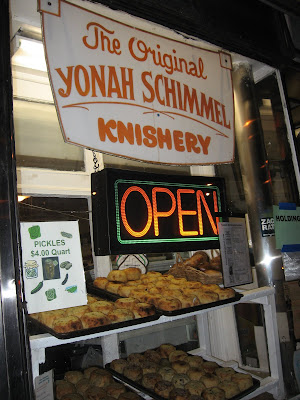 I have a long history with knishes, going back to my childhood in the Bronx where knishes were available at nearly every corner deli, of which there used to be a lot more back in the 20th century than there are now. I think knishes were the first food I actually bought for myself. And a knish was a flat pocket of oily dough filled with potato, usually stacked warm by the deli grill, as these, below, from Katz's Deli in NYC.
 It didn't have broccoli, spinach, or cheese involved in it. It wasn't round and bulbous, as the Israeli influenced knishoid objects that I see around New York today often are. Knishes want to kill you. They may take 70 or 80 years to do you in, but Knishes want you dead. Healthy knish? To paraphrase Lisa Simpson, I know what those two words mean but I do not understand them when you put them together in a sentence.
  I started noticing these newfangled knishes about ten years ago on a trip back the US - all the neo-ortho delis in Teaneck New Jersey had them (Teaneck, N.J. is to kosher food what Hong Kong is to Chinese food.) I was told they were an attempt at making a "healthy knish" that would appeal to a wider audience. Who needs a healthy knish? What was worse: these were from Yonah's Shimmel's Knishery on Houston Street, one of the oldest Romanian Jewish bakeries in New York City (and you can still get a decent, old style knish there.) But wait... the march of progress can not leave even the humble knish alone for long... how about a McPlăcintă from McDonald's in Chişinău?
 Knish, in some for or another, were everywhere, the snack food of mass convenience. If the Ukraine has some version of potato latkes congealing in grease on almost every snack counter, Moldova goes for the knish, always served warm, on the street, in the market, or in bars and cafes.
 Where there is knish, there will be chicken soup, and there is. The Republic of Moldova is a country based on chicken soup, swimming in chicken noodles, broth, and boiled breast meat called zama.
  Much as I love chicken soup, there was also a lot of borscht (Chişinău is about half Romanian speaking and half Russian and Ukrainian, after all) in both red and clear versions, but oddly enough, none of the tripe soup ciorba de burta that Romanians across the border eat so much of. I asked Semyon, our driver, where I could get a plate of nice sour, spicy tripe soup... and he answered "We don't eat that stuff here. Don't like it. Only in Romania, across the river." In the meantime, you could open up a bottle of home made wine with every meal, usually served in recycled mineral water bottles, such as this one, which is a brand called "Mouth of the Dog."
 The sarmale we had in Edinets were unique - stuffed sour cabbage leaves filled with rice and great hunks of smoked pork hock, on the bone. Never had a stuffed cabbage with bones before, and recipes from Romania usually use only a small amount of smoked meat as a flavoring. In the countryside, most sarmale in Romania are nearly vegetarian concoctions of rice, barley, or cornmeal flavored with a small amount of meat. And no paprika. The Hungarian versions are never served without paprika, but I love the sour dill and thyme flavor of the Romanian versions as well.
  While staying in Chişinău we discovered the joys of take out food from the main downtown supermarket, especially little sarmale wrapped in grape leaves stuffed whether with rice and barley, or chunky bits of meat. Restaurants in Chişinău have been getting more and more expensive over the years, and so we kept to our budget by shopping at the markets and eating in and we were glad to do it. Of course, there are times when you have to go for the mici... which in Moldova were huge and much more refined than the rustic meat tubes we usually get at bars and snack stands in Romania.
 And the master of dessert eaters is world reknowned cimbalom master
 Watching Kalman jam along with Marin Bunea and Adam Stinga was one of the highlights of the countless jam sessions we had in the wedding hall of the Edinets hotel.
 One of the clues that you are in the former Soviet Union is the little lacey aprons that the women wear in the meat and dairy markets. It looks like they were designed by Disney for some movie about french maids... and also the fact that nobody objects to having their photo taken. You can't just walk around a Hungarian or Austrian market snapping pix without fielding a bit of verbal abuse. In Moldova, no problem with photos at all.
 Fish was everywhere - interesting given that Moldova is landlocked, but Odessa is only an hour away and as former CCCP appetites know, if you want to drink you need some
  Turning a row we came on the pickle sellers, always happy to let you taste a bit because they know a sucker when they see one and I am a deep sucker for pickles. These were... and I don't like to use superlatives - the best pickles in the world.
 Pickles stuffed with pickles, eggplants pickled whole, tomatos, cabbage, peppers, if it grows it gets pickled. The cucumber pickles... oh my fracking Gods... Moldovans are proud of their wine and cognac, but they should be exporting the pickles. They should open pickle bars in all of Europe's cities and watch the money flow in. These weren't just good - they were A-Number One Hebrew Semitically Approved Sour Bombs.
 Whole pickled wathermelons. I mean, what if you and some friends are watching the TV one night and you need something to go with your beer? Why not a whole pickled watermelon. It tastes like... pickles.
 The wild mushroom pickles are everywhere in Moldova. While we stayed in Chisinau we rented an apartment and after a busy day were too tired to bother going out to a restaurant - and in Chisinau restaurants are not cheap. So we would pick up a little bit of food at the local supermarket take out stand, and we may have eaten far better than any restaurant could have served us. I mean, how many soviet style chicken soups do I need? Not so many. Instead we would have mushroom pickles, grape leaves stuffed with rice, bits of smoked fish, and more pickles.
 There was an entire section of the market dedicated to prunes in every form: dried prunes, smoked prunes, pitted or unpitted, I had never guessed that there were so many different kinds of prunes. And yes, they were good. Having eaten too many pickles by this point, I had no need of the medicinal properties for which prunes are famous, so I passed on buying a kilo of prunes, making this woman very sad.