Sad news came my way this month. Two of the New York City folk music scene's loudest and funniest personalities passed away, Richie Shulberg and Bob Giuda. Both were old buddies of mine from the Old Time music scene that used to congeal around the Eagle Taven jam sessions South Street Seaport Museum concert series back in the 1970s and 80s, when lower Manhattan had yet to gentrify and CBGB's still booked Appalachian string bands and blues acts.Richie Shulberg finally left the boundaries of New York City on 14 March 2009 of a heart attack, aged 61. Richie was the epitome of the New York Jewish bluegrass musician, a manic combination of Lenny Bruce and uncle Dave Macon wrapped in a New York Cantonese Egg Roll skin and deep fried until the result was beyond recognition as anything other than pure Brooklyn. Known to much of the world as Citizen Kafka, the persona he adopted while broadcasting his dadaist radio show on WBAI in New York, Richie was a man of too many doubtful skills: broadcaster, opal miner, Theremin player, junk dealer, music archivist, art collector, bookseller, and musician. Above all else, he was a great Old Time fiddler, the de facto leader of the bluegrass band "The Wretched Refuse String Band. Possbly known best for their blugrass adaption of the Danny Kaye hit "Thumbelina" sung in broad, Brooklyn Jewish accents, the Wretched Refuse under Richie's "direction" were a uniquly unemployable icon of New York musical expression:The band's name came from the Emma Lazarus poem inscribed at the foot of the Statue of Liberty: "Give me your tired, your poor/ Your wretched refuse yearning to breath free." Which, Ritchie once told me, was the more acceptable band name than "The Coney Island Whitefish" (you have to be from Brooklyn to appreciate that one.) Richie's stage presence was that of the ranting new York Jewish poetic genius riffing on sounds that clogged his brain from being raised in the late 1950s and 60s: sort of a Firesign theater Meets Allen Ginsburg at a Knish stand in West Virginia. As one commentor on his memorial Facebook page said: Shulberg never met a social convention he wasn’t compelled to violate. The more tightly wound the promoter or client, the greater was the potential for comic riot (Margaret Dumont syndrome). His radio show on WBAI included fiddler Kenny Kosek and a Missouri newcomer named John Goodman who would go on to make himself a bit better known in Hollywood as one of the Coen Brother's favorite character actors.Although we all played Appalachian music, the Wretched Refuse String Band were one of the first bands that dabbled in reviving klezmer music. Andy Statman played mandolin with them, and it was fiddler Alan Kaufmann who first gave me cassettes of Jewish wedding music from Brooklyn in trade for tapes of Transylvanian fiddle music from the Palatka Band that I had brought home from Hungary. The Wretched Refuse were The String Band in New York's folk scene. Like many of New York's folk bands, the members were mostly Jewish or Italian, and not the easily assimilated, suburban type of ethnoid that America feels comfy with, but crazed, cross pollenated, ranting and raving Judeo-Wops with a penchant for singing archaic Black Sanctified Church music on period vintage guitars bought for pennies in Brooklyn junk shops. Which meant we all ate Chinese food, all the time. Richie was famous in Chinatown - he was a true gourmand of the now archaic classic American Cantonese cuisine, and he knew all the waiters by name, and all the Chinese waiters knew him by name: Litchie! After a gig it was always Ritchie who chose the after party venue (Wo Hop) as well as the menu (orange flavored beef). Richie had been suffering from a variety of ailments over the last decade, and the annual “Thank God the Citizen is Still Alive” concert is still going booked, as the Wretcheds would say, with or without him, at Brooklyn’s Jalopy venue on 9 May 2009. The Here's a taste of Wretched Madness from their regular gigs at the Jalopy in Brooklyn last year.Another pillar of the New York Folk Scene was Bob Giuda, the massive (400 pound) Brooklyn mortician and Blues guitarist who formed one half of the semi-fictional Otis Brothers alongside Pat Conte. Bob passed on on March 11, 2009, while setting up a gig at a library, holding his favorite fender bass guitar. Probably just as he would have wished to go.Bob and Pat performed as the Otis Brothers, and like a lot of the best traditional acts in the US, they were virtually unknown outside of New York, their recordings virtual collectors items of music that reaches into genuine American folk and popular traditions that just never crossed into the territory of hit music. They didn't care one bit. Bob and Pat were (and in the case of Pat, is) true Brooklyn originals. Both were huge, hefty men who enjoyed eating in a world dominated by skinniness. Bob and Pat used to go into a Brooklyn diner for lunch, scarf down the all you can eat special and then split an entire chocolate cake for dessert.Bob was famous as one of the loudest acoustic singers to ever vibrate a vocal chord. I last saw him around 1988, singing blues with an electric guitar cranked up, outdoors, with no mike and no need for one. Once, at a private reception, a woman came up to him and asked if he could possibly turn his mike volume down a bit. Bob stared at her and answered "I'm sorry, Lady, but there is no mike."That's Bob Giuda, Pat Conte, and Richie Shulberg at a gig last year. Pat and Richie used to share the amazing radio show "The Secret Museum of the Air" on WFMU playing only rare 78 rpm gramophone recordings from their collections. The Otis Brothers were, in a sense, the live performance version of the Secret Museum. Pat Conte still records and gigs around New York - I saw him last year with John Cohen and Peter Stampfel on the lower East Side, after having not seen him in about 25 years. After the gig he said to me "Man it's good to see you. I never thought I would see you alive again." Pat: keep a lid on the extra servings of ravioli. I want to see you next time I'm in New York.To Richie and Bob: keep the vintage 1950s tube amps in Heaven warm for us. And save me some chocolate cake and egg rolls.
Been sparse with blog posts lately, for many reasons (or, if you will, excuses.) One was massive computer problems in February, causing me to have to backup a lot of files and reinstall my Windows system. To everyone who says “Get a Mac” I should set up a paypal account so that you can all get me a mac. And if I had a Mac I am pretty sure Fumie would take it over for her graphics work and I would never get near it. Besides, I almost enjoy wrestling with Mr. Gate’s foul monstrosities. So it’s XP for the time being (I have Vista on the Acer I got as a gift… which reminds me of the joke: What would you get if Microsoft made vacume cleaners? A product that does not suck.) Second: a bit of unexpected travel.Last week saw me spend a day in Warsaw. A film crew (I won’t go into details) who had interviewed me a year ago wanted some more interviews, so they flew me up to Warsaw for the day. That's right: the day. Up at dawn, I was on the flight and in Warsaw at 9 am, and flew home at 8 that evening. Rather abrupt, but after the morning interview, I had the day free. My base was at the Warsaw Jewish museum. Warsaw isn’t the most graceful city in Poland. Most of Warsaw was stematically destroyed by the German Army in 1944 in the aftermath of the Warsaw uprising. Which left Warsaw looking like this.Postwar rebuilding focused on making the city habitable, and historical reconstruction has been ongoing for over 60 years. Much of the history of the city has been obliterated, but people have not forgotten the majestic Warsaw of pre-war years, and memorial plaques can be found all over the downtown, pointing out locations of former glory. Poland has a population of almost 38 million: they don't have time to worry about a cute capitol city.The building in which the Jewish museum is housed used to be the Jewish library next to the Great Synagogue. Many of the exhibits are documents and art from the library and the Jewish records offices that were secretly buried in metal milk barrels beneath the library, and dug up after the war from the rubble.Across the street from the Jewish museum is a small park behind a nondescript office block and a Kentucky Fried Chicken outlet. This is where the gate to the Jewish Ghetto was located during the war. Much of the Jewish Ghetto now lies where the gigantic Palace of Culture now stands, and as Warsaw is continually rebuilding itself and healing the scars of WWII, there is little to remind anyone that this was once the seat of Polish Jewish culture.But there is a neat new downtown mall… And what would a trip to Poland be without pierogis? Having eaten pierogis in Russia, the Ukraine, and all over the lower east side of New York, I am completely taken by the Polish version. Oh, litttle dough sack of meat and mushroom, I am yours completely...And Zurek? Ahhh… sour rye bran soup with a nice sausage. It isn’t kosher, but it sure works for me on a cold windy day.
I had been meaning to post about Moldavian chow for months since our Novemeber trip to Chişinău/Kishinev and Edinets, but suddenly a flood of Moldavo-mania has me going back to fill the gaps. This morning my good buddy Claude C. called to ask my opinion on a job offer he has with an international agency in Chişinău. Since most of the news that comes out of the Republic of Moldova is usually bad news (breakaway ethnic republics, pushy Putin threats, kidneys for sale, to name a few) I was happy to inform Claude that the worst seems to be over and things are looking up for Moldova. It would probably be a delightful place to take a job, not the least for the quality of chow. For one thing, the ubiquitous knish (as seen above) can be found for sale in just about every bar and bakery in town, usually going under the name placinta or pateu. A simple filling wrapped in strudel sheets, nothing beats a fresh hot potato or cabbage knish.I have a long history with knishes, going back to my childhood in the Bronx where knishes were available at nearly every corner deli, of which there used to be a lot more back in the 20th century than there are now. I think knishes were the first food I actually bought for myself. And a knish was a flat pocket of oily dough filled with potato, usually stacked warm by the deli grill, as these, below, from Katz's Deli in NYC.It didn't have broccoli, spinach, or cheese involved in it. It wasn't round and bulbous, as the Israeli influenced knishoid objects that I see around New York today often are. Knishes want to kill you. They may take 70 or 80 years to do you in, but Knishes want you dead. Healthy knish? To paraphrase Lisa Simpson, I know what those two words mean but I do not understand them when you put them together in a sentence.I started noticing these newfangled knishes about ten years ago on a trip back the US - all the neo-ortho delis in Teaneck New Jersey had them (Teaneck, N.J. is to kosher food what Hong Kong is to Chinese food.) I was told they were an attempt at making a "healthy knish" that would appeal to a wider audience. Who needs a healthy knish? What was worse: these were from Yonah's Shimmel's Knishery on Houston Street, one of the oldest Romanian Jewish bakeries in New York City (and you can still get a decent, old style knish there.) But wait... the march of progress can not leave even the humble knish alone for long... how about a McPlăcintă from McDonald's in Chişinău?Knish, in some for or another, were everywhere, the snack food of mass convenience. If the Ukraine has some version of potato latkes congealing in grease on almost every snack counter, Moldova goes for the knish, always served warm, on the street, in the market, or in bars and cafes.Where there is knish, there will be chicken soup, and there is. The Republic of Moldova is a country based on chicken soup, swimming in chicken noodles, broth, and boiled breast meat called zama. Much as I love chicken soup, there was also a lot of borscht (Chişinău is about half Romanian speaking and half Russian and Ukrainian, after all) in both red and clear versions, but oddly enough, none of the tripe soup ciorba de burta that Romanians across the border eat so much of. I asked Semyon, our driver, where I could get a plate of nice sour, spicy tripe soup... and he answered "We don't eat that stuff here. Don't like it. Only in Romania, across the river." In the meantime, you could open up a bottle of home made wine with every meal, usually served in recycled mineral water bottles, such as this one, which is a brand called "Mouth of the Dog."The sarmale we had in Edinets were unique - stuffed sour cabbage leaves filled with rice and great hunks of smoked pork hock, on the bone. Never had a stuffed cabbage with bones before, and recipes from Romania usually use only a small amount of smoked meat as a flavoring. In the countryside, most sarmale in Romania are nearly vegetarian concoctions of rice, barley, or cornmeal flavored with a small amount of meat. And no paprika. The Hungarian versions are never served without paprika, but I love the sour dill and thyme flavor of the Romanian versions as well. While staying in Chişinău we discovered the joys of take out food from the main downtown supermarket, especially little sarmale wrapped in grape leaves stuffed whether with rice and barley, or chunky bits of meat. Restaurants in Chişinău have been getting more and more expensive over the years, and so we kept to our budget by shopping at the markets and eating in and we were glad to do it. Of course, there are times when you have to go for the mici... which in Moldova were huge and much more refined than the rustic meat tubes we usually get at bars and snack stands in Romania.
Oh... the desserts... I am not a dessert eater, although Fumie definately is. However, I rediscovered blintzes on this trip. Last year in the Ukraine I actually managed to maintain an ongoing course of the Atkins diet in that Kindom of Blintzes that is Kiev. I would not let that deter me now.And the master of dessert eaters is world reknowned cimbalom master Kalman Balogh. Kalman never misses a dessert, regarding it as the highlight of any meal, and this is a guy who is a connosieur of real Hungarian Musician Gypsy style cooking - which means Hungarian food even fattier and spicier than Magyars normally serve it. And no, he doesn't show it... at all... (Behind him is Alan Bern, director of the Other Euopeans Project and musical director of Brave Old World and... a vegan! No problem, that leaves more chow for us!)
What a lot of people don't know is that Kalman has been playing Klezmer music for over fifteen years, with groups such as Joel Rubin Jewish Music Ensemble as well as his own Gypsy Cimbalom Band. Small wonder... Kalman has Jewish ancestry as well in his family. Watching Kalman jam along with Marin Bunea and Adam Stinga was one of the highlights of the countless jam sessions we had in the wedding hall of the Edinets hotel.
Back in November, when Fumie and were in the Republic of Moldova, we were surprised at how good the food was - not something you would expect from a country that is widely known as one of the poorest in Europe. But we really enjoyed the offerings, especially the pickles. Susan and Diana Ghergus took us to the central market in Chisinau/Kishinev on one of our free days in Moldova's capitol.One of the clues that you are in the former Soviet Union is the little lacey aprons that the women wear in the meat and dairy markets. It looks like they were designed by Disney for some movie about french maids... and also the fact that nobody objects to having their photo taken. You can't just walk around a Hungarian or Austrian market snapping pix without fielding a bit of verbal abuse. In Moldova, no problem with photos at all.Fish was everywhere - interesting given that Moldova is landlocked, but Odessa is only an hour away and as former CCCP appetites know, if you want to drink you need some zakuska to eat with your vodka, and that means some smoked fish. In many ways, if you are used to New York jewish foods, you won't be dissappointed in fressing in Moldova. Jewish culinary traditions have been deeply absorbed into Moldovan cuisine - supermarkets are packed at the arrival of hot, fresh baked challah on friday afternoons.Turning a row we came on the pickle sellers, always happy to let you taste a bit because they know a sucker when they see one and I am a deep sucker for pickles. These were... and I don't like to use superlatives - the best pickles in the world.Pickles stuffed with pickles, eggplants pickled whole, tomatos, cabbage, peppers, if it grows it gets pickled. The cucumber pickles... oh my fracking Gods... Moldovans are proud of their wine and cognac, but they should be exporting the pickles. They should open pickle bars in all of Europe's cities and watch the money flow in. These weren't just good - they were A-Number One Hebrew Semitically Approved Sour Bombs.Whole pickled wathermelons. I mean, what if you and some friends are watching the TV one night and you need something to go with your beer? Why not a whole pickled watermelon. It tastes like... pickles.The wild mushroom pickles are everywhere in Moldova. While we stayed in Chisinau we rented an apartment and after a busy day were too tired to bother going out to a restaurant - and in Chisinau restaurants are not cheap. So we would pick up a little bit of food at the local supermarket take out stand, and we may have eaten far better than any restaurant could have served us. I mean, how many soviet style chicken soups do I need? Not so many. Instead we would have mushroom pickles, grape leaves stuffed with rice, bits of smoked fish, and more pickles.There was an entire section of the market dedicated to prunes in every form: dried prunes, smoked prunes, pitted or unpitted, I had never guessed that there were so many different kinds of prunes. And yes, they were good. Having eaten too many pickles by this point, I had no need of the medicinal properties for which prunes are famous, so I passed on buying a kilo of prunes, making this woman very sad.
Yankl Falk just sent me this... worth your attention. It's hard so soon after an episode of national trauma, I know... but... music cures everything... we all need a sense of humor sometimes.
I had a interesting time running around Budapest recently with the tireless appetite of Jim Leff, the founder of the original Chowhound website and a great influence on a generation of hungry writers who find deliciousness a worthy cause in its own right. The Chowhound philosophy extolled in the original Chowhound site was a breath of fresh air in a world of stodgy chain foods and expensive restaurants. Which is to say, I don't think Jim was too impressed by Budapest, given the preponderence of stodgy franchises and expensive restaurants. He did, however, turn me on to one good thing: The Best Strudel in Budapest.
Jim had picked this tip up from John Farago, a New Yorker and frequent Chowhound forum contributor whom I had known through postings about Hungarian food over the years. John invited me to the dinner party where I met Jim, and had written on his own Budapest website about the discovery of a small hole in the wall strudel bakery way out in Pest near the Kika furniture store on Róbert Károly kőrút. John had commented "It’s a Chaplin-esque production line like the one that makes tiny hamburgers at White Castle in NYC (or perhaps like one from a long-ago I Love Lucy episode, if memory serves), and it’s no less greasy but 100 times more tasty" If you can make any comparison at all to White Castle burgers, I gotta go.
Living up to their reputation, this is what we like when we think retes in Hungarian: Simple, straightforward flaky pastry wrapped around fresh filling, a served hot out of the oven. It's not a fancy dessert - in fact, for most Hungarians it is not a dessert at all but a cheap and filling snack, a meal replacement in a culture that never really developed fast foods. This unimposing and virtually nameless place offers the usual suspects: sweet cheese (turos), poppy seed, apple, plum, apricot, cherry, pineapple (!?) and a more savoury cabbage strudel. Incidentally, Jim doesn't like having his picture taken - when he appears at book signings and for public speaking, he actually wears a hound dog mask. So no, you do not get to see the original Chow Dogg in action. Instead, he has been writing the history of the amazing series of events that led to the sale of Chowhound to Cnet... a lesson to anybody who takes an online passion for writing and ends up with a runaway success that takes over one's life and eventually... does OK. We hope.
This is the strudel to get when you have friends over for dinner and you really want to serve them something in the "Best of Hungary" category without having to take out a bank loan to do it (I'm talking toyou,mangalitsa sausage makers!) The fun part is getting out there. The shop itself is on Lehel utca behind the Kika store... it is on the #1 tram line )which runs along Hungária kőrút, or the tram that runs out from Lehel ter towards Angyálfőld. Actually a short bike ride from where we live in Zugló.Been a bit busy with other projects lately and haven't been posting as much as I would like. Besides, it is January in Budapest, and not much is happening, a good time to stay inside and get stuff done... housecleaning is going around all over the world, even as we speak.
Allow me to take a moment to welcome the new President of the United States of America, Barack Hussein Obama, into office. I voted for the man, and although a majority of my Budapest based international journalist buddies told me I was naive and he "could never win" he did. Not only because the Republicans showed themselves as the morally corrupt band of criminals that they are, but because Americans - the majority of Americans - are not as cynical and childish as they were thought to be by their own entranched cabal of leaders. Americans have grown up as a nation and can no longer be led by an outdated, Lee Atwater-Karl Rove-GOP policy based on an ancient legacy of divisive American racism. Children are easy to control, but children grow up. Still... I tend to think of our new President in these terms:
It is hard to express the relief that I feel - we feel - at being present for the change of a regime that began with the theft of the 2000 Presidential election in Florida. the Bush administration is destined to go down in History as the absolute worst in American history. On January 21, 2001, the American satirical newspaper The Onion published this: WASHINGTON, DC–Mere days from assuming the presidency and closing the door on eight years of Bill Clinton, president-elect George W. Bush assured the nation in a televised address Tuesday that "our long national nightmare of peace and prosperity is finally over."President-elect Bush vows that "together, we can put the triumphs of the recent past behind us." "My fellow Americans," Bush said, "at long last, we have reached the end of the dark period in American history that will come to be known as the Clinton Era, eight long years characterized by unprecedented economic expansion, a sharp decrease in crime, and sustained peace overseas. The time has come to put all of that behind us."Well, we have put that behind us. Obama faces challenges in his presidency comparable to those faced by Franklin Roosevelt in 1932: a shattered economy, a rising fascist-nationalist-terror tide of world politics, a loss of orientation between philosophies that guide the practice of governance. Unlike Bush (or Bill Clinton) Obama is not a longstanding creature of the poltical environment. He's fresh. He hasn't lost a sense of a vision for the greater social good. I think it is obvious that down the line Obama will dissapoint us in many ways. And I am ready to deal with that. At least I can not predict what the disappointment will be. I was raised during the 1960s. I remember where I was on the day John F. Kennedy died. I remember the TV news on the night Martin Luther King died. I remember watching the sense of loss and the rise of a sarcastic cynical tone in public debate: it won't get better from here. That tone lasted forty years. And I welcome the fresh air that I breathe today. I am amused by the sullen tone of the right wing media in America today. There is not much they can say: the majority of Americans are glad to see the back of the Bush administration. And finally, I should mention that I am overwhelmed that the USA has finally looked its legacy of racism in the face and rejected it by electing a president who is not lily white. So far, the closest I know of anyone who is not white was vice president Charles Curtis, Senator of Kansas and a Kaw (Kansa) Indian, who served under - urk! - Calvin Coolidge. He was the first person with acknowledged non-European ancestry to reach either of the two highest offices in the United States government's executive branch (and the last until Barack Obama's election as president in 2008).President Obama's inauguration has galvanized Black Americans in a way not seen since the civil rights era. A Black president! A Fela Kuti album voted into reality! This is a time to reflect on the long road American history has taken over the last two hundred years. Give a thought this day to all the descendants of slaves who have become America's real middle class. Harriet Tubman sleeps well tonight. We here at this blog have been lazy lately, but we will be back with more on Moldova... strudels... and Hungary... after we celebrate our new President.
Happy New Years, Season's greetings, 2008 is done and gone... time to look forward to 2009. I spent this holiday season in Budapest, which is rare for me... Last year I was in New York. Dim Sum for Christmas. Dim Sum for New Year's Eve. Amazing Burgers at Five Guys in Hackensack for New Years' Day. As usual, I didn't go out on New Year's eve, but spend it at home with my parents and Fumie. My folks were back in New Jersery this year and Fumie is in Tokyo for the winter... so this year it was Budapest:The Christmas markets were out in full strength, but no, I couldn't bring myself to eat at them, highly overpriced sausages and Transylvanian rolled kalacs, it just aint the same as Dim Sum in Chinatown. But as always, Hungary's strong point is treyf... pig meat. Pork-o-rama. If you like eating hog, and you can't be in North Carolina for Christmas, then Budapest is definately your second best bet.Of course, the global economic situation has people in Hungary worried about their budgets, and since Hungarians, due to their bizarre tax laws, do not save money up in bank accounts (it gets taxed and lost that way) they spend an incredible amount at Christmas on gifts (gigantic-wall-mount television screens were a big mover this year) and scrimp on the pork. But only a little. This year was the first time I noticed the abundance of pig noses that came out at Christmas markets.Now, for all I know, pig nose is a healthy alternative to say, chicken nose or cow nose. But it did seem a bit depression-era surprising "Back in them days we fed the kids on pig nose. Seems like Christmas without hog snout warn't Cristmas at all..." I have never seen a recipe for Christmas Pig Nose Soup, or a pig nose casserole. But at FT 600 a kilo (about three bucks for two punds), a lot of people were going to have a surprise out on the table on Dec. 26th... don't forget the kleenex!I did, however, forego the pork. Di Nayes played for the first ever Klezmer dance workshop at the Siraly for Chanukah, which brought out a lot more people than I expected for December 23rd. Sue Foy taught the dances while we played - without Feri, our cimbalom player, who is in a lot of plaster casts since having a moped accident in November. He should be back in action in a few weeks, though. Something to look forward to. Another thing to look forward to is January 20th (a mere four days after Battlestar Galactica returns for its final season!) when we can finally say goodbye to the worst governement the United States has ever had the misfortune to experience. I, for one, welcome our new ObamacratOverlords!We promise to be better during the new years and keep up with our posting. We still have a lot of interesting stuff from our trip to Moldova, particularly from Kishinev... home of the world's best pickles... coming soon.
 Richie Shulberg finally left the boundaries of New York City on 14 March 2009 of a heart attack, aged 61. Richie was the epitome of the New York Jewish bluegrass musician, a manic combination of Lenny Bruce and uncle Dave Macon wrapped in a New York Cantonese Egg Roll skin and deep fried until the result was beyond recognition as anything other than pure Brooklyn. Known to much of the world as Citizen Kafka, the persona he adopted while broadcasting his dadaist radio show on WBAI in New York, Richie was a man of too many doubtful skills: broadcaster, opal miner, Theremin player, junk dealer, music archivist, art collector, bookseller, and musician. Above all else, he was a great Old Time fiddler, the de facto leader of the bluegrass band "The Wretched Refuse String Band. Possbly known best for their blugrass adaption of the Danny Kaye hit "Thumbelina" sung in broad, Brooklyn Jewish accents, the Wretched Refuse under Richie's "direction" were a uniquly unemployable icon of New York musical expression:
 The band's name came from the Emma Lazarus poem inscribed at the foot of the Statue of Liberty: "Give me your tired, your poor/ Your wretched refuse yearning to breath free." Which, Ritchie once told me, was the more acceptable band name than "The Coney Island Whitefish" (you have to be from Brooklyn to appreciate that one.) Richie's stage presence was that of the ranting new York Jewish poetic genius riffing on sounds that clogged his brain from being raised in the late 1950s and 60s: sort of a Firesign theater Meets Allen Ginsburg at a Knish stand in West Virginia. As one commentor on his memorial Facebook page said: Shulberg never met a social convention he wasn’t compelled to violate. The more tightly wound the promoter or client, the greater was the potential for comic riot (Margaret Dumont syndrome). His radio show on WBAI included fiddler Kenny Kosek and a Missouri newcomer named John Goodman who would go on to make himself a bit better known in Hollywood as one of the Coen Brother's favorite character actors.
 Although we all played Appalachian music, the Wretched Refuse String Band were one of the first bands that dabbled in reviving klezmer music. Andy Statman played mandolin with them, and it was fiddler Alan Kaufmann who first gave me cassettes of Jewish wedding music from Brooklyn in trade for tapes of Transylvanian fiddle music from the Palatka Band that I had brought home from Hungary. The Wretched Refuse were The String Band in New York's folk scene. Like many of New York's folk bands, the members were mostly Jewish or Italian, and not the easily assimilated, suburban type of ethnoid that America feels comfy with, but crazed, cross pollenated, ranting and raving Judeo-Wops with a penchant for singing archaic Black Sanctified Church music on period vintage guitars bought for pennies in Brooklyn junk shops. Which meant we all ate Chinese food, all the time. Richie was famous in Chinatown - he was a true gourmand of the now archaic classic American Cantonese cuisine, and he knew all the waiters by name, and all the Chinese waiters knew him by name: Litchie! After a gig it was always Ritchie who chose the after party venue (Wo Hop) as well as the menu (orange flavored beef). Richie had been suffering from a variety of ailments over the last decade, and the annual “Thank God the Citizen is Still Alive” concert is still going booked, as the Wretcheds would say, with or without him, at Brooklyn’s Jalopy venue on 9 May 2009. The Here's a taste of Wretched Madness from their regular gigs at the Jalopy in Brooklyn last year.Another pillar of the New York Folk Scene was Bob Giuda, the massive (400 pound) Brooklyn mortician and Blues guitarist who formed one half of the semi-fictional Otis Brothers alongside Pat Conte. Bob passed on on March 11, 2009, while setting up a gig at a library, holding his favorite fender bass guitar. Probably just as he would have wished to go.
 Bob and Pat performed as the Otis Brothers, and like a lot of the best traditional acts in the US, they were virtually unknown outside of New York, their recordings virtual collectors items of music that reaches into genuine American folk and popular traditions that just never crossed into the territory of hit music. They didn't care one bit. Bob and Pat were (and in the case of Pat, is) true Brooklyn originals. Both were huge, hefty men who enjoyed eating in a world dominated by skinniness. Bob and Pat used to go into a Brooklyn diner for lunch, scarf down the all you can eat special and then split an entire chocolate cake for dessert.
 Bob was famous as one of the loudest acoustic singers to ever vibrate a vocal chord. I last saw him around 1988, singing blues with an electric guitar cranked up, outdoors, with no mike and no need for one. Once, at a private reception, a woman came up to him and asked if he could possibly turn his mike volume down a bit. Bob stared at her and answered "I'm sorry, Lady, but there is no mike."
 That's Bob Giuda, Pat Conte, and Richie Shulberg at a gig last year. Pat and Richie used to share the amazing radio show "The Secret Museum of the Air" on WFMU playing only rare 78 rpm gramophone recordings from their collections. The Otis Brothers were, in a sense, the live performance version of the Secret Museum. Pat Conte still records and gigs around New York - I saw him last year with John Cohen and Peter Stampfel on the lower East Side, after having not seen him in about 25 years. After the gig he said to me "Man it's good to see you. I never thought I would see you alive again." Pat: keep a lid on the extra servings of ravioli. I want to see you next time I'm in New York.To Richie and Bob: keep the vintage 1950s tube amps in Heaven warm for us. And save me some chocolate cake and egg rolls.

 Last week saw me spend a day in Warsaw. A film crew (I won’t go into details) who had interviewed me a year ago wanted some more interviews, so they flew me up to Warsaw for the day. That's right: the day. Up at dawn, I was on the flight and in Warsaw at 9 am, and flew home at 8 that evening. Rather abrupt, but after the morning interview, I had the day free. My base was at the Warsaw Jewish museum.
 Warsaw isn’t the most graceful city in Poland. Most of Warsaw was stematically destroyed by the German Army in 1944 in the aftermath of the Warsaw uprising. Which left Warsaw looking
  Postwar rebuilding focused on making the city habitable, and historical reconstruction has been ongoing for over 60 years. Much of the history of the city has been obliterated, but people have not forgotten the majestic Warsaw of pre-war years, and memorial plaques can be found all over the downtown, pointing out locations of former glory. Poland has a population of almost 38 million: they don't have time to worry about a cute capitol city.
 The building in which the Jewish museum is housed used to be the Jewish library next to the Great Synagogue. Many of the exhibits are documents and art from the library and the Jewish records offices that were secretly buried in metal milk barrels beneath the library, and dug up after the war from the rubble.
 Across the street from the Jewish museum is a small park behind a nondescript office block and a Kentucky Fried Chicken outlet. This is where the gate to the Jewish Ghetto was located during the war. Much of the Jewish Ghetto now lies where the gigantic Palace of Culture now stands, and as Warsaw is continually rebuilding itself and healing the scars of WWII, there is little to remind anyone that this was once the seat of Polish Jewish culture.
 But there is a neat new downtown mall…
  And what would a trip to Poland be without pierogis? Having eaten pierogis in Russia, the Ukraine, and all over the lower east side of New York, I am completely taken by the Polish version. Oh, litttle dough sack of meat and mushroom, I am yours completely...
 And Zurek? Ahhh… sour rye bran soup with a nice sausage. It isn’t kosher, but it sure works for me on a cold windy day.

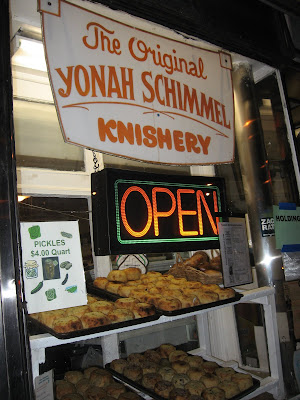 I have a long history with knishes, going back to my childhood in the Bronx where knishes were available at nearly every corner deli, of which there used to be a lot more back in the 20th century than there are now. I think knishes were the first food I actually bought for myself. And a knish was a flat pocket of oily dough filled with potato, usually stacked warm by the deli grill, as these, below, from Katz's Deli in NYC.
 It didn't have broccoli, spinach, or cheese involved in it. It wasn't round and bulbous, as the Israeli influenced knishoid objects that I see around New York today often are. Knishes want to kill you. They may take 70 or 80 years to do you in, but Knishes want you dead. Healthy knish? To paraphrase Lisa Simpson, I know what those two words mean but I do not understand them when you put them together in a sentence.
  I started noticing these newfangled knishes about ten years ago on a trip back the US - all the neo-ortho delis in Teaneck New Jersey had them (Teaneck, N.J. is to kosher food what Hong Kong is to Chinese food.) I was told they were an attempt at making a "healthy knish" that would appeal to a wider audience. Who needs a healthy knish? What was worse: these were from Yonah's Shimmel's Knishery on Houston Street, one of the oldest Romanian Jewish bakeries in New York City (and you can still get a decent, old style knish there.) But wait... the march of progress can not leave even the humble knish alone for long... how about a McPlăcintă from McDonald's in Chişinău?
 Knish, in some for or another, were everywhere, the snack food of mass convenience. If the Ukraine has some version of potato latkes congealing in grease on almost every snack counter, Moldova goes for the knish, always served warm, on the street, in the market, or in bars and cafes.
 Where there is knish, there will be chicken soup, and there is. The Republic of Moldova is a country based on chicken soup, swimming in chicken noodles, broth, and boiled breast meat called zama.
  Much as I love chicken soup, there was also a lot of borscht (Chişinău is about half Romanian speaking and half Russian and Ukrainian, after all) in both red and clear versions, but oddly enough, none of the tripe soup ciorba de burta that Romanians across the border eat so much of. I asked Semyon, our driver, where I could get a plate of nice sour, spicy tripe soup... and he answered "We don't eat that stuff here. Don't like it. Only in Romania, across the river." In the meantime, you could open up a bottle of home made wine with every meal, usually served in recycled mineral water bottles, such as this one, which is a brand called "Mouth of the Dog."
 The sarmale we had in Edinets were unique - stuffed sour cabbage leaves filled with rice and great hunks of smoked pork hock, on the bone. Never had a stuffed cabbage with bones before, and recipes from Romania usually use only a small amount of smoked meat as a flavoring. In the countryside, most sarmale in Romania are nearly vegetarian concoctions of rice, barley, or cornmeal flavored with a small amount of meat. And no paprika. The Hungarian versions are never served without paprika, but I love the sour dill and thyme flavor of the Romanian versions as well.
  While staying in Chişinău we discovered the joys of take out food from the main downtown supermarket, especially little sarmale wrapped in grape leaves stuffed whether with rice and barley, or chunky bits of meat. Restaurants in Chişinău have been getting more and more expensive over the years, and so we kept to our budget by shopping at the markets and eating in and we were glad to do it. Of course, there are times when you have to go for the mici... which in Moldova were huge and much more refined than the rustic meat tubes we usually get at bars and snack stands in Romania.
 And the master of dessert eaters is world reknowned cimbalom master
 Watching Kalman jam along with Marin Bunea and Adam Stinga was one of the highlights of the countless jam sessions we had in the wedding hall of the Edinets hotel.
 One of the clues that you are in the former Soviet Union is the little lacey aprons that the women wear in the meat and dairy markets. It looks like they were designed by Disney for some movie about french maids... and also the fact that nobody objects to having their photo taken. You can't just walk around a Hungarian or Austrian market snapping pix without fielding a bit of verbal abuse. In Moldova, no problem with photos at all.
 Fish was everywhere - interesting given that Moldova is landlocked, but Odessa is only an hour away and as former CCCP appetites know, if you want to drink you need some
  Turning a row we came on the pickle sellers, always happy to let you taste a bit because they know a sucker when they see one and I am a deep sucker for pickles. These were... and I don't like to use superlatives - the best pickles in the world.
 Pickles stuffed with pickles, eggplants pickled whole, tomatos, cabbage, peppers, if it grows it gets pickled. The cucumber pickles... oh my fracking Gods... Moldovans are proud of their wine and cognac, but they should be exporting the pickles. They should open pickle bars in all of Europe's cities and watch the money flow in. These weren't just good - they were A-Number One Hebrew Semitically Approved Sour Bombs.
 Whole pickled wathermelons. I mean, what if you and some friends are watching the TV one night and you need something to go with your beer? Why not a whole pickled watermelon. It tastes like... pickles.
 The wild mushroom pickles are everywhere in Moldova. While we stayed in Chisinau we rented an apartment and after a busy day were too tired to bother going out to a restaurant - and in Chisinau restaurants are not cheap. So we would pick up a little bit of food at the local supermarket take out stand, and we may have eaten far better than any restaurant could have served us. I mean, how many soviet style chicken soups do I need? Not so many. Instead we would have mushroom pickles, grape leaves stuffed with rice, bits of smoked fish, and more pickles.
 There was an entire section of the market dedicated to prunes in every form: dried prunes, smoked prunes, pitted or unpitted, I had never guessed that there were so many different kinds of prunes. And yes, they were good. Having eaten too many pickles by this point, I had no need of the medicinal properties for which prunes are famous, so I passed on buying a kilo of prunes, making this woman very sad.


 This is the strudel to get when you have friends over for dinner and you really want to serve them something in the "Best of Hungary" category without having to take out a bank loan to do it (I'm talking to you, mangalitsa sausage makers!) The fun part is getting out there. The shop itself is on Lehel utca behind the Kika store... it is on the #1 tram line )which runs along Hungária kőrút, or the tram that runs out from Lehel ter towards Angyálfőld. Actually a short bike ride from where we live in Zugló.
 Been a bit busy with other projects lately and haven't been posting as much as I would like. Besides, it is January in Budapest, and not much is happening, a good time to stay inside and get stuff done... housecleaning is going around all over the world, even as we speak.

 Well, we have put that behind us. Obama faces challenges in his presidency comparable to those faced by Franklin Roosevelt in 1932: a shattered economy, a rising fascist-nationalist-terror tide of world politics, a loss of orientation between philosophies that guide the practice of governance. Unlike Bush (or Bill Clinton) Obama is not a longstanding creature of the poltical environment. He's fresh. He hasn't lost a sense of a vision for the greater social good. I think it is obvious that down the line Obama will dissapoint us in many ways. And I am ready to deal with that. At least I can not predict what the disappointment will be. I was raised during the 1960s. I remember where I was on the day John F. Kennedy died. I remember the TV news on the night Martin Luther King died. I remember watching the sense of loss and the rise of a sarcastic cynical tone in public debate: it won't get better from here. That tone lasted forty years. And I welcome the fresh air that I breathe today. I am amused by the sullen tone of the right wing media in America today. There is not much they can say: the majority of Americans are glad to see the back of the Bush administration.
 And finally, I should mention that I am overwhelmed that the USA has finally looked its legacy of racism in the face and rejected it by electing a president who is not lily white. So far, the closest I know of anyone who is not white was vice president
  President Obama's inauguration has galvanized Black Americans in a way not seen since the civil rights era. A Black president! A
  We here at this blog have been lazy lately, but we will be back with more on Moldova... strudels... and Hungary... after we celebrate our new President.
 The Christmas markets were out in full strength, but no, I couldn't bring myself to eat at them, highly overpriced sausages and Transylvanian rolled kalacs, it just aint the same as Dim Sum in Chinatown. But as always, Hungary's strong point is treyf... pig meat. Pork-o-rama. If you like eating hog, and you can't be in North Carolina for Christmas, then Budapest is definately your second best bet.
 Of course, the global economic situation has people in Hungary worried about their budgets, and since Hungarians, due to their bizarre tax laws, do not save money up in bank accounts (it gets taxed and lost that way) they spend an incredible amount at Christmas on gifts (gigantic-wall-mount television screens were a big mover this year) and scrimp on the pork. But only a little. This year was the first time I noticed the abundance of pig noses that came out at Christmas markets.
 Now, for all I know, pig nose is a healthy alternative to say, chicken nose or cow nose. But it did seem a bit depression-era surprising "Back in them days we fed the kids on pig nose. Seems like Christmas without hog snout warn't Cristmas at all..." I have never seen a recipe for Christmas Pig Nose Soup, or a pig nose casserole. But at FT 600 a kilo (about three bucks for two punds), a lot of people were going to have a surprise out on the table on Dec. 26th... don't forget the kleenex!
 I did, however, forego the pork. Di Nayes played for the first ever Klezmer dance workshop at the Siraly for Chanukah, which brought out a lot more people than I expected for December 23rd. Sue Foy taught the dances while we played - without Feri, our cimbalom player, who is in a lot of plaster casts since having a moped accident in November. He should be back in action in a few weeks, though. Something to look forward to. Another thing to look forward to is January 20th (a mere four days after Battlestar Galactica returns for its final season!) when we can finally say goodbye to the worst governement the United States has ever had the misfortune to experience. I, for one, welcome our new Obamacrat Overlords!
 We promise to be better during the new years and keep up with our posting. We still have a lot of interesting stuff from our trip to Moldova, particularly from Kishinev... home of the world's best pickles... coming soon.