On my arrival back in New York, my luggage seemed to have been stuck in Amsterdam. Being a patient sort of person, I didn't worry... and was told to stay home an wait for its delivery. Well it took three days. Why?
Well... we had packed a gift box from Budapest's Gerbeaud Pastry shop containing traditional Hungarian holiday cakes -
beigli - that contained one nut cake and one
poppy seed cake. The drug-sniffing dogs must have gone nuts over this suitcase! When we opened it up, we could see where the customs officials had carefully unwrapped the cakes, cut into the poppy seed cake, and then carefully re-wrapped the box and sent it on to the next customs stations where the drug puppies promptly would go crazy again...

Back in New York with Fumie for Chanukah... the whole city has been up in arms after a supermarket accidentally mislabeled an innocent holiday suggestion in the meat section... this has been on the TV news for a week. Now... just wait for
Yom Ha-Lobster!

Fumie's mission has been to get her hands on a new Nikon D300 camera... for months the city's camera stores have had them on order, and when a shipment arrives, it sells out within hours. Nikon simply can't manufacture them fast enough.
B&H Camera - one of the world's largest and cheapest Photo suppliers, run entirely by a staff of Brooklyn hasids - didn't know when they would get them in again... but
17th St. Photo - another NY institution with virtually the same low prices and also run by Brooklyn hasids - had a few in stock... and here is Fumie with one of the last three available Nikons in the city of New York.

Nikon in hand, we wandered around midtown Manhatten for a bit until the cold drove us indoors to... Macy's Department store at 34th St. Christmas at Macy's was already in full swing.

Christmas in New York traditionally meant a trip to Macy's to visit Santa Claus, and Macy's has kept the tradition of providing the most elaborate department store Santa ever since the
1947 film "Miracle on 34th Street." Personally, I would have much preferred to go to the eighth floor of Macy's and sit in Haile Selassie's lap, but in this life we make do with what we have...

The entrance to the magic train to the North Pole... lots of families, yes, but the crowd consisted of at least 70% fully grown adults such as ourselves, coming to grips with their own Santa fascination in a culture given to ever-increasing caustic irony... Finally, we were assisted by our own personal Elves to Santa's room. "Is this your first time to visit Santa?" asked our Elf. "Actually... I'm Jewish, and she's Buddhist, so we are new to the whole Santa thing." Irony factor at less than 10%... doing well... ahh, now
let's sit the Japanese girl on Santa's lap! Irony factor rising ... rising...

To be honest, I don't think Santa was impressed with me - I haven't really been nice this year, preferring naughty as my main mode of operation - and I don't have much faith that there really is going to be a bottle of Glenlivet Single Malt and a vintage original 1930 National Style O guitar beneath the tree on Xmas morning. I would have to search for religious epiphany in other New York neighborhoods. Cue the F train. Next stop, East Broadway stop in Chinatown.

There may be folks who complain that eating well in New York is expensive. I am not one of those people. So far I have had a series of meals under $15 for two people that are as good as any I have ever had. Sure, I may have to share the dining room with the Guangdong Province Noodle-Slurping Chorale and maybe a few megasized cockroaches, but that really doesn't bother me when it comes to Chinese noodle and wonton soups. And this
part of Chinatown, off the tourist route and next to the Chinese bus stations, is the place to go.

Let's see... Cattle's viscera with soup, $3.50. Maybe hog's hand with thin noodles for a premium $6.00 a bowl? Walking along lower east Broadway near the Manhatten Bridge overpasss we came across the
East Corner Wonton Shop at 70 East B'way. A peek in the window was all it took to convince us - experienced noodle masters at work. And half of Guangdong province was sitting inside.
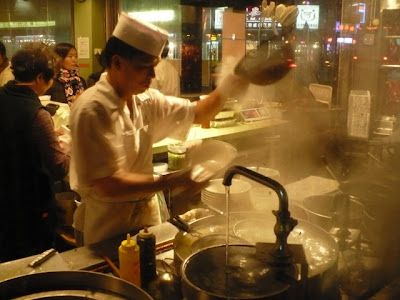
The menu was simple and specialized in what I love - noodle soups, and Chinese roast BBQ meats chopped and served on rice. Excuse me... roast duck soup for $3.50??? And I am not kidding - there is a quarter of a roast duck in there...

I chose beef tripe and wonton noodles in soup, Fumie went for plain pork and shrimp wonton and noodles, and we shared a plate of roast
char-siu pork and roast duck on a small Himalayan mountain of rice at $4.50. "You know that this is tripe?" asked our waiter. "Yes, I like tripe." "But you know this is tripe, OK?" "Yes OK." "And the barbeque is served at room temperature, you understand?" Obviously the waiter had experienced some kind of traumatic experience with clueless tourists walking in off the street and accidentally ordering the screamingly disgusting assorted soup plate. But as we all know, when the Chinese waiter tells you "You no like that" then
that is exactly what you want to eat.
Works every time. 
Take your girlfriend out to a sit down meal in Manhatten and walk out having paid $12.50. What's not to love? This was so good the problem will be to try eating at other soup joints in the area without automatically heading back to this one.

 Getting into the city from Teaneck usually means taking the $2 "Spanish bus" into the George Washingtion bridge bus terminal, and just up the street lives one of the world's best fish soups... at the Mid Atlantic Fish Market on Broadway near 181st St.
 This neighborhood is an outpost of the Dominican Republic - at any given time, about a quarter of the Dominican Republic lives in New York City - and possibly one of the least English-speaking nabes in Manhatten after Chinatown. No matter. Point and pay. Fried and steamed (al vapor!) fish galore at prices below McDonald's.
 The last time Fumie was in New York she claimed this place served the best fish soup in the universe, so we had to try it again. the fish soup had changed a bit - not bad, but not the Champion del Mundo it once was, but at $5 it was packed with huge hunks of fish, shrimp, and mussels in a thick yam-based broth.
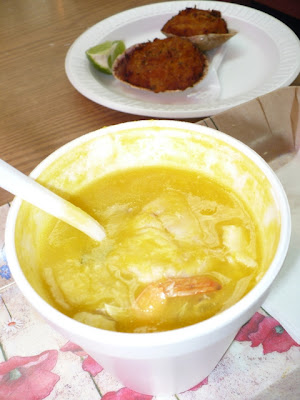 Just behind the fish soup are two deep fried stuffed clams - chopped clams mixed with herbs and breading and deep fried in the shell at $1.50 a piece. As good as any I ever had in any New England clam shack. I went for the fried flounder and shrimp combo with "spanish rice" and salad- $7.
 Almost as good as the tempura plate I had eaten in Japanese lunch joint the day before. At the Fish Market you share your table.
 Last time we were there there were no tables, so this is a step up. For cheap fresh fish in Manhatten, we can share tables. You want to spend $50 on a fish dinner downtown, you can have your own table and a snooty waiter to boot. I prefer company at $7 a meal.
 The fellow eating next to us didn't speak a word of English, but he was accomodating enough when Fumie decided to ask if she could photograph his fried fish - a whole grouper chosen from the fresh fish laying out on ice on the other side of the fish shop. This is a proper Caribbean meal for a wet and wintery New York day.
 Next stop was to get downtown so Fumie could hit the 50% off sale at the Japanese language Kinokuniya books store, which is moving a few blocks to Bryant Park from Rockefeller center. The area was packed with tourists drawn by the famed Christmas tree in front of the NBC building.
 A slice of strawberry cheesecake stood us well for an afternoon pick us up.
 A midtown delicatessen had cheesecakes galore, but after adding a coffe and taxes - New York City loves its taxes - this cost us almost as much as lunch. Still... good New York cheesecake does not travel well, and this is the real deal. A meal in itself.
 Grand Central station has an hourly holographic kaleidescope show, which stopped everybody in their commuting mode tracks for five minutes. It is at time like this that New Yorkers will turn to the unknown person next to them and say "Hey - dontcha just love New Yawk?"
 People would lie down on their backs on the floor to watch the images projected on the roof of the Grand Hall. For five minutes this huge public space morphed into one big amusement park for commuters.
 Back down into the bowels of the 6 train to the Village.
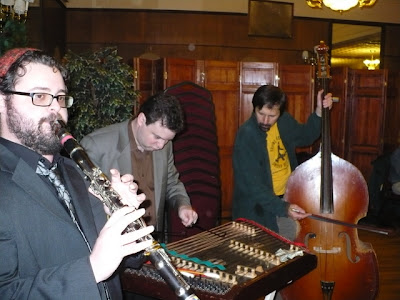
  And here's a taste of Yiddish dancing... first off, a Maramures Hutsulka as played in Ieud, leading into a nice fast Jewish sirba. Then... playing for tables, in which the musicians park next to your dinner and try to get you to pry open your own wallet and transfer the contents into our musicians' pockets. And guess what? It works. Actually, as you can see, the proper method is to string your twenty EU bill into the horse hairs of the primas' bow. This, my friends, is the true context of traditional music!


 White Manna is an old Burger hut that began as a snack stand at the 1938 New York World's Fair and was was moved to the banks of the Hackensack River afterwards. It hasn't had any redesign since.
 White Manna's burgers are tiny... a surviving adaption from the Great Depression of the 1930s when a very small amount of meat would be grilled or steamed on top of a huge mound of onions in order to produce an affordably cheap burger sandwich. The only other places that makes Depression-era burgers like this that I know of are in
  The grill cooks in this tiny joint have the drill down to an art form. Take order. Slap tiny meat patty onto grill, toss onions on top, squash together, and wait. This is actually very slow food, and there is always a crowd at lunch. The burgers are still cheap, at $1 for a regular, and usually one orders at least two or three. While we were there once guy ordered eight of them, while his wife ordered only four.
 The 1930s also gave birth to the first fast food chain in America, the
  At 50 cents a burger, that is not their target consumer profile. This one is located on Rte. 46 in Hasbrook Heights, NJ, an ugly bit of roadway where you might venture to get a new muffler for your car. Ordered a dozen burgers for three of us - I like their newfangled Jalapeno-Cheese burgers, which my dad thinks is sacriligeous to the Holy White Castle Mythos ("There are Burgers and Cheeseburgers. Nothing else!")
 There is something about the cheap meat combination - bits of innards for flavor? Mushy steamed bun? - and the steaming process that gives White Castles a flavor that is every bit as evocative as the madeleines that Proust bit into. These are worth every penny - and it is pennies we are talking about here - and anybody who watched the excorably bad
  Then there is the famous Jersey Diner Burger. My folks decided that they had to try a new Mega-Diner at the Garden State Mall... the Grande Lux Cafe.
 This is a shining example of Garden State Grandiousity - it ain't worth building unless it is so huge that the word "tasteless" becomes meaningless. When we first moved to New Jersey in 1966 our first meal was at the old Forum Diner on Rte. Four, a classic Greek-owned highway eatery that remained legendary in Bergen County until it closed last year. Now my folks are entirely pleased to take their custom to the Grande Lux.
 For a Disney-sized mega-bistro in a mall, it wasn't half bad. The Angus beef burger with jalapeno jack cheese passed muster, comparing favorably to the White Castle Jalapeno-Cheese burger at only 17 times the price.
 Of course, for only $6.95 we don't need to go farther than to
  Fumie has been getting nostalgic for Japanese style hamburger and rice plates. Fortunately, the


 The musicians of the village of Clejani, located about twenty kilometers west of Bucharest on the dusty Oltenian plains, are better known as the world music phenomenon called Taraf de Haidouks. I had heard the band from Clejani earlier on a French Ocora label CD. Speranta Radulescu began recording the Lautarii from Clejani in the early 1980s and, in 1986, she took the Swiss musicologist Laurent Aubert to Clejani, where they made a series of recordings with the
  Aubert released this work on the French label Ocora in 1988 as "Musique des Tsiganes de Valachie; les lăutari de Clejani" In their original formation, the bands tended to comprise about four or five members, which is about how many musicians could be supported on the money from a wedding gig in traditional context. Their western promoters felt that the band should be presented as a large scale spectacole, and so the Taraf de Haidouks was formed which included as many as 30 musicians on stage at a time.
  In a traditional context, however, the bands would have been much smaller, and to my tastes, it is in those line ups that one can really appreciate the old style lautar presentations of ballads and epic songs which would be sung after midnight by the friends of the groom. The musicians from Clejani were not some discovery made out of the blue in 1990, however. Clejani had been active playing in national folk festivals and stage performances as early as the 1940s in Romania. The existence of so many dynastic lautar families in Clejani is attributed to the days when Gypsies were slaves to noble Boyar estates in pre-independence Wallachia. Clejani, apparently, was attached to a larger Boyar sponsored monastery, providing work for many Rom Lautar families.
  A newspaper in Romania, the Jurnalul National, has been issuing a series of classic recordings of Romanian music over the last year as gift CD to subscribers. Unfortunately, this means that these are not current, commercially available recordings. We’ve already posted about their fantastic CD of
 (The link leads to a German based file sharing site, don’t worry, it is safe. Type in the pass code, wait a few minutes, and it’s all yours. How I got to that file is another, very Romanian story… ahhh, Romanians and the internet, a match made in Heaven!) If you can’t read Romanian, the
  This is the sound I love. The small ensemble style really gives a sense of what the music of the outer marches of the Ottoman world sounded like when this music still functioned within a feudal society that provided for a professional caste of musicians. You can hear the more archaic Turkish/Ottoman influences on the repertoire, alongside Central European music for the new urban Elite of Romania. Although Klezmer music doesn't actually share much direct influence with the lautar traditions of southern Romania (as opposed to the lautar tradition in Moldavia, where the two musics do converge in a strong way) both Jews and Gypsies functioned as conveyors of Ottoman musical practice and theory into European music.
 This is Clejani without the glitz of the World Music spotlight. This is the good stuff.

 It's a month of chotchkes galore for sale. Folk-inspired items like painted ceramic plates are easy movers, children's wooden toys and folk flutes do a brisk business. Honey cakes - emblazened with Christmas symbols - are a traditional Hungarian Christmas gift, like the ones sold by the honey seller below.


 Too much market, needed time out to sit in the Siraly Cafe on Kiraly utca for some tea with

 Sándor Csoóri (formerly of Muzsikas, now with "Young Muzsikas") and son... and family... performing at the market. Yeah, it looks like a string quartet but it sounds like the Ramones on palinka. Some of the most energetic Hungarian folk around. Each afternoon has bands playing in folk and other styles while freezing their.... hands... off. Do not miss. A Giter Nitl far ale!