Sunday, September 07, 2014

The Brothers Nazaroff Deli Report: Summer 2014

"I went to work in a delicatessen
For dreysik dollar and plenty to fresn
The balebos promised me a real gedila
instead of a gedila I catched me a kila

Sixteen tons of hot salami,
corned beef, rolled beef, and hot pastrami,
I hock arayn everything git tsu esn
I owe my neshomah to the delicatessen

Sixteen tons all kinds smoked fishes
Latkes, blintzes, un heyse knishes,
O Lordy nem es shnell to the promised land
A fayer afn boss zol er veln farbrent"
                 Micky Katz, "Sixteen Tons" (see bottom of post.)


I thought I would be able to maintain my strict dieting regime while on tour in the US and Canada with the noble Brothers Nazaroff, but that was not to be. Performing Yiddish music at Klezkanada and in Montreal, Toronto, and New York put us near of some of the best Jewish delicatessens around. On my first free half day in Montreal I was breaking my fast on the King of Meats: Schwartz's smoked meat sandwich.

Schwartz's Smoked Meat
 All spring I had fasted on vegetable juices and tee-totaled goodbye to demon rum in expectation of this day. On this day I marched up Boulevard Sainte Laurent at 11 AM to make it to Schwartz's Delicatessen before the eternal line of tourists begins snaking out the door and down the street. I had waited through months of vegan misery for this moment. I even ate salads for a week at Klezkanada.Today was the day I would introduce my beloved Fumie to the magical world of Montreal smoked meat, a world that I had spoken so much about since my last trip to Montreal.

She calls it "steak sashimi" and rates it better than Katz's.
I have posted about Schwartz's here before. Simply put, in the world of Jewish cured meats, the argument always comes down to Schwartz's versus Katz's Deli in New York. Montrealers tell me that Schwartz's isn't the only great smoked meat sandwich in town (there is the Main, and Lester's and Smoked Meat Pete among others) but for Fumie, on her first trip to Montreal, a pilgrimage to Schwartz's was obligatory. She bloats up on bread, so she went for the small plate of smoked meat (fatty, of course) which comes with a stack of rye bread on the side should one wish to construct sandwiches. 

This is the small plate. The large plate... haunts my dreams...
Kind of like cured beef sashimi if you approach it right. My sandwich was small - as most deli sandwiches are outside of the tourist belt of Manhattan - and although perfect in every way, I eventually used Fumie's rye bread and leftovers to increase my dosage by another half sandwich. Smoked meat is a bit different than pastrami: its is made from the brisket, the lower part of the beef stomach flap, not deckel, the breast flap as is used in US made pastrami, and the spicing is a bit heavier on coriander, but risking charges of heresy I may actually say it is better than Katz's, at least until I sink my molars into one of Katz's ridiculously expensive (but great) $18 pastrami sandwiches before I head back to Budapest. 


After the nationalist Parti Quebecois came to power in the 1970s, a lot of Montreal's English speaking population, including a large percentage of its Jews, migrated to Toronto. Toronto's Jews brought a nostalgia for smoked meat that led Zane Caplansky to start smoking his own variation in a local bar, which proved so successful that he soon opened Caplansky's Deli nearby, experimenting and tweaking the recipes until he had created one of North America's best pastrami/smoked meat hybrids.

Jake, before the vicious knife attack that left him a scarred shell of a mentsh.
We arrived to meet with Michael Wex, author of the bestselling book about the Yiddish language Born to Kvetch, and Canadian singer songwriter Geoff Berner - known as the "Whiskey Rabbi" - who has also recently penned the hilarious novel Festival Man. Wex is the heart and soul of Canadian Jewish wit, and Berner, well... Geoff is fast becoming a lesion on its liver. Geoff and his band traveled with me to Romania about ten years ago to look for Jewish fiddlers in Tranylvania and Moldavia, He still sings about that trip.

Berner and Wex, the Judeo-Canadian Literary establishment, nu?
After filming some enlightening interviews, including Wex declaring that by singing in the Yiddish Language the Brothers Nazaroff are voluntarily choosing to commit commercial suicide, we ordered lunch (on somebody else's budget, Thank you very much!) Unfortunately, Geoff Berner accidentally beaned Jake Shulman-Ment on the head with a knife while trying to dismember an errant hornet, but in truth the gash was minor and didn't bleed much and was at least a wide half inch from Jake's cornea and Jake is a fiddler and doesn't really need his eyes all that much to make a living anyway because blind musicians have always been a part of traditional music and he has already seen so much that he doesn't really need those eyes and he would have had one left over anyway. 

Geoff Berner plans his next move as a bandaged Jake contemplates lawsuits and sandwiches.
And Geoff felt really bad about it, the throwing a knife at a new acquaintance's face thing... it was so un-Canadian, really. So... Geoff! You never know what he will be up to next. Touring Norway with his band or stabbing fiddlers in the face... such a character! And thus our sandwiches arrived. 

Caplansky's Smoked Meat. 
My previous experiences with Caplansky's sandwiches were at the Ashkenaz festival a few years back, and I wasn't blown away, but obviously the recipes have been perfected and this baby was a close contender for Top Ten deli masterworks of the world.  We also split a "What Hank Eats" special, which was a classic old school deli sandwich of griddled Kosher salami, red onions, and chopped liver. The chopped liver... too creamy. I understand why catering halls started making chopped liver in machine blenders, but I used to make three kilos by hand chopping liver, onions, and eggs together every afternoon when cooking for a Budapest bistro and there can be no better texture than chunky chopped liver. We sold it out by 8 pm every day. Hand choppingg the liver while warm is the secret to good chopped liver.

"What Hank Eats" Grilled kosher salami, chopped liver, onions. 
I also opted for a small smoked meat poutine, but since that is a purely Canadian concoction I will leave it to provide fodder for the full poutine rant in a later post. Other than Caplansky's and the Ashkenaz Festival, I should mention that Toronto has a really great Brazilian bakery, a Chinatown, and a big tower. Onward to New York! When we talk about New York, we usually talk about Katz's, and yes, I will talk about Katz's very soon but not right now... I want to talk about my home province, the Bronx. 

Liebmann's: The only Deli in New York in a place where you can find parking.
Working with a film crew in tow is tiring for a band, and one works up a hunger, or as Dan Kahn calls it when he sees me getting grouchy and nasty around noon "Uh-oh! Bob is getting hangry." Lucky for us we were near Liebman's Deli. Located in the Kingsbridge section, near Riverdale, Liebman's is one of the last two delis in the Bronx, where there were once well over a hundred delis. And Liebman's is still serving a local clientele, unlike the delis in Manhattan which can only survive as tourist attractions due to the high rents and rising costs of making an artisanal deli meat product in house. 

Liebman's Deli. Herring, I tell you! Herring!
We showed up at Liebmans at lunch hour - somewhat unfortunate time since we had a full film crew in tow and there were already lots of people waiting for tables for lunch, but the management of the place were patient and smoothed out all our difficulties. So here we are, the egg creme de la monde klezmer, all seated around a kosher deli table, and what do we order? Pastrami, my good man, and plenty of it. 

The Borthers Nazaroff: Meyshke Nazaroff, Yankl Nazaroff,Danik Nazaroff, Pasha Nazaroff, Zaelic Nazaroff, with director Csaba Bereczky at Liebmans Deli n the Bronx. 
Liebmans is one of the few places in New York that still cures its pastrami in house. They also cut it thin, on a machine slicer, which is actually how most of the old delis in New York used to serve it. Hand cutting pastrami or corned beef, the way it is done at Katz's or Schwartz's, produces a huge amount of wasted bits of meat produced by the cutting. 


Pastrami or corned beef are one of the most fragile of things you can eat: from the moment it comes out of the steamer and gets sliced it begins cooling. By the time it reachers your table it is in prime condition but as it cools it begins to dry out, slowly deteriorating in quality even as you eat it. By the time you bit into the second half of the sandwich the difference is usually noticeable, and by the time you finish the texture and flavor of the sandwich has changed considerably from what you began with. Nobody really wants to take home leftover pastrami... 

Gabila's knish. Potato. Accept no substitutes.
This is a genuine New York knish. A fried potato knish (pronounced ka-nish) to be exact, produced by the Gabila Family factory out in Long Island. For a century, this was the knish New Yorkers bought on the street and in delis, the cheap, hot, filling meal of the working classses that transcended race, religion, and ethnicity to become the stuff that filled New York's stomach in times of no money. A jacket of dough that covers a mixture of mashed potato, onions, and pepper, knish were also made at home and sold on the street by itinerant knish men, and each family had their own style and recipes. Home made knish tended to be bulbous things often filled with kasha (buckwheat groats) and mushrooms. The Gabila family originally came from Niš, in Serbia, and were Sephardic Jews who adapted their potato burek filling to the hardier New York market. About four years ago the Gabila factory burned down and for years the newspapers reported a knish shortage in the city and eventually lamented the disappearance of New York's iconic square knish, as bulging vegetarian baked knishes attempted to fill the void left by the fried potato squares. Gabila's have rebuilt and now they are back and promoting themselves as a healthy vegetarian meal, which, if you take a lot of drugs and are very, very old, kind of makes sense. 

The Brothers Nazaroff: Unimaginably Nazarovian!

And as with all things... after lunch we have to get to the gig. At the Eldridge St. synagogue and Museum in Chinatown. Nazarovye!

Saturday, August 02, 2014

New Jersey: Gone to the Dogs.

“Wait." Clary was suddenly nervous. "The melted metal-it could be, like, toxic or something."
Maia snorted. "I'm from New Jersey. I born in toxic sludge.” 
― Cassandra Clare, City of Ashes


Unfortunately, you can go home again, if you are from Jersey. Like a lot of Garden Staters, I was born and raised in New York City and only sent into cruel exile beyond the GW Bridge in my teen years, but it was enough to brand my soul with the existential sense of emptiness and pizza grease that defines a Jerseyite. Sprawling out of the New York urbanopolis like a bad rash, New Jersey exists in several simultaneous time zones.


Bits of history lie scattered about the suburban lansdscape. Old Jersey Dutch families from the 1600s linger on as drug dealing real estate agents and high school dropouts. Lenape Indian descendants fight lawsuits against Ford Motors in Mahwah, five minutes drive from the Garden State Mall. Half the towns in Bergen county are called "Boroughs" or "Boro" in the local spelling: reminders of a half witted scheme in the 1890s to lower taxes. The depression era 1930s is still alive here, as are the suburban migrations of the 1960s, the highway strip mall culture of the 1970s, the immigrants of the 1990s replacing the old German and Italian speaking neighborhoods with Peruvians, Lebanese, Bosnians and specialty enclaves offering Kabardins, Tatars, and Kumyks from the valleys of the Caucasus. Ye shall know them by their bakeries.


I am "home" again, the home I left a lifetime ago and still feel wrong in, but it is where my folks live and where I will have work for the immediate future, so here I am. And so is my son, visiting the Grandparents and Aunts and Uncles, tasting the ethnic specialties that his Dad was raised on... corned beef sandwiches, pizza, Chinese food, and yesterday, an introduction into the peculiar Jerseyite cult of the Texas Wiener. I have posted before about the Jersey Hot Dog. New York has the classic kosher dirty water dog, the soggy push cart variety as well as the snappy skinned grilled deli style. New Jersey has several regional styles, including the deep fried ripper made famous by Rutts Hutt and by Hiram's in Ft. Lee. Since Uncle Ron got the air conditioned Jew Canoe for the day, we took Aron out to try the lesser known locavore specialty known as the Texas Wiener. Texas wieners are not from Texas. No Texan would ever deign to do this to a Wiener.

Texas Wiener at the New Corral Grill
Texas Wieners are a regional hot dog style from the area around Paterson and Clifton New Jersey, a snarl of highway overpasses, used car lots, aluminum siding retail lots, and a large and shifting ethnic population heavy on Middle Easterners ever since Syrian merchants were attracted to the booming silk trade centered in Paterson in the 19th century. The silk industry is gone, but the flavor of a Balkan red meat sauce spiced with oregano and cinnamon remains, slopped onto budget hot dogs with onions and considered to be authentically Texan enough to merit the name "chili" and thus "Texas Wieners." (Usually spelled "weiners.") Drive ten miles away and they are again called Chili dogs, but in the Clfton and Paterson area, Texas Wieners do daily battle with fans of the deep fried hot dogs known as rippers.
Taylor Ham: its what's for breakfast!
Our first stop was the New Corral Diner. Aron was impressed by the interior: anyplace else that looked like this would be considered a hipster graphic artists's idea of an ironic American diner. But no, this is the real thing. Breakfast served all day, because that is how we roll in Jersey. The Texas Wiener was excellent: some kind of weird Grandma's spice from a forgotten region that once interested linguists due to their absolute lack of vowels or past tense. Aron heard the staff speaking some language that may have been Izhor, or possibly a Mandean Aramaic dialect, or possibly Zazaki. we will never know. This is Clifton, after all, so it could be anything besides Albanian, because we know that is what they speak over at the Hot Grill. We are here for Texan food, right? Not Albanian. The Corral is nothing if not honest, simple New Jersey food, with such standards as chocolate pudding, eggs and bacon, and that most New Jersey of Mystery Meats, Taylor "Ham."
Corral Grill: Texas Wieners without irony.
The real reason we were in Clifton was to visit the Istanbul Food Bazaar - I have to eat, after all - and to find Rutts Hutt, which we did not locate, it being famous and located on the main highway and us being... well... us. But passing the great steaming lava spread of used car dealers and highway detritus that leads to Teterboro airport we found ourselves at Hank's Franks. By accident, of course. Hank's Franks is not a destination. Nobody leaves their house saying "I am going to Hank's Franks. That will be my destination. I am sooo there! At Hank's Franks!" It is just a place you find yourself, and they happen to have Texas Wieners. Ask your local Zen practitioner for details.

Fine dining near Teterboro
Hanks serves basic New York Kosher Sabretts dogs in classic mustard and sauerkraut style, but also, this being Route 46, the Texas Wiener. And it was quite good, as things Weiner and Texas go. Spicier than the usual, but with enough cayenne in the sauce to feel the heat, and lacking any trace of the ethnic herbs that Grandma brought back with her when she fled from Wherethefuckistan so many years ago.

The aesthetically unpleasant food of New Jersey.
This being the Passaic River valley, everybody's cell phones rang with warnings of flash floods as storm clouds rose over the horizon. This is another fact about New Jersey. It is geographically unsafe to live here. There are annual floods that make home-owning suspiciously affordable in certain low lying regions. There are occasional earthquakes. Chemical dumps regularly erupt in spontaneous combustion. The swamps reek of heavy metal pollution, rotting cane, and the decomposing remains of former members of This Thing of Ours. Chris Christie - the Jabba the Hutt lookalike who illegally ordered the George Washington Bridge to be shut down for political reasons - is not only still Governor, he thinks he may run for President. There is a reason that old comic books always had stories about subhuman monsters emerging from the Jersey swamps. It was true. New Jersey is the State of Mutants. 


And you can't run away. To get anywhere in Jersey you have to sit in a small metal container and plummet at insane speeds along crowded highways designed during the Great Depression when there were only 724 automobiles in the entire state, and you have to share this crumbling cement donkey path with even bigger and more dangerous vehicles driven by the angry guy who was just wolfing down Texas Wieners next to you at that stand near Clifton. And everywhere you go in Jersey there are American flags flying. Huge American flags. Just in case you ever forget exactly which Great Country you are in. You are in Jersey. Welcome home.


Friday, July 04, 2014

The Hungarian Parliament: Of Power and Pastry.

Demo at Parliament in better times.
The Hungarian Parliament building is Europe's largest, an imposing and elaborate structure that dominated Budapest's Danube profile. Designed at the end of the 19th century to accommodate the growing number of representatives expected from Hungary's growing stature in the Austro-Hungarian Empire, it was inaugurated in 1896 to celebrate the 1000th anniversary of Hungary (which actually happened in 895 AD, but the architect for the 1895 millennial celebrations died before the Budapest World Exposition at Hősök tér could be completed, so the history books were amended to the more convenient millennial date that could accommodate the celebration in 1896.) but only completed in 1904, because, according the a Wikipedia article, the architect went blind (perhaps from looking at it?) No sooner had it opened than a riot broke out among quarreling political factions in 1904, a pattern in Hungarian politics that would carry over well into the 21st century.
Remember Armenian axe murder victim Gurgen Margayan? We do.
Natives of Budapest, always a snarky lot, often refer to the Parliament as the "Great Circus" or as the "Wedding Cake" in reference to its imposing, imposing, very imposing architecture. Less than 10% of the building is actually in use. The first world war put an end to Hungary's dreams of packing the building full of half-assimilated Bosnians and Ruthenians arguing about tax abatement in broken Hungarian, and the Wedding Cake became a symbol of Imperial dreams worthy of Icarus as well as a pretty nifty place to park tourist buses. With the electoral victory of the FIDESZ party in 2010, party leader Viktor Orban felt the need for a more imperial... imposing... or perhaps, defensible... look to the square, and reconstruction of the entire area around Kossuth square was begun. First parks full of unsightly trees were cut down, and soon statues of obscure and historically doubtful politicians were removed. The statue of Attila József - perhaps Hungary's greatest poet and the first person ever to be kicked out of the communist party - was found to be offensive to the Prime Minister's line of site, but protests saved the statue which was moved to a less prominent site nearby. For a year or so the entire area was a construction site, complete with an unexpected green slime lake when the Danube seeped into one of the excavations for an underground parking lot.

Mmm... cement!
But today it is complete... a massive expanse of cement, perfect for massive party rallies extolling Our Great Leader as he makes yet another speech to the Adoring Masses. And what goes better with a new Parliament prone to rioting representatives than... a new parliamentary guard with the power to remove MPs who cross the Speaker of the House! Yes, these flesh and blood tinker toy soldiers are an official branch of the Hungarian defense services. Yes, large amounts of tax money is spent on tailored uniforms and choreographers. Could these guys stop an invading horde of beer-crazed Slovak football fans? I doubt it.


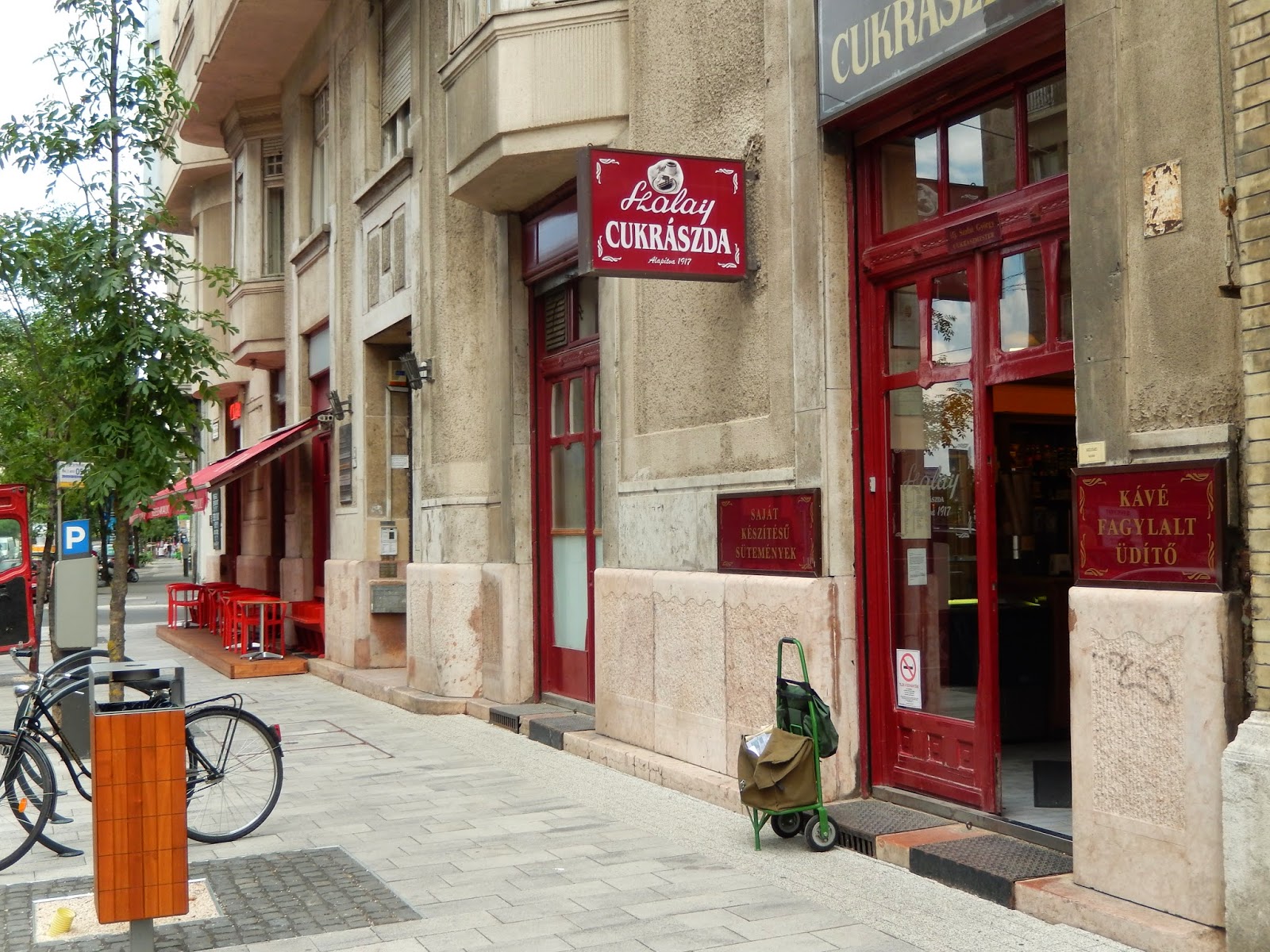
But enough of this political foolishness. We have loads of that in this part of the world, although, speaking as a Hungarian nationalist chauvinist I will loudly assert that our political ass-clowns are the biggest and best ass-clowns in the world. That said, if you are in the neighborhood of the Parliament and Kossuth square you can visit something that can actually make a claim on being the best in its field, and that excludes parliamentary democracy. Just north around the corner from the Parliament at Balassi Balint utca is the Szalay Cukraszda, an old family-owned pastry shop that has been in this location since 1917.


Legend has it that it escaped being taken over by the state during communist times because the party functionaries (the Party offices were just across the street in the "White House" at Jaszai Mari square) wanted a place that actually cared about its baking and coffee. I hadn't visited in years - I don't ramble around the Parliament much unless the Prime Minister hands over Azeri axe murderers to be released and rewarded by the Azeri government. (Jeez, doncha just miss Ferenc Kumin?) Or when there is something interesting at the Museum of Folklore located across the street from the Parliament, but soon to be removed to some cement structure in the soon-to-become-a-treeless-memory City Park.

Elegance in miniature.
In those cases a side trip to the Szalay shop is a given. The place is tiny, as a good coffee shop should be, and spotless despite its age. Most of the baked goods are made in house, and my special assigned pastry taster Fumie took special note (buying an extra for breakfast) of the svájci kifli "Swiss croissant".

How pastry porn is made.
As always, I get a "long coffee" with no sugar. The days have been extremely pleasant in Budapest this summer: so far none of the heat waves that have scorched us in times past have arrived. While biking up Falk Miksa utca near the parliament we passed the Google Mapmobile taking snaps. I have already checked: I have not yet been immortalized in Google maps but I may be soon!
Say CHEESE!

Monday, June 16, 2014

The Final Death of the Four Tigers.

Photo: 444.hu

We all knew it was coming. We were warned. For years the Four Tigers Chinese Market has faced being shut down by Hungarian politicians, especially the creepy FIDESZ mayor of the Eighth District in which it is located  (previously made famous for criminalizing homelessness in Budapest.) The word had gone out months ago, and the stall owners and retailers of cheap Chinese underwear and bad fishing equipment begin their sorry exodus across the road to the newer market area across the street. Branded in the Hungarian press as a hotbed of crime and mafia dealings, a magnet for smuggling and stolen goods, and even for making less than exemplary tofu in illegal - yet artisanal - factories, The Four Tigers Market was all of that and much, much less. To put it bluntly: if you are Hungarian (or Slovak, or Czech, or Romanian, or Ukrainian) and you wear socks or underwear or pop viagra, shoot off fireworks, or fish for carp in the Tisza with budget gear then you can thank the Chinese market for providing these to you at a price you can afford. No Chinese market means a whole lot of sockless, shit-stained, limp, quiet and fish-less East Europeans. Not a happy image. ( Next photo is also from 444.hu)


A lot of Hungarians were afraid to even enter the market, a scary multilingual zone full of Romanians and Arabs and Gypsies and Chinese, Vietnamese, and even Mongols all chatting away in distinctly non-Hungarian languages and snacking on really good things with no name in Hungarian. (You could actually get freshly baked Turkish breakfast pastries in the center of the Market where a knot of Muslim eateries all tried to outdo each other with the same Gyro menus.) It was also a place where I saw a large number of Transylvanian Gypsies actually speaking in Vietnamese, and Hungarians happily chatting in regional Chinese dialects. Not many of them, mind you, but apart from its evil reputation it was actually one of the safer areas of the eighth district if you knew the rules (no photographs! no samurai swords!) It will be missed, but not all is lost: the Chinese Market is basically moving across the street. 


The first sign of this was the empty shell of the once glorious Dang Muoi Vietnamese Buffet, which was - and I am not exaggerating - the best restaurant in Budapest for many, many years. Sure, we now have a Nobu, and there is a Michelin Star tossed here and there, but Dang Muoi was the place we would go to eat if we had the choice. We even took visiting friends and dignitaries to eat there. 


Fumie and I do a lot of our food shopping at the stalls inside the Four Tigers, as well as the huge Chinese supermarket across the street. Next door was the Vietnamese coffee stand where we could get primo Cà phê sữa đá and free lotus tea and chat with the owner. The Vietnamese fish market offered affordable frozen squid and dozens of seasonal herbs and greens unheard of in Hungarian markets. And we usually stop for pho or bun cha noodles at Dang Muoi, since the area's Viet food is a bit more interesting than the Northern Chinese stodge that you can find poking around the stalls across the street. The woman working the last remaining Vietnamese grocery stall told us the Dang Muoi had moved across the street, as they would be doing, to "Vietnami Utca" in the Europa Piac, the more recently developed miniature Chinese wholesale suburb that has taken over the old factory district. 


We checked it out: all is well. Dang Muoi now has a small grocery and lunch counter near the entry gate to Vietnam street in the market, as well as an upstairs dining area and a couple of outdoor picnic benches.The food remains the best in Budapest if you don't want yet another helping of frozen Tesco chicken and CBA paprika. The wall shows offerings of over dozen soup based specialties, but I still find myself mysteriously drawn to the mysterious steam table: belly pork in spicy sauce, pickled veggies, Vietnamese slaw, chicken done four ways, tofu, eggs, and even slices of stewed or fried fish... just point... and as long as it fits on top of a plate of rice, it is yours.


My yardstick for Viet buffet dining is always going to be bun cha - grilled pork on cold rice boodles dunked in spicy fish sauce dip, but today I went for bun nem, the same but with fried spring rolls in place of pork. It is the perfect meal for a hot day. Note: if you want bun cha or bun nem you have to ask for it, it wasn't listed on the wall menu. All this for about FT 1000 a serving (about USD $4.00) The drill goes like this: dump salad and herbs into bowl of fish sauce and spicy broth. Then dunk heaps of rice noodle into broth bowl. Now dump a piece of spring roll or meat on top of that. Use chopstick to convey to mouth. Splatter with their home made sriracha sauce if need be. 


We hit this market for grocery shopping about once a week, so we will be searching around the winding alleys of the Europa Piac for any new eateries that may pop up. It is a wondrous world back there. I mean... how often can you have a fresh, tasty, affordable lunch al fresco and look out to a glorious panorama view like this one? This, my friends, is terroir! I love this place. 


It almost makes me feel like I am back in New Jersey. We are truly blessed. But if I wanted to look up from my bowl of pho and see some downtown skyscraper office building full of suited worker drones, I would have chosen to eat downtown.  Of course, you don't have to trek out to the market to test Dang Muoi. They have expanded and opened several Vietnamese restaurants in Budapest, including one on Nagymezo utca. 


Or you can do what we do: shop for your basic ingredients at the Vietnamese and Chinese grocery stalls in the market and make it all yourself. This is Fumie's idea of a light lunch: spring roll with shrimp and pork wrapped in lettuce leaf, basil, and mint with fish sauce and lime dip. Or maybe I should just have a couple of turo rudi instead?


Tuesday, June 03, 2014

Holocaust Revision, Hungarian Style.

Hungary has grown a reputation in the press as a hotbed for antisemitic political movements over the last decade. The other day my father's friend, a guy in his 80s who tends to repeat himself a lot  looked at me through a skype screen and asked "Is there a lot of antisemitism in Hungary?" He asks me this every single time I have ever met him. And for the first time I simply told him "Yes." Usually I go into a convoluted explanation of Hungarian society and history, pointing out how Hungary didn't develop a political antisemitic tradition until the 20th century. Hungary didn't match the classic Russian definition of Jews as outsiders, there were no church sponsored pogroms such as my paternal Grandparents faced. The classic Austrian Catholic antisemitic tradition was blocked by the rise of the Hungarian middle class in the 19th century, which found urban Jews and Protestant (poor) nobles from east Hungary in an alliance both linguistic and economic. So why does Hungary now face the accusation of antisemitism? Simple. Because its political leaders are ethically challenged baboons.


Back in January, Prime Minister Viktor Orban, taking valuable time from his busy schedule of building himself a personal football stadium in his backyard, announced the erection of a monument in Budapest's downtown Kossuth Square to commemorate the 70th anniversary of the "Occupation of Hungary" that led to some 700,000 Jews being deported to the Nazi death camps in a matter of months. Except, if you are Hungarian Jewish (and about 100,000 of us still are) you may not remember History in exactly that manner. As in "What occupation?" Hungary was not an occupied country, it was an Ally of Nazi Germany. This was seen by members of the Jewish community, as well as most literate Hungarians, as a whitewashing of the role of Hungary in the Holocaust. Orban said he could not discuss the matter while busy fixing the national elcctions ... er... running for re-election. Subsequently, most of Hungary's Jewish organizations chose to boycott the government's planned events and refuse its funding.

"Dialogue, not doubletalk!"
Now, originally I wrote a detailed analysis of that history, which I then decided to shelve. You can read about the monument debacle at the Wall Street Journal, the Hungarian Spectrum, the Economist, also here and here and a zillion divisive poltics.hu articles to boot. Meanwhile, Jewish organizations are taking the effort to support independent memorials, such as that prepared by the Yellow Star Houses Project. These were houses around Budapest in which Jews were allowed to reside in 1944. They are everywhere - there are two on my street and another two on the corner two blocks away, and I don't even live downtown. The corner on Andrassy housing the Polish institute was also one.

This was a Star house. Remember on June 21."
The monument planned for the memory of the "German Occupation of Hungary" has yet to be completed. From the location and the existing structures - which would not be out of place in any Greek restaurant toilet in central New Jersey - it promises to be a classic of FIDESZ kitsch. It will be located on a strip dividing two lanes of an underground parking garage exit. How's that for an honored and sanctified location.


For a while the site was the scene of protests by Jewish organizations and their supporters. Nonetheless protesters were detained by the police and the right wing news cycles went into overdrive painting the events as disruptive left wing violence. Now the monument itself is under wraps, literally, guarded by police awaiting the day - soon - when Prime Minister Orban will dedicate the completed statue.


In the meantime, the area around it has become something of a spontaneous shrine to the victims of the holocaust. People have left mementos of lost family members, or objects symbolic of those murdered in the Holocaust, marked by piles of stones in the Jewish cemetery custom.


For years I have spoken defensively when asked about "antisemitism in Hungary." I still stand by it: it is not the Hungarian people that are markedly antisemitic - it is the Hungarian political system, whether right or left, communist or "Christian", that can't exist without the rhetoric of the antisemite. It is the Hungarian political system, with its stubborn addiction to hair-brained "third road" schemes and creative economics combined with bad bookkeeping (and too many hungry poltical in-laws waiting in line to be fed) that sends the ping pong ball of Hungarian history on its eternal trip bouncing off the table. Blaming nationalism or the hangover of communism is a bluff. Hungarians have been locked out of a participatory role in politics by their ruling class ever since King Arpad arrived in the 9th century. The PR machine that keeps Orban's government going believes it can revise history in its image with an humongously ugly statue. The problem is: its image is just as ugly as that history.