Wednesday, June 06, 2012

Gypsy Festival in the Netherlands!

Been home a week since playing the International Gypsy Festival in Tilburg, Netherlands. The Festival is one of Western Europe's best venues for Gypsy bands getting together for a long weekend of music, culture and dance organized by Albert Siebelink's Stichtung Kultoer music agency, based in Tilburg. Over the years they have toured many of East Europe's best folk and Gypsy music acts around the Low Countries and have a lot of experience dealing with the particularities of working with Gypsy musicians on the road. And working with local Gypsy communities, Albert has been able to promote a sense of cultural inclusion that would be welcome in the frighteningly anti-Gypsy political atmosphere we presently have here in Hungary. It all added up to a seamlessly organized festival, a great and enthusiastic crowd dancing outdoors in downtown Tilburg.
So what is a Klezmer band doing playing at a Gypsy festval... in the Netherlands? The theme this year was inspired by the work of a Dutch Gypsy classical composer, Roger "Moreno" Rathgeb, whose composition "Requiem for Auschwitz" reminds the world that Roma, as well as Jews, homosexuals, and political prisoners were murdered by the racist policies of the Nazis at Auschwitz. People don't usually associate Roma with Holland: under the Nazi occupation they were almost entirely exterminated alongside the Dutch Jews. Those that survive are determined to keep a vigil over their people in Europe, and the Festival is just one part of their public presence in NL.Albert asked that Di Nayes play alongside the Hutsul Gypsy band Manyo from the Ukraine, as we did on our last CD Traktorist. The band - known in Hungary as the Tecsoi Banda - learned a lot of Jewish music via their father, the fiddler Manyo Cheriavets, who played for Jewish communities in the Ukraine in the years after WWII. And so it was a matter of getting the band from Tjaciv to Budapest and on a plane to Eindhoven, NL. Not easy. But I love a challenge, and after taking these guys to New York two years ago it was fun to watch them experience west Europe for the first time. We stopped at a supermarket for snack supplies on the way in from the airport, and they were somewhat blown away by the free promotional serve-yourself coffee machine located in the middle of the produce department. In the west, they give coffee away... for free! At the hotel we were rubbing shoulders with some of the musicians from Taraf Des Haidouks and the Kocani Orkestar... Yes, thank you, dutch Hotel, for knowing exactly what Gypsy musicians want to eat at the breakfast buffet: mounds of greasy bacon and eggs, bread and cheese, and coffee. Yes I even met happy Gypsies (maladyilem baXtale romensa...)
The main festival was on Monday - Pentecost, a holiday known as "Pinkster" in the predominantly Catholic southern Netherlends - Taraf des Haidouks and Kocani Orkestar, as well as Olah Vincze's band and Lajko Felix from Serbia, and Amparo Cortes' flamenco inspired project from Spain, Temperamanto Gitano, which featured the violin of my old friend Tcha Limberger. Tcha is a Sinto Gypsy from Belgium who came to Hungary in the 1990s to learn music. He apprenticed under master fiddlers in Transylvania like Netti Sannyi and picked up the virutostic style and repetoire of the Kalotaszeg region. For the last few years Tcha has also been working with Alan Bern's Yiddish Summer Weimar program teaching Gypsy music and theory.
Born blind, Tcha is something of a genius, speaking at least a dozen languages (including several dialects of Romani, Hungarian, and Romanian) and playing Gypsy fiddle in a number of styles. When Yuri the drummer from Manyo met him he listened and then said to me in Hungarian "It is a pity he's blind." to which Tcha piped in fluent Hungarian "No, I can hear well enough!" Backstage you could hear musicians from all over speaking in Hungarian, alongside Romani, Serbian and Romanian. It was like we had never left home.Special thanks to our friends Hans and Vera for putting Fumie up and taking good care of the band, and to the Rom Baro himself, Albert, who managed to produce a festival of outstanding quality while facing a year of health concerns. As we say in Romani "T'aves but sastipe!" May you have much health!

Monday, April 30, 2012

Budapest: The Kosher Butcher on Dob utca

I’ve been a fan of the blog “Save the Deli” for years. Writer David Sax followed the decline and revival of delicatessen food for several years while researching his book Save the Deli. A couple of years ago I got an email from David asking for some assistance on a story he was writing for Saveur Magazine on the roots of Jewsh deli food in east Europe. I was happy to help out. Part of my participation was arranging to spend a day at the Budapest’s kosher butchers at the Kovari Dezso Meat shop, attached to the Orthodox Synagogue on Kazinczy utca in the 7thdistrict “Ghetto” district of Pest. We needed permission so I set up a visit with the rabbi of the local Orthodox Synagogue community on Kazinczy utca. Budapest is one of the few places left in east Europe with a real, fully functioning kosher butcher.
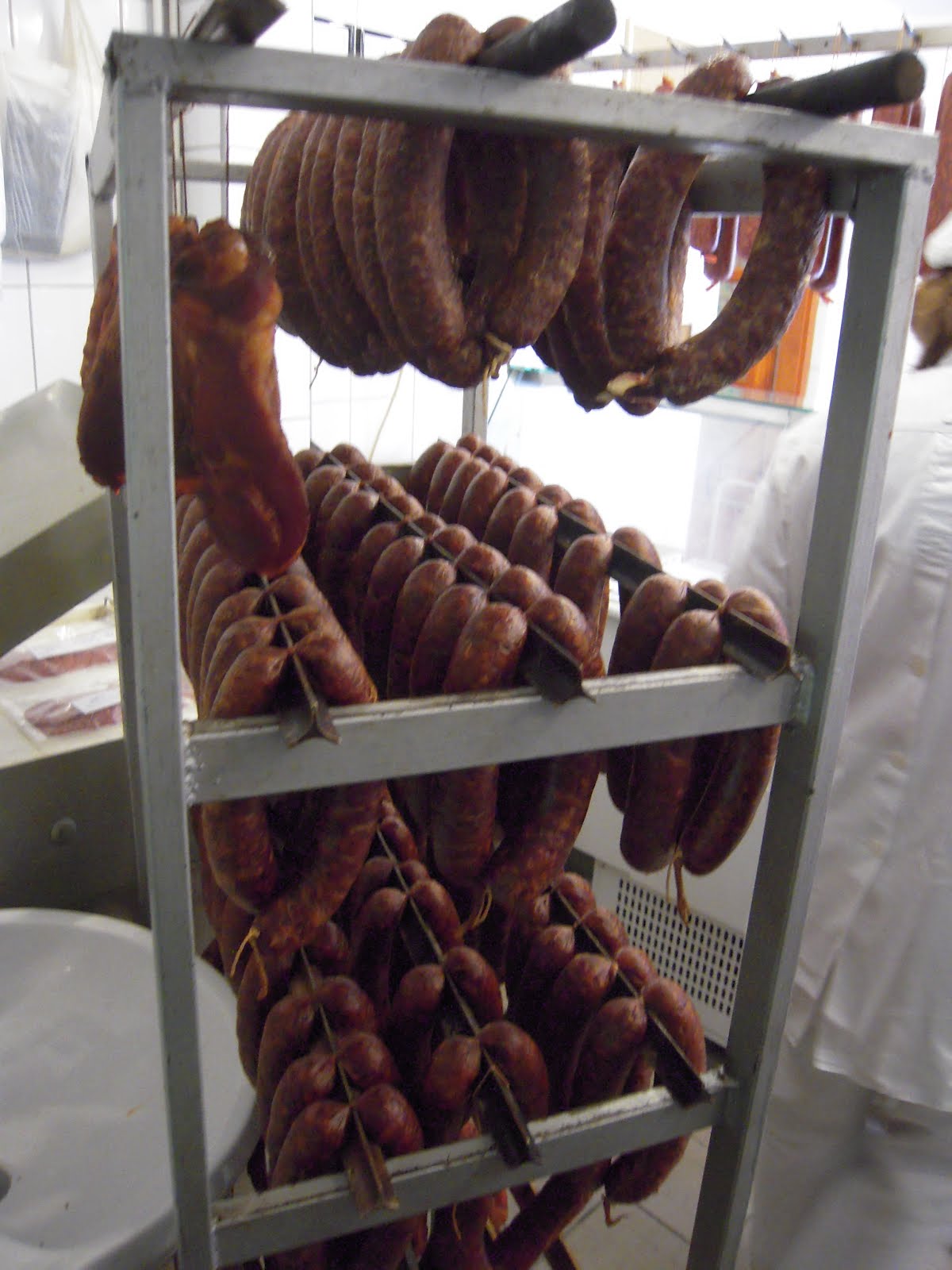
If any place is going to support a real Jewish community, then that place needs to have a good kosher butcher. Eating kosher food is so central to Jewish identity that even secular Jews like myself feel a lot more comfortable knowing that observant Jews can maintain the basic laws that underpin their religious commitment. Eating kosher is all about commitment: you can’t just eat partially kosher. I know a lot of people who avoid pork, or who do not mix meat and milk, or who are “New York”” kosher until they hit a nice plate of take out Chinese food. I have no problems with the shrimp fried noodles or with cheeseburgers, but I find it comforting to know that when the Great Wall of Baal Tsuvah arises on the horizon, there will be an all-beef hot dog waiting for me.The butcher shop is located on Dob utca in the Jewish Ghetto of the 7th district in downtown Budapest. With us was David’s photographer, Landon Nordeman, who knows a thing or three about photographing food (see his photos in the Saveur layout) so part of our mission was to document the processing of meat into kosher sausages and salami. We were there early to await the delivery of the quarter sides of beef from the slaughterhouse. In order to be kosher the animals must be killed by a ritual slaughterer, called the shoychet in Yiddish,who uses a special knife that must be ritually sharpened in order that the animal dies as quickly and painlessly as possible.The shoychet works on site at the cattle yard. Once the meat is delivered the two mashgiachs (kosher butchers) lead a team of trained butchers in taking the animal apart and stripping the layers of unkosher fat and membrane from the carcass. The presence of trained, religious butchers is one of the keys that define how kosher the final product is: it has to be handled by Jews who are kosher themselves. This is locavore cuisine at its best. You want garlic flavor in your salami? No artificial garlic powder here. Hand clean and crush garlic.The end result is some pretty fine sausages, cold cuts, and salamis. I sometimes drop in to buy the kosher frankfurters, simply because being a New Yorker I have to have a hefty beef frank to register “hot dog!” in my brain, and in Hungary beef never gets near the hot dog recipe. The salamis are hung to dry on Tuesdays, and ideally should hang a week to be ready, but they never last that long.
A steady stream of orthodox Jewish travelers, visitors from Israel, and tourists buy the shop out by Friday. If you have ever traveled around Europe with somebody who maintains Jewish dietary laws, you know the drill. They live on canned food, kosher junk food from bags, cookies, hard boiled eggs, and vegan pizza until you come within an hour’s drive of a kosher butcher shop. Then they stock up on smoked sausages, salamis, packed smoked turkey wings.Most of the Dob utca’s customers buy several days worth of cold cuts at a time, packed in cryovac plastic for takeaway. In fact, when I had some Israeli friends living in Budapest they used to sing the praises of our butcher shop for the simple reason that they could buy fresh meat there – most of what they bought in Israel was kosher meat frozen and shipped in from Argentina and the USA.

Saturday, March 17, 2012

Kaddish for My Uncle: Eli Cohen 1931-2012

Some of my best memories of being a little kid, say around four years old, was when my Uncle Eli would drop by at our house in the Bronx to visit. Eli was my Dad’s younger brother. Where my Dad had the gravitas of being the father figure (and was a New York Policeman to boot) my Uncle Eli had all the spark and flame of youth. When he showed up me and my sister would jump up and down and scream “Uncle Eli! Uncle Eli!” He told jokes, he brought gifts, his pockets would be full of candy. And best of all, he walked on his hands. He would empty his pockets (I can hear the jingle of coins and keys as I type this) and do a backflip and walk around upside down on his hands as me and my sister laughed and clapped our hands in delight. When you are four, it simply does not get any better than an Uncle who will walk on his hands for you. My Uncle Eli Cohen, sadly, passed away suddenly two days ago, at the age of 81. Like a lot of the men in my family, he never accepted the idea of retirement as an option, and he was working and active until the day he passed, so his sudden death came as a shock to those who knew him. He leaves my Aunt Norma and three daughters – Gerry, Hillary, and Madeline – behind, along with many grandchildren, as well as my father, who loved his little brother dearly. Eli Cohen leaves a legacy of influence, inspiration, and education behind as well. Uncle Eli was the striver in our family, the brother that valued education and learning and knew that positive reinforcement was the best way to inspire that quality in us kids. He was the Smart Uncle.
As a little kid I remember him perking up as I would try to impress him with some bit of science I had heard on the Mr. Wizard TV show or some new dinosaur factoid I had picked up. He would engage me for hours, making me feel like adults actually cared what I was interested in. He knew how to make you feel that your interest was valuable to him. Eli trained to become a Geologist, and when I was a child he would describe New Jersey’s glacial boulders in a way that sounded like nothing in the world could be more fascinating than poking around ice age bogs in Morris county looking for granite outcroppings. Uncle Eli gave me his love of science, of explanation, of curiosity, and showed me how life is a lot more than it seems on the surface. Every family has its Einstein. Ours was Eli. Eli was also the anchor stone of our extended family’s Jewish life.  It was something he took seriously, and that is one of the strongest things he left as our heritage.
The Sabbath and Jewish holidays were taken seriously at his house, and he was very much the family historian of his generation, with a photographic memory of names and events that stretched back into the 19th century family history in Moldavia. Luckily, he passed on much of the family lore to me and his son in law Peter, but he knew so much more that is now lost. Eli was on the younger side of that generation who were formed by the Great Depression and World War Two, which has come to be known in the USA as the “Great Generation” – having lived through poverty, war, and then rebuilding in the post war era. Eli served his country as a Military policeman in England after the War, where he met my Aunt Norma.
Grandpa Morris Cohen, Aunt Norma Cohen, Gerry Onitskansky, Grandma Betty Cohen, and my Mom at shabbes dinner.
And like many of his generation, he took advantage of the educational opportunities offered under the GI bill at a time which is generally considered to have been the golden age of American education. And he was smart as a whip. He was always getting patents on inventions he would come up with – better mouse traps, a specialized paint brush for painting in corners, improved surveying equipment, you name it, Eli patented it. Eventually he patented and actually produced and marketed an air soled running and walking shoe. Eventually, Eli realized that his knowledge of geology could be adapted to the market for real estate in New Jersey, and when he moved to the Garden State, my father soon followed with us in tow.
The two sharpest cards in the deck: Jack and Eli Cohen.
And when my Dad needed help, my Uncle was there with a job for him – for decades they worked together in the gritty arena of New Jersey industrial real estate.And although Uncle Eli inspired my love of science, it was an unrequited love. I went in the other direction, towards anthropology. Eventually I focused on African and American Indian linguistics, and I learned some West African concepts that are not the usual line of thought for New York Jews, but they apply here. The Yoruba are constantly aware – in act as well as in speech – of their ancestors. When you reach that stage in life where you leave this plane, you family holds a funeral where your life is celebrated. A band is hired, food is catered, the neighborhood shows up for a party to see you to the other side. (This is where the grand tradition of New Orleans Jazz funerals comes from. Your friends don’t only remember your life – they never forget your passing.) Your role is now to be that of an ancestor, an inspiration for the living and a source of continuity between the past, present, and future. And one stays in touch with one’s ancestors through a kind of inner dialogue of memory and fondness (and if you are a Yoruba, a shot of spirits spilled on the ground helps. Spirits for the spirit.) The ancestors are not gone. They are always present. You just have to live your life keeping their spirit alive. Their love and ongoing guidance is their existence. Consider your ancestors, and feel their love. It comes back to you. And we will always love you, Uncle Eli. Legn zol in Gan Eyden.
Around 1938, New York: Aunt Fran, Aunt Gerri, my Dad Jack, Grandma Betty, Uncle Eli Cohen.

Wednesday, February 22, 2012

Dorel Codoban 1944-2012. Master of the Vioara cu Goarne.

Dorel Codoban, the master folk fiddler and instrument builder from the village of Lazuri de Rosia, who was well known as the best builder of the enigmatic Romanian folk violin known as vioara cu goarne, passed away on February 7 at the age of 67. Dorel was more than a simple folk fiddler. He was the center of a cultural scene that represented his region – the Transylvanian region of Bihor – and the unique regional culture that still thrives in the mountains there. Dorel not only built these unique instruments, he played them and encouraged other to play them, and he made sure that if you played one yours would be in working order. He walked around with his coat pockets full of spare resonators, tiny HO size screws, gramophone stylus jacks, ready for anything and everything that could go wrong with a metal fiddle resonator.
Playing at Negreni around 1999.
Dorel was good friend of mine, and I looked forward to meeting him each year at either folk festivals in Hungary or at the sprawling peasant market that convenes every second weekend in October in Negreni. I first met him and his family in 1990, at the Budapest Dance House Festival. His group of Bihor folk dancers had been invited to represent Transylvanian Romanian culture, and I wound up recording some of his music in the basement of a sports stadium at an impromptu session that lasted at least two hours, during which we finished a two liter bottle of his famed home brewed Bihor palinka. Later, when his son-in-law Dan and wife Florica came to Budapest to buy auto parts they would stay at my flat. But the best memories of him were always at the Negreni fair.
Dorel and Florica Codoban.
Dorel and Florica would be busy selling shepherd goods out of the trunk of their car – the coarse sheepskin capes worn by shepherds, thick homespun wool winter coats, and, of course, the vioara cu goarne fiddles that drew the most interest from curious foreigners.Pretty soon a knot of fiddlers would gather around, a drummer would appear, and Dorel would lead the band around the fairgrounds to the beer tents. Vioara cu goarne are extremely loud instruments, and you could hear the thin metallic outpour of sixteenth notes from a half kilometer away. They are also very focused instruments – since the metal resonator is directed into a bugle bell, it is loud only in the direction you point the trumpet at.
Fiddlers habitually swing around while playing, creating a kind of Doppler effect, a natural wah-wah pedal depending on where the bell is aimed at. To counter this, fiddlers often played in pairs or trios, pointing their fiddle horns in different directions. Like other resonator instruments, such as National guitars, they are loud but their sonic profile is extremely hard to mike correctly – they are natural feedback machines near a microphone.  And if you are playing one, the trumpet is pointed away from you, so you can hardly hear what it sounds like when you play it, making it frustrating to record in a studio. I know – I have tried many times. Dorel was well known as a craftsman who dared to take chances designing his fiddles.
Dorel's fiddles. I own the older one pictured here.
At the request of a French musician, he began making fiddles with two horns (Pom Collins actually has one of these monstrosities)and fiddles using mica sheets for the resonator (instead of the usual sheet of beer can stamped flat using one of his specially made brass hammer presses. Some builders also liked to use the sheet metal from energy drink cans, claiming the tone is more energetic .) Dorel was constantly on the lookout for old gramophone Victrolas to scavenge for parts used in the making of the resonator mechanism, as well as old bugles dating from the era when Communist boy scout troops always employed a bugler. No more communists meant no new bugles, so Dorel experimented with sheet metal horns, used horns from camion trucks, and eventually, bugles ordered directly from a factory in China. When I first moved to this part of the world in the late 1980s, I was anxious to collect and learn the local traditions before the modern world swept in and replaced all this homemade traditional music with the commercial barking of globalized pop. Luckily, some of the tradtions are still strong, particularly in Bihor, where the trumpet fiddle has been adopted as the acoustic symbol of the regional obsession with the Oradea football team. Because of this, Youtube videos I have put up of Dorel and other Bihor fiddlers have immense viewer statistics that would make any indie pop band jealous. But with Dorel’s passing I know of only one other reliable maker of vioara cu goarne: Mircea Rostas and his son Adi in Bratca. There are lots of players, to be sure, but fewer makers.One of my fondest memories of Dorel was the trip we took from Negreni to Oradea, with Camille and Dejan in tow. During the trip we played the unsold fiddles that Dorel had brought to the fair as a fairly large group of Gypsies and peasants gathered in the hallway of the train, drinking beer and dancing. As you can tell in the video, we were pretty well though a Pepsi bottle of the good stuff as well. The next morning in Oradea Dorel was tremedously hungover, but that changed the moment he got in his folk costume. Dorel and Florica led the Rosia dance troupe in the annual Bihor folk parade through the streets on their way to a folk festival in one of the city parks.
Florica leading the parade in Oradea
You can see the pride in place that these people have, something Romanians really treasure, a sense of home and hearth and continuity that transcends a single lifetime. Dorel gave us something, he gave his culture something, and he gave his family something very special. He was a good man. And I will remember him everytime I hear those tunes. And Although Dorel has passed on, I will go back, because it is not just music that draws me to Transylvania, but the people. The ones I can proudly call my friends.

Monday, January 23, 2012

Obama and Solinsky. Again.

"My Grandmother, Mrs. Imre Zala, meets Finance Minister Győrgy Matolcsy"
It has been a slow month here in blogland. Hungary has been in the news in a big way, and as long time readers know, I tend to avoid discussions of Hungarian politics in this space. You want to hear my opinions about Hungarian politics? Take me out and buy me a few drinks. You will get an earful. But more to the point, other people do it better - check out my blogroll for Eva Balog's Hungarian Spectrum, or the newer Hungarian Contrarian and Andor Jakab's Blog. Paul Krugman has been examining Hungary's antic relationship with its new constitution via a series excellent posts by Princeton Proffessor of constitutional law Kim Scheppele. The Economist, Financial Times, and Washington Post have also kept our addled one-Party rulers in their sights. When you read the NY Times pieces, the Economist, or any of the other newspapers on stories about hungary, please do not fail to read the comments sections.They are infested by the uniquely Hungarian version of internet troll. Now, Hungary is not the only country that pays PR hacks to troll for stories and 'correct' them in the comment sections. But it is fun to watch the language-challenged Ministry of Propaganda hacks try and take down a Krugman or a Princeton Law prof by labeling them a "post-commie" or attacking them for causing Hungary's serious economic ills. Because in Hungary, propaganda is very big business. FIDESZ, the ruling party, is nothing so much as a gigantic PR machine, driving home its talking points wit a grim determination and a surprising lack of ideology. FIDESZ prospered in opposition due to its skillful use of public relations firms and advisors to drive a wedge into the Hungarian public opinion, dividing every conceivable issue as one of "Us vs. Them." It is all done with mirrors. Here is a secret: public relations is the enemy of democracy, folks.
The Father of Modern Public Relations
It was invented by Edward Bernays, a cousin of Sigmund Freud who emigrated to the US in 1892 from Austria. In his main work "Propaganda" in 1928 Bernays argued that the manipulation of public opinion was a necessary part of democracy: "The conscious and intelligent manipulation of the organized habits and opinions of the masses is an important element in democratic society. Those who manipulate this unseen mechanism of society constitute an invisible government which is the true ruling power of our country. ...We are governed, our minds are molded, our tastes formed, our ideas suggested, largely by men we have never heard of. This is a logical result of the way in which our democratic society is organized." Bernays was behind PR campaigns that convinced the American public that smoking was acceptable for women, that bacon and eggs was a healthy breakfast, that Calvin Coolidge was a nice guy, and that ballet was fun to watch. But beneath it all he was aware of the power that comes from lies. "PR must create news." wrote Bernays in his 1923 book 'Crystalizing Public Opinion'  "in order to appeal to the instincts and fundamental emotions of the public." If you have a few hours and want to spend them watching a highly disturbing BBC documentary about Bernays and his work, I highly recommend the three hour long "Century of the Self" on Youtube. Yes, indeed, it is all done with mirrors... no hay banda...no hay banda...Anyway, the reason I delve this far into politics at all was that I took a peek at my blog statistics and noticed a serious jump in readership in the last few weeks. Was it because of a sudden leap in interest in Hungarian politics? Looking through some of the clicks I found out that it was people searching for the name "Solinsky." Something even more silly and ignorant was to blame. The American Tea Party! Back during the 2008 presidential elections Sarah Palin accused Barak Obama of following the teachings of "Solinsky" - which was her addled attempt at conceptualizing the name of social activist Saul Alinsky. I posted a story about that. Tea Partiers were marching around with bumper stickers printed with the slogan "Solinsky=Communism." Josef Solinsky, however, was the name of a Klezmer violinist who recorded several rare Jewish fiddle pieces on gramophone records back in the pre-World War One era, all of which have become basic to the recreated style of traditional klezmer fiddle.
Not Josef Solinsky, either.
That story died back when Obama won the election and I thought the American looney right wing would never again become riled up with a long deceased Klezmer violinist. But I was wrong. Never underestimate the ability of the wingnut to run with wrong information. For days now, I have been getting up to 500 blog visits a day looking for information on this nefarious "Solinsky." So here he is, in the original: Josef Solinsky on the violin. And given that the US Republican presidential race is narrowing down to a contest between Obama and either a lying billionaire who believes that the Garden of Eden was located in Jackson County Missouri, or a guy who was cheating on his wife while he was trying to have President Clinton impeached for a blow job. I'm sticking with Obama. He's a lot more my style - a fly fisherman. And so is Solinsky, at least style-wise on the fiddle. So if you want to complain about my lack of comment on the growing crisis in Hungary, I hear you. If things hot up I may change that policy. But for now I will stick to what I know. Want to tell me I don't know about Klezmer fiddle? I don't think sooooo....(Oh, and trolls? The delete button anxiously awaits you. But you knew that.)

Thursday, December 15, 2011

Slovakia: Extreme Fly Fishing with Diplomats.

It is Christmas season and cold and wet in Budapest. What better excuse do I need to yearn for the hot days of summer? Yes, when I am not traveling with my band or ferreting out Chinese groceries in Budapest, I do like a vacation sometimes, preferably in an exotic locale. And what could possibly be more exotic than… Slovakia! It has all the necessary ingredients I require of a strange and enlightening holiday destination. Bizarre accordion music!
A language that is absolutely beyond my powers of comprehension! A cuisine that is based on the theory that food should all be one color (white!) And most important: pristine mountains covered in forests and rivers filled with trout. Yes, I am a trout fisherman. Hungary is not a paradise for trout fishing, although it is a Mecca for European fishermen who travel here hunting for its legendary monster sized carp. Yes, there are a few places one can find trout streams in Hungary – the Garadna and Szinva near Miskolc come to mind, although the Szinva suffers an almost annual indignity as a dumping ground for photographic chemicals producing spectacular fish kills that drift into the downtown area of Miskolc and stink up the business district. The Josva stream near Aggtelek actually supports a wild trout population, but since it is located in a National Park zone, fisheries experts are not allowed to develop it as a proper sport fishery. But the trout fishing is better in the neighboring countries.
Release me! Please! Release me!
Slovenia has some of the best trout fishing in Europe, but the license fees are steep and it is not exactly close to Budapest. That leaves Slovakia, which offers reasonable fees for non-resident fishing permits and good, cheap accommodation in the off season ski regions in the mountains. Even without a car I can take a train to the small town of Liptovsky Hradok and have access to two excellent mountain rivers, the Bela and the Vah. But luckily, I have a fishing buddy, and he has a driver’s license, and at least once a year we rent a car and head north to be humbled and shamed by a creature with no arms and legs and a brain the size of a lentil. Claude has been met in these pages before. Once an iconoclastic punk rocker he has transformed into an international diplomat and campaigner for Human Rights, and is now married and raising a pair of beautiful and clever daughters. He has put aside the foolishness of youth, and taken up the foolishness of middle age. Fishing for trout. I mean, usually Claude goes out to fight The Good Fight armored in a three piece suit with a silk tie in a big Windsor knot.
Come to Papa!
On fishing days Claude looks like this. He walks around in this outfit entirely without any sense of irony or shame. He claims it "keeps him dry" even as we watch the water seeping into his pants. The first time we went fishing in Slovakia, his wife Mina and Fumie took one look at us in our rubber pants and hit the floor howling with laughter. While Claude goes for the full chest wader “Michelin Man” look, I prefer hip waders, and until it was pointed out to me I never considered that they made me look like a slightly chubby Chippendale Dancer.
 World's only Judeo-Romani Fly Fishing Team
Another issue is “catch and release.” After standing in a cold alpine stream with ice water lapping at our family jewels for hours, I don’t really want to kill the fish and take it home and eat it. I want a hot soup, or in Slovakia, at least, something starchy and white with sheep cheese and bacon bits on top. Halushky is probably the Slovak national dish. Potato dumplings with sheep cheese and bacon bits. Eat it and you will never be hungry again. It doesn't sound like much, but it is one of Europe's great foods. You can fnd it in literally every resturant in the land, but it is best when you get it a cheap lunch stops attracting lumberjacks and truck drivers. Thousands of Slovak truck drivers can't be wrong.
There is no such thing as "lo-carb" in Slovakia.
Wild trout are so beautiful, and as we fly fishermen say “too valuable to only be caught once.” Mina, however, comes from a Roma family in Romania, and Fumie comes from the fresh fish mecca of Tokyo, so they were no laughing mood when they informed us that anything we caught was to be killed and considered as food, no argument, were we crazy, and why the hell were we fishing, anyway? We nodded dumbly (never argue with women armed with fly rods!) and we released our fish in secret. On arriving in Liptovsky Hradok, we checked out the river Vah and decided that it was too high to fish. That left the alpine Bela, which flows into the Vah from the High Tatras. And we needed to get fishing licenses. In Slovakia this is never easy – you need to have a state permit and then a local day permit to fish a specific trout stream. Nobody ever knows where to get both, although local fishing tackle shops are a good bet if you can find one. In Hradok you need to go to the paper store next to the hotel across from the train station.
Bravely standing up to the EU.
The assistant there informed us that we needed to pay double the local rate for a day permit (a regulation that we didn’t encounter elsewhere in Slovakia) and Claude – who has a degree in law and can often be found prowling the halls of the European Parliament in Brussels - calmly explained that under EU law, administrative fees such as fishing permits can no longer allow discrimination between EU passport holders (such as both of us.) Claude told her this in his fluent and formal Czech learned from years teaching in Prague. The woman sputtered something and turned red. Nothing seems to enrage a Slovak store clerk more than being lectured in EU law in Czech by a foreigner. The breakup of Czechoslovakia wasn’t so long ago and the languages are still mutually intelligible, but she wasn’t having it. Claude immediately sensed her frustration and – in the calm and monotonous voice that comprises the ninja arsenal of EU Human Rights lawyers – began to prod her into conniptions by reciting a long list of EU laws and regulations backing up his preliminary objection. It was getting late. “Let’s just pay the fee and go fishing, Claude.” “No. It is a matter of principle. She has no right under the EU laws to double charge for a foreigner’s permit.” I went outside for a smoke. Twenty minutes later Claude emerged from the shop, muttering about bringing the case of the Stubborn Paper Shop Fishing Permit to the European Courts. I just wanted to get on the water. Now, here is a basic tip for fly fishermen: always ask the locals where to go.
Of course, we did no such thing. We drove up the Bela valley marveling at the scenery and the fact that here seemed to be absolutely no access roads to the stream itself. Where there was it was only accessible by rappelling down limestone cliffs where one false move would cost you your life. This never seems to bother Claude, who approaches fly fishing as an extreme sport combining the best features of base jumping with the thrill of deep sea free diving. I come from a more Isaac Walton, “pastoral pleasures” school of fly fishing, so we continued driving until we finally found a spot near a local holiday camp, so we could fish while watching fat nude Germans splashing in the icy waters across from us. As always, Claude found a classic pool and was soon onto some trout. After a while he graciously moved on and Fumie took her shot at the pool, and again, trout.
Sushi. Step number one. Catch it.
Fumie is not a “by the book” angler. She doesn’t care about careful casting, or spooking the fish, or having a perfectly straight leader. She only uses two fly patterns: the Red Tag – because she caught her first trout using one, and a ridiculous chimera of a beadhead nymph she calls “The Dancing Queen” because I tie them for her in colors usually reserved for inking “Hello Kitty” illustrations. It makes fly selection easier for her and, in terms of fish caught; it beats the rubber pants off of me. So, at the end of day one, everybody goes home happy and I have caught absolutely zip. The next day we tried the Bela closer to the town of Hradok, but the summer temperature had put the fish into slow mode and we were all without any of what fishermen call “luck.” We watched one local took some fish using the specialized form of fly fishing known as “Czech nymphing.” This consists of tying about three heavy sinking nymph flies to a long nylon leader, wading out to the middle of the stream where the current is constantly threatening to drown you, and then flailing a short line upstream as if whipping a team of intransigent oxen. Yes it seems to catch fish. No it doesn’t look like a lot of fun.
I dare you to release me!
Having been taught a lesson by the wily trout of the Bela, we decided to move on to more familiar ground. The Revuca, flowing between Donovaly and Ruzemberok, has been our home stream for the last few years. Only three hours drive from Budapest, it is a smaller woodland stream where we have all caught some beautiful trout and grayling. And we knew where to get our day permits. Like a lot of Slovak fishing licensors, it is located in a private home and handled by a little old lady who speaks only Slovak and thinks that all Japanese people are the same person. Unlike the wild rapids of the alpine Bela, the Revuca is gentler, full of pools and holes that we have fished many times before. We never get skunked on the Revuca. Almost never. This day, however, started off difficult. No trout. At least for me, no trout. Claude and Fumie caught and released a few small ones, but I had nothing and we had to get back to Budapest by evening so we couldn’t stay until the evening when stream fish usually start hitting at the end of a hot day. After wasting several hours being cruelly taunted by a school of anti-Semitic grayling in one of the downstream holes that had always given up some fish in previous trips, I accepted defeat and was hiking back toward the car when i heard Fumie and Claude shouting. They had fish.
The exciting denouement of Cahn's ballet "The Fingerling"
Claude told me to lose my nymphs and tie on a dry fly, so I picked out a deer hair caddish fly that I could easily see in the shallow rapids, waded out, and started casting. Fumie and Claude were catching rainbow trout on almost every other cast and soon so was I. This was great. And then… I get my fly line caught in a tree. No, problem. I know how to deal with this. A gentle tug and… my rod tip breaks. Clean in the middle. After sitting on a rock in the middle of the stream and fuming while watching Fumie and Claude reel in fish after fish, I re-strung my rod without the tip and began casting with the stumpy, unresponsive stick I was left with. And yes, I caught trout. And yes, it was fun – catching trout on dry flies is always fun, even if they seem to be small stocked rainbow trout who don’t know the difference between a size 14 deer hair caddis fly and trout farm puppy chow. And yes – I have a spare rod, but it was home in Budapest. Where else would a serial fly rod murderer like myself want to keep his spare fly rod, right? And yes, I actually like the cheesy starchy halushky dumplings that are served all over Slovakia, especially after a year of a very lo-carb eating regimen, and I like some of the other stuff that Slovaks produce as well and I like just being in a place called Slovakia.
And now it is winter. I have a new fly tying vise. It is time to tie a few dozen flies and wait for next year’s Slovakian trout trip. I can hear the trout mocking me in Slovak even now. I never learn. 

Friday, December 02, 2011

MaramureÅŸ: The Fashion Shoot!

Last spring I managed to get to one of my favorite places in Europe – the MaramureÅŸ region in northern Romania – twice in the space of a month. The first trip was in May, part of a project involving my ongoing folk music research. The second trip was even more interesting. As soon as I returned to Budapest I was contacted by Nigel, a professional photographer who had contracted with an American fashion company to arrange a photo shoot in MaramureÅŸ. He was already occupied with a job elsewhere, so could I return to MaramureÅŸ to do some preliminary location scouting, shoot some photos, and set up some contacts to prepare for their upcoming fashion catalog shoot for the USA based clothing and design company Anthroplogie, which situates its catalogue shoots in various exotic locales. The next shoot chosen was in MaramureÅŸ, which the art directors had seen while browsing for “exotic” locations on the internet. Of course, with me being the anti-matter version of a fashionista, I had no idea who or what this was all about, had never heard of Anthropologie (spelled with a ‘y’ that was what I spent a decade studying at University and is a pretty good explanation for why I can speak a bit of Zulu) And, Nigel added, it was a fully paid gig: travel, expenses, honorarium. Even though I had just returned from ten days on the road in Transylvania I was all over that like sheep cheese on mamaliga. First I had to get there. I don’t drive. Luckily, my old buddy Gabor does, and as a Hungarian theater musician he is/was/will always be severely underemployed and has way too much idle time on his hands, so he was happy to jump at the chance to act as paid chauffeur in his 1985 Mazda – an ugly old little machine, but tough as a billy goat and it did run.And I was able to take Fumie along – an added asset since we would be visiting our friends in the archly traditional village of Ieud, where Fumie began learning to speak Romanian back in 2001 from our host Nitsa, an amazingly strong and independent village woman who is a living encyclopedia of local Romanian folklore and a pillar of her local Greco-Orthodox church. There is nothing MaramureÅŸ villagers love more than a Japanese girl who can speak basic Romanian with a MaramureÅŸ dialect.The fashion shoot folks were going to need some local help as a fixer for their work, and Nitsa – one of the most beloved and respected figures in the village hierarchy - was just the ticket to do it. And, best of all, she was well compensated for her time and trouble. That was in June, and in September the catalog came out online.I had never heard about Anthroplogie clothing, although asking around it seems to be well known and quite trendy (and expensive) but it was great seeing our friends in MaramureÅŸ included in some of the photos alongside towering Danish models draped in upscale fashions. Of course, the fashion models and photo shoot staff stayed in the city of Sighet at the swank Hotel MarmaÅ£ia with all the mod cons.I stayed in that hotel back in 1997, when it was a classic post-communist dump with stained furniture and odd wooden chandeliers in classic Ceaucescu hotel style. Today it is wall to wall wifi and quality capuccino and cable TV in every room. I shouldn't really be surprised. So many travel writers have made a living stereotyping Romania as Europe's backwater for so long that when you find a five star hotel in a small town it still elicits a sense of surprise. But I still prefer village life. While we were in Ieud, however, we stayed with our friends in the village. On the first morning, Nitsa invited us to a ceremony at the wooden church across the street. It was the seventh month after the burial one of the villagers, and a memorial ceremony was held in the church.Afterwards, everybody gathered in the churchyard and was given cake and a shot of home brewed horinca brandy, and then all marched down to the village hall for the feast. It was around noon, but already the "paharnic" - the bottle bearers - were in action serving drinks. What was amazing was that as they moved around the tables serving a glass of 110 proof plum brandy to groups of three or four people, they would also take a drink as a toast, yet we never saw any of them get noticeably tipsy. In Ieud people drink a lot for ceremonial situations, but we rarely saw anybody drunk. Which is not the case in all villages.Nitsa pulled us in and we were seated for a lunch of meatball ciorba and sarmale stuffed cabbage. These are different from the stuffed cabbage we have in Hungary. Smaller rolls, almost no paprika to speak of, more rice and less meat, and flavored with dill and thyme. There is even the vegetarian version, the lenten sarmale de post made with vegetables and rice which wins my vote for best vegetarian food in the world (in a close race with pizza and felaful.) Romanians eat a lot of sarmale and never get tired of it. It is the perfect food.These funeral anniversary feasts are held quite often in the village and within a few days we were invited again, on a day when Nitsa was part of the catering and cooking brigade who donate their time and services as part of their duty to their church. While the crew was doing their shoot they also did some shooting at musician Ion Pop's home in Hoteni. When their fixer, our Transylvanian-from-Budapest friend Andrea called him up to set up a meeting he told her "Come by any time, I'm always at home. I'm a peasant from Monday to Friday. I'm a musician only on weekends."