Thursday, July 25, 2013

Smithsonian Folklife Festival: Endangered Language Speakers Just Want to Have Fun.

Yiddish fiddler and folklorist Michael Alpert described participating in the 2013 Smithsonian Folklife Festival as  being in "Bob Heaven" and he wasn't far off the mark. Aside from the Hungarian folk tradition focus, the festival also featured areas on Black American dress and adornment in "The Will to Adorn" theme area, and on endangered language groups in the "One World, Many Voices" focus of the festival. Having worked with language revival linguistics for many years, it was an amazing experience to wake up and have breakfast with some of the last 20 speakers of Bolivian Kallawaya languge,
Kallawaya women
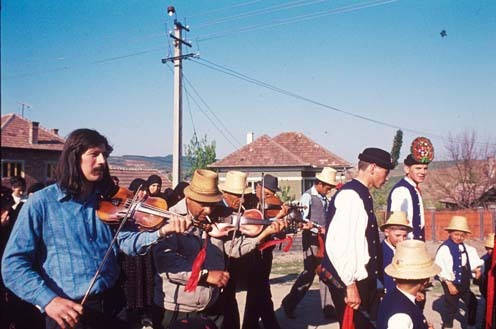
or with a dozen of the speakers of Passamaquoddy, a Wabanaki language from Maine, while comparing breakfast choices among several groups of native peoples from Columbia (they like fruit for breakfast) and the Transylvanians (who decided that the low fat skinless turkey sausages were "breakfast mici.") Istvan Jambor "Dumnezo" and Dezso neni often shared a table with me (yes, he is the fiddler who inspired the name of this blog.
The original "Dumnezo"
It means "The Lord" in Romanian, and aptly describes his job as bandleader in Szaszcsavas: he tells you what to do, and you do it.) Then everybody heads out to the air conditioned shuttle buses to get to the festival site on the national Mall. Washington DC was in the midst of a heat wave, which meant nothing to the Waayu indians from Columbia, who were always dressed for the heat.
How to beat the heat, Waayu style.
The Hungarians tended to wilt a bit in the heat, not surprising given that many were dressed in heavy embroidery or even wool shepherds cloaks, but luckily the festival set out iced water and huge fans backstage in most of the participant areas. In one program, the Will To Adorn area sent over a designer of African American ladies' hats to discuss fashion. Her talk was as much a carefully honed sales pitch as folkloric event: "Ladies, this hat is called a fascinator... you can wear it anywhere... to church, to a social... it works fabulously in any color... wear it everywhere and everyone will take notice!" to which her panel companion, a maker of Hungarian shepherd hats balanced the discussion with "I make hats. My father made hats. My Uncle makes hats. My Grandfather made hats..."
Not actually a fascinator.
Among the groups I found the most engaging were the Garifuna, also known as the Black Caribs. Two emigrant groups of Garifuna from the Bronx and from LA took part in the festival. The Garifuna are the descendants of Africans who were either shipwrecked or escaped to the Island of Saint Vincent in the 1600s, merging with the indigenous Carib people and adopting much of their language and culture, while retaining elements of African culture, such drumming and religion.
Garifuna drummers.
They were transported by the British in the late 1780s to the coast of Central America where they have settlements in Honduras, Belize, and Guatemala, from whence they have emigrated to North American cities for work. Most are trilingual in Garifuna, English, and Spanish, and being on the bus with these guys was a blast: imagine being on a bus full of Jamaicans who suddenly speak Arawak (Garifuna is a mixed language with a predominance of Arawak vocabulary, since Carib was the men's language and Arawak the women's. Ruben Reyes, a Garifuna language activist, spent a lot of time with the Columbian Arhuacos making comparative Arawak word lists and even gave me a lesson in basic Garifuna verb morphology.
Garifuna party band.
Like I said: Bob heaven.) Among the endangered language groups who were represented at the festival were native American groups like the Wabanaki, represented by mostly Passamaquoddy people from Sipayik (Pleasant Point, Maine.) Passamaquoddy was at the point where the language was still spoken by the older generation but was not being learned by children, until a project was begun to introduce immersion schooling and produce a Wabanaki dictionary. The language is now beginning to produce new competent speakers among the younger generation who will  have the opportunity to learn from those who actually grew up in the language.
Blanche Sockbasin, Passamaquody speaker and basket weaver.
While I have done a lot of reading on Eastern Algonkian languages, until I sat on a bus surrounded by the Passamaquoddy I had never heard it spoken. Another language presented was the Siletz Dee-ni language of Oregon and northern California. When the Siletz tribe's reservation and federal Indian status was terminated by the US government, members of the community worked to preserve what they could of its language and culture. With recognition by the BIA, they began a language revival program which is beginning to produce a new generation of competent speakers.
Siletz Dee-ni members
Since there was no generation of older speakers to mentor them, however, the younger users of Siletz Dee-ni found new contexts in which to communicate in their language: they begin to send text messages to each other in it. Closer to (my) home, Yiddish language and culture was represented by the An-Ski Ensemble from New York, consisting of my good friends Rete Rushevsky, Ethel Raim (both of the New York Center for Traditional Music and Dance) Michael Alpert and Jake Shulman-Ment, presenting an older klezmer tradition alongside Yiddish song.
An-Sky Ensemble
I did one concert with them as a cross-program with the Hungarian program, but this is a group that needs to record a CD as soon as possible. you rarely hear Yiddish music done as well in an informal context, and with such verve and such yikhes (look it up) as this. Possibly the most successful case of language renewal among american indigenous people is that of the Hawaiians. Hawaiian suffered greatly during the 20th century, until a generation ago it was barely spoken in the home by any but the older generation, and the only place still raising children in the Hawaiian language was on the restricted island of Ni'ihau and nearby Kaua'i.
Hawaiian party at the hotel
By setting up language nest immersion schools while there were still young speakers, Hawaiian language activists have managed to arrest the loss of the language for at least another generation, but, as educator and musician Kalehua Krug told me "there are only about 50 households in all that speak Hawaiian every day all the time. That's not much." Among other things, Krug was able to show me a few tips on how to play slack key guitar riffs on the ukulele.
Kalehua Krug
By early evening everybody headed back to the hotel and the daily after party that began at 9 and ran until... dawn in most cases. The Hungarians tended to open the evenings with a dance house, which often brought local Hungarians and folkies along to dance and chat.
Pubi and Florin play Palatka
The Folk Music society of Washington DC sponsored the parties, offering free snacks and cheap beer - much welcome in a Marriott hotel with hotel priced beer. On the second day, while the Hungarians were winding down, the Garifuna showed up, borrowed a drum from the Mexican Zapotecs, and set the room on fire with a long set of drumming and singing. It drew the Hungarians in to dance with the African Maroons from Palenque, had the Zapotec flute players jamming along, and sure enough the ultimate party hounds - the Kalmyk Mongol women - joined in doing their birdlike dancing to the beat.
Palenque meets Garifuna

Friday, July 19, 2013

Béla Halmos: 1946 - 2013.

Béla Halmos, one of the founding fathers of the Hungarian folk music revival movement, passed away at his home in Budapest yesterday. He was 68. Béla was one of my great friends and a role model as I was growing up. He was, in fact, one of the main reasons I live in Hungary today.
In 1972 I was staying at my Uncle's house in Veszprém when I saw a TV documentary following two long haired but serious young Hungarians as they went from village to village in Hungary sticking microphones into old people's faces, collecting folk music, and then attempting to reproduce it themselves. I was fascinated, and so my uncle began taking me to friends of his who played the fiddle or the Hungarian zither. Eventually my uncle bought me a cheap Czech fiddle (which is hanging on the wall behind me as I type) and started me on my lifelong path to making screaming East European fiddle music. That TV show was a window on the very beginning of the Dance House movement.
At the original dance house, Kossuth Klub, Zuglo, 1972
Eventually, I got to meet Béla Halmos in 1986 in Boston Massachusetts, when Beth Cohen and her all Woman Hungarian folk band brought him over to play for Dance workshops. The serious unsmiling guy in the film turned out to be a rather jolly fellow with a taste for Chinese and Japanese food and a wonderfully competent, if quirky, command of English. Béla Halmos took Hungarian musical culture out of the academic and folkloristic realm and put it back into the hands of everyday people, especially young people, and set an example that would grow into a movement. That movement – beginning with 1970s communist era Hungarian youth in bad hippie haircuts – grew into a unifying social force for Hungarians called the Tanchaz, or Dance House movement. Dance House put the fun back into folk dancing, put fiddles back in the hands of teen musicians, returned the csárdás  to its place as a sexy dance for young Hungarians, and helped Hungarians retain their unique cultural identity at a time when the prevailing Communist ideology still strove for a Stalinoid cultural sameness in the identity of the World Proletariat. What Béla Halmos did was simply genius: he learned to play the fiddle in Hungarian village style. And then he played. A lot. Everywhere.
Fiddling in the bar at the Fono Club
Béla bácsi (Uncle Béla) was as central to the shift in consciousness that led to the fall of Communism as any samizdat publisher or Radio Free Europe broadcaster. Bela helped shift a cultural viewpoint, and he did it simply by saying “This is how we sound.” And then he would pick up a fiddle and show you. I mentioned Bela a couple of posts ago when he was playing a set of dances from Szék at the Dance House Day celebration at Franz Liszt Sq. in Pest in June. While at the Smithsonian Folklife Festival I asked several organizers there “Why isn't Béla bácsi here?” since anything celebrating Dance House culture on a large scale could have included the participation of one of its founders and key popularizers. Béla Halmos was (with Ferenc Sebő) the founder of the first of the Hungarian Folk revival band back in the early 1970s, the Sebo-Halmos band. As such, he had a stature in the scene equivalent to, say, that of a Pete Seeger in the USA or a Ewan MacColl in the UK as the Father of the Folk Scene. Trained in classical violin and studying to be an engineer, Halmos met Sebő as students taking part in a folk song competition around 1969. Rejecting the over-arranged restaurant Gypsy music style of the folklore troupes, Sebő and Halmos wanted to sound like the village musicians they had heard on field recordings of folk music recorded by ethnomusicologists like Bartók and Lajtha.
Playing with Icsan in Szek, around 1973
They sought out the dance ethnographer Gyorgy Martin who shared his huge collection of original recordings of Transylvanian folk bands and steered them in the right direction of getting on a train and going to the “pure source” of the village musicians themselves in Transylvania, where the older Hungarian traditions still maintain their context in rural villages. Béla found his sound in the village of Szek, in the north Transylvanian plain, and his mentor was Adám István, named “Icsán” - a hard-boiled old village Gypsy fiddler whose repertoire and fiddle style were absorbed by Béla to became the core of the Dance House revival.
"Icsan"
While the Dance House movement was “tolerated” during the 1980s, after 1990 Béla and other Dance House researchers worked to make the folk dance movement a part of the education system and bring it to a wider audience. Béla produced a long running TV series on Hungarian folk music as well as taking a position at the Hungarian Academy of Sciences as a musicologist and archivist, all the while teaching workshops and performing concerts and dances.He preferred the simple joys of a weekend night playing fiddle for a room full of sweaty dancers to almost anything – except maybe a few strong shots of palinka after the set, as long as somebody had the foresight to bring along some spicy salami or bacon to settle the stomach. Which I always didBéla Halmos' influence will far out shadow the sorrow at his passing: he leaves behind thousands of active musicians, singers, and dancers all over the world whose love of the arcane village band sounds of Transylvania is directly the result of his life's work. Béla was one of the strongest supporters of what we were doing in Di Naye Kapelye, and included us in several of his music series and TV projects. He had a broad, relativistic modern Anthropologists' view of the world, not the provincial East European “folklore” vision so many still profess. He was not a ranting nationalist, but he loved Hungarian culture while valuing the multicultural aspects of life in the Carpathian basin. He was a cultural treasure as well as a cultural activist, a real Renaissance man. But most of all, he was a nice guy. A wonderfully nice guy. A good friend. He knew what was good. As his mentor, Icsán the fiddler used to say "Ami jó, az jó." What is good , is good. Bela simply did good work.

He played a dance in Budapest like he belonged in a village in the Mezőség. He was a good teacher, a good man. We will miss him, but we will feel his influence for many, many years to come whenever a fiddle comes out of a case, and a Hungarian tune comes out of a fiddle. Nyugodj békében Béla!

Monday, July 15, 2013

Hungary at the 2013 Smithsonian Folklife Festival, Washington DC.

Women from Szék meet Garifuna (Black Carib) women.
The 2013 Smithsonian Folklife Festival just ended, and I was proud to have been a participant in the Hungarian focus area of the festival, representing Jewish folk music traditions from Hungary. I often balk at labeling what I do as "Klezmer" but then again... that is what people expect of Ashkenazic traditional music, so Klezmer they got. I didn't have my own band - Di Naye Kapelye - there with me, but I worked out a couple of sets with Pal Istvan "Szalonna" (the word means 'bacon' - Istvan's nickname. Jewish music always goes better with bacon!) and his band, who are as perfect a Hungarian folk band as it can get. Szalonna comes from the Karpatalja / West Ukraine town of Visk, and so he is a natural master of the style of music played in the Szatmar region, so I chose a repertoire leaning heavy on the Satmar and Vizhnitz Hasidic traditions, which borrow a lot of motifs from the local Hungarian folk styles and allowed the members of Szalonna's band - including the fearsome cimbalom virtuoso Sandor Urmos - to really settle into the tunes and let loose with some great solos and ensemble improv. We did a few side gigs: played the Kennedy Center on July 4th and did the Katzen Arts Center as a special concert for the Hungarian Embassy. We even got to meet Hungary's ambassador to the USA, György Szapáry. He's the well dressed chap standing next to me in the photo below. 
Jews and Bacon. Always a treat. 
A gig is a gig, though, and this one meant that we were missing dinner. Thanks to Festival Transport manager /driver Andrew Bautista, a half hour after this pic was taken we were all chowing down on Five Guys hamburgers. Does life get better? And while I couldn't have my whole band there, Jake Shulman-Ment was on hand to help out - a satellite member of Di Nayes and - now that he lives in the USA - a key member of the An-ski Ensemble which was representing Yiddish music in the Endangered Languages focus of the Festival. After the first days the hundred or so Hungarians who took part in the Folklife Festival all became something of a small community.
Kun Goulash of the Immortals!
The Csontos family from Karcag in the Kun region of the Hungarian plains demonstrated their award winning sheep goulash every other day, and while visitors could not taste any of the traditional foods prepared (due to strict rules by the National Park Service which controls the National Mall in DC) we particpants would wait behind the stage to wolf the sheep stew down. If you missed the goulash, there was always something from Kollar Ilona Neni and Bepe from the Voivodina town of Kishegyes. Ilona neni is a master of both Bacska cuisine and of salty ways to describe the searing, muggy DC heat (usually involving bits of dog anatomy.)
Apricot jam and pickles with Ilona Neni and Bepe!
The food demonstrations were probably the most popular event - it drew crowds of people lusting for a forbidden taste of paprika cake, puliszka with cheese, or slambuc, Hungary's answer to lasagna. Since most of the Hungarians chose not to take the evening dinner catered by our Hotel (in order to save by pocketing the per diem instead) this was also the area where everybody in the Magyar contingent hovered about waiting to eat "normal" Hungarian food, albeit food prepared by some of the best regional cooks in the Carpathian basin.) Personally, I think Transylvanian cheese puliszka is the perfect food for a hot summer day. Thanks Tekla!
Boot-slapping fun, 8 hours a day in the 93 degree heat.
While the main Danubius stage featured folk dance 
ensembles performing very un-Smithsonian folk dance choreographies while wearing layers of embroidered wool in the DC heat, there was a lot of music happening all across the Hungarian Heritage area. Anthropologist Mary Taylor managed the Heritage tent with an almost supernatural sense of 'cool' through the chaos of schedule changes and self-destructing bass strings. You couldn't tune up without drawing a crowd.
Duda
Several of Hungary's best duda bagpipe players were on hand, but we definitely missed having Ferenc Tobak there - he lives in Fort Bragg, California and is, beyond a doubt, America's best maker and player of the Hungarian Duda, and has beena major force in keeping Hungarian heritage alive in the USA since he moved here in the early 1990s (right after making me a duda which I still have, although - in a gesture of mercy to my apartment neighbors in Zuglo - I haven't actively played bagpipe in years.) The best part of the festival was what visitors didn't see: the after parties at our Hotel in Arlington, Virginia. I post more on that very soon.


Tuesday, June 18, 2013

Fiddling up a Storm in Budapest

It has been a couple of years since I was last seen in the United States, but tomorrow I am boarding a plane out of Budapest and heading to New York City. Hungary will be the featured national culture at this year's Smithsonian Folklife Festival in Washington DC from June 26 to July 7, and I have been asked to perform some Hungarian Jewish and Carpathian Jewish repertoire. My band, Di Naye Kapelye, will not be travelling with me, however, and I am looking forward to doing some concerts with the capable band of violinist István Pál, also known as Szalonna - the Hungarian word for 'bacon." Here is your chance to catch a concert of Jewish music with a band named after a tasty smoked pork product! (This will not go over well in Williamsburg or Boro Park, I can assure you.) Among the other musicians going are the Tukros Band and three of Transylvania's best Gypsy fiddlers: Istvan "Kis Csipas" Varga from the Kalotaszeg region, Jambor Istvan (the original 'Dumnezeu') from Szaszcsavas, and Florin Codoba from Palatka. 
Florin was in Budapest last week for some concerts and played a dance at the Picasso Point Bar on Hajos utca in the sixth district. Spring tends to bring out the best in music in Budapest, and after catching Florin;s set at the Picasso Point, we biked over to the New Godor Klub in Kiraly utca to catch some of the Athe Sam Roma festival.  
These guys were busy playing a burning Gypsy-Ska-Jazz set to the crowd. The next day it was over to the Gondozo Kert bar in the ninth district for a Moldavian tanchaz with Jam de Strune ("String jam" in Romanian) who play very hard core old time western Moldavian music on fiddles and koboz lutes.  
The session is on every Sunday, and attracts a small but dedicated crowd of dancers. Musicians are encouraged to play in the older style of Moldavian Csango music - no jazz chords, no chromatic sax runs, just foot stomping fun music. Last month was the 40th anniversary of the first tanchaz - folk dance house - and a festival was held to celebrate on Ferenc Liszt ter in Pest. I caught one of the last sets, featuring Bela Halmos on fiddle.  
Bela is one of the founding fathers of the Hungarian folk music revival movement, and still manages to get out to a lot of tanchaz events and fiddle late into the night alongside the younger generation. In other notable events, the Danube flooded at record levels this year, and came dangerously close to overflowing its upper banks and making downtown Budapest look like a swimming pool.  
This was the scene on Saturday night when the river was at its highest level - that is the stairway leading down to the river, usually about eight feet down below this level. In other  news, it has started to become hard to find a pack of cigarettes in Budapest, or at least harder, especially for some of the more widespread brands.  Here is an about-to-be-opened "National Tobacco Shop" at Kalvaria ter. 
Starting in July, all cigarettes will be sold by the newly 
re-nationalized government cigarette shops. All concessions for the shops seem to have been given only to supporters of the ruling coalition party, so you can imagine a lot of small businesses are not happy about this at all.  Below: Drinks, No Tobacco, Candies.
The word "scam" has been flying around a lot concerning the whole deal, and rather than dwell on the consequences I will simply congratulate myself for having made it through one year as a non-smoker. I gave up cigarettes last June after spending a weekend chain smoking in the 
company of Taraf des Haidouks, the Tecso Band, and the Kocani Orkestra at the Tilburg Gypsy Festival. By the time I got home I was pretty burned out on butts. And now I can pedal a bike uphill at full blast without effort and ... I noticed that almost everything smells bad. I'll be posting a bit more often during the summer: I always do when I am in the USA. Next  stop: The Fish Market in Washington DC with Transylvania's best Gypsy fiddlers!

Saturday, April 27, 2013

Hungarian Spring: The Morel Dilemna

Sometimes you get the bear...
Global warming, Greenland's ice caps melting... whatever the reason this winter was long and dreary in Hungary. Spring hit only a week ago and already it is shorts and t-shirt season and - that rarest of sights - Hungarians walking sprightly in the streets, smiles on their faces not a complaint to be heard, enjoying the long awaited spring days that we thought might never arrive. Nowhere is this more apparent than in our local market at Bosnyak ter. Usually the dire epicenter of Magyar culinary pessimism, the Bosnyak ter market undergoes a transformation with the coming of spring as shoppers greet the arrival of fresh fruit and vegetables and revel in watching the prices drop before their eyes. (The fresh veg? They will probably stew and freeze or pickle it. The shoppers at Bosnyak ter are not a salad eating folk. Far from it. Fresh is not a necessary value attribute for vegetables around here.)
And sometimes the bear gets you...
Ramps - wild onions called medve hagyma or 'bear onions' in Hungarian" dropped from FT 900 ($4.00 USD) to Ft 150 (85 cents) in two weeks. And last week we hit the motherload of market delicacies: fresh wild morels. Called kucsma gomba in Hungarian (kucsma is a squat fur hat made from fetal lamb's pelts) morels are among the very first mushrooms that appear in the spring, and the season is usually very short - two weeks at most. We saw these for sale on the tables of the mushroom sellers - people who pick wild mushrooms, then bring them to the market where they are checked by official mushroom inspectors at a truck parked at the market entrance. There is very little chance of buying a poison mushroom in a Hungarian market. In Transylvania, where wild mushrooms are - or were - even more commonly eaten, people used to buy in open markets from trusted sellers - usually Gypsies from families who specialized in following the mushroom picking seasons around the country - until widespread poverty in the 1990s led many rural amateur mushroomers to try their hand at the mushroom business. Of course, this led to a good number of people in Romania being poisoned yearly. With EU membership influencing what you can and can not do in markets these days, wild mushrooms any more are pretty much gone from Romania's markets (but... maybe not entirely... Daca cunostiţi cineva...)
The morel of our story.
Morels are often classed just one step below truffles in the hierarchy of posh fungi. Fumie remembers having a soup at the Gundel restaurant that was a small bowl of beef consomme with a single morel floating in it. Madame Squid in Paris told me that a kilo of morels in Paris is going for around Euro 90 this week (that's about $125 or more for all you sad $USD addicts.) These babies were FT 2500 a kilo - again, if you are reading this in the US that is about ten bucks for more than two frigging pounds of fungus. Good tasting fungus. I bought several kilos and, using the balmy spring weather in a magical manner, dried most of them. Fumie has this Japanese drying net she won in a contest drawing in Tokyo.
The agro-industrial complex on our Zuglo terrace.
Why she has it here I will never know, but it is basically a box frame covered with netting and has several net shelf levels to hold your drying shrooms (or small drying fish or squid or fruit or whatever it is that the Japanese dry.) In four days you have dried morel mushrooms. Place them in a jar and we have morel risotto for the rest of the year. From the remaining morels, we feasted on fungus. I made a steak with mamaliga and a cream of morel sauce that made both of us very happy. One thing about morels: they are slightly toxic for some folks. Never eat a raw morel. They won't kill you, but you don't want to experiement with what they might do to you. Cooking neutralizes whatever it is in morels that causes Wikipedia to warn us about them. Cooking morels neutralizes the toxins. I come from New York City, where wild mushroom gathering is not one of the more commonly taught street arts, and there is a similar looking shroom called a "false morel" that you do not want to mess with. Luckily, all Hungarian open produce markets have mushroom inspectors, and they really do know their fungus, so I trust what I buy there.
De-tox!
What to do with fresh morels? They have a flavor like concentrate of mushroom... so they go well with a nice bit of beef. Steak is a rarity in Hungary, where unwanted or used-up dairy cows tend to be summarily hacked up for use in stews and for gulyas soup. But we have a couple of butchers at Bosnyak ter market that sometimes - in spring and summer - offer beef that can be fashioned into an acceptable steak. Some years we get decent beef, some years (last year) none at all. There has to be more to life in Hungary than pork and chicken... so we treat visits to the market as a Beef Quest. Hungarian steak usually has no fat marbling, and is often very fresh, both making for a tough bit of meat. These are not Angus or Hereford steers - they probably were making milk for a couple of years before they found themselves on the no exit ramp of the goulash highway. Of course we have no grill on our 1947 era not-quite-up-to-code kitchen stove, so preaparing a steak has required years of careful research and practice.
Re-tox!
The secret is to pan fry a thick slice of deboned steak (hatszin or rostelyos) in butter on a very low heat setting for a long time (7-10 minutes) on each side, then let the still rare steak sit under aluminium foil for ten minutes. If the steak slice is thick, I prop it up with some kitchen tongs and let the sides of the steak brown in the pan for about five minutes as well. With a sauce of morels filled out with brown champignon mushrooms, onions, and cream poured over mamaliga we were among the best fed paupers in Budapest this week. Leftover sauce found its way into a pasta lunch the next day. And with a second trip to the market supplying us with even more morels to feed to the mushroom dryer, I made the world's most luxurious breakfast: loose scrambled eggs with morel mushrooms on toast.
Morel season is now coming to a close in our part of the world, but with luck the cepes should be coming in soon. Huge "chicken of the woods" fungus - the big yellow things that grow on the side of trees - usually come in about now as well. I have a lot of local buddies who are avid mushroom hunters. It is a lesser known fact of the Hungarian folk music scene that the members of the band Muzsikás are all avid and experienced mushroom hunters, who often spend their down time on tour prowling the woods in search of rare edible fungi. During shroom season my fungus crazed Hungarian friends often lay huge bags of sárgagéva which we know as  Chicken of the Woods on me at this time of the year. As a food, these huge meaty shrooms are kind of insipid. They do not really taste like chicken at all... but... they are edible. I'd normally look forward to porcini season in Hungary during the summer... but... I will be in the USA for most of the season. More on that later, as soon as I can tame the new and annoyingly unwieldy Blogger dashboard to bow to my commands.

Thursday, March 21, 2013

In Budapest, But Dreaming of Istanbul.

No, the blog is not dead yet, just resting. If I have to blame anything for the sparse posting of late, two things come to mind. First, I have to finish a couple of book length works for a publisher in the States, people who actually contribute to me paying the rent and eating and other worldly functions necessary to the running of an Ethnomusicological Empire. Second: my camera died. My beloved Nikon Coolpix has reached the age (two years) at which digital cameras remember that their owners should go out and buy a new digital camera, preferably from the same maker who produced the last camera that died at the age of two years… So without fresh visual aids to spur me on, I haven’t been posting pictures of freshly caught trout, fiddling ethnicities, or Japanese food made from Slovak ingredients. But then I realized I was leaving all you readers out there in Blog Land in the lurch. I have a hard drive stuffed with photos.
I don’t have to blog my latest lunch each week. I can blog lunches from ages ago and you would never complain. And so I shall. My last Nikon Coolpix did not actually die on me. It was stolen in Istanbul in 2010. Luckily, Fumie was there with her Nikon, which did not get nicked.  So these photos are from Fumie... which kind of explains why they are so frigging better than photos taken by me. And since our favorite food blogger Robyn at The Girl Who Ate Everything is headed to Istanbul soon, I figured she could use a heads up on where to chow down in Byzantium.
First, Istanbul is all about lamb. For the best lamb, the Siirt Market in Fatih, right next to the Aqueduct that crosses Ataturk Bulevard. We visited during Ramadan, and each evening devout Muslims broke their fast at dusk with the special iftar plate on sale at the tandoor roasted lamb places that ring the market. Buryan kebab, a whole lamb hung in an underground oven, is thought of as a winter food, but the market places serve it all year long, as well as perde pilav, a chicken pilaf baked inside a pastry shell that has never lived up to its reputation.
During the daytime the Siirt Market is one of the best traditional food markets in downtown Istanbul. Most of the vendors come from Arab speaking area of South Turkey around the town of Siirt, and the salgam suyu is some of the best to be found. Salgam suyu is a sour pickle juice made from fermented red turnips, carrots and beets. Sounds lovely, doesn’t it?
It is a common drink to chase raki when drinking at a kebab house, and in the summer heat I found kit to be the most refreshing drink around – until I discovered what drinking two liters of beet juice a day does to the color of your natural waste maintainance sytem. Blue! The rarest color in nature… and it came out of … me! I use a modicum of restraint after that. It is nearly impossible to say which is the best kebab joint in Istanbul. There are so few bad ones.
But my favorite was the Kardesler Kebabci inCihangir. And I always suggest that when visiting the Karakoy neighborhood, nose around the old Arap Dzami Mosque until you find the kebab place in the cement market. Of course, there is always a fish sandwich available from the boats which used to line the ferry docks at Eminonu.
Lately these have been regulated out of the city proper. Only a couple still work the ferry docks, and word is that most of the fish (bonito) is imported frozen. But it is still a cheap option for seafood. OF course, so are the fish markets. The famous one in Beyoglu is in the Cicegi Pasaj, supplying the meyhanes nearby. Originally Beyoglu was the Pera neighborhood of Ottoman times, a place where westerners and Jews lived and freely drank alcohol, which in the Mediterranean always means eating and music as well as imbibing.  And since a poor man's penny is as welcome as a rich man's, the vendors have something for every budget, including bulgur stuffed kofte shells of the most intimate sort.
 Unfortunately, we may not be able to get to Istanbul this year. We traveled there quite regularly for a decade - waiters and tea shop owners would expect us back and usher us to our favorite table on our return. And although I have tracked down the best Turkish restaurants in Budapest (and Berlin and Vienna and...)  here are some basic things that just do not travel - like decent kofte or good stuffed vegetable restaurants. But... somehow we will survive. Until we get back to Turkey.

Wednesday, January 02, 2013

2012: The Year in Awesome.

Well, its done. 2012. Gone, over, vanished, blown away in the winds of time. Kész, slussz, vége... şi gata. And it was a year of not very much blog action here, due, perhaps, to the realization that if somebody is paying me for writing then maybe I shouldn't be penning 2000 word odes to Balkan grilled meat products every afternoon. Not to mention those who did not pay me for my writing... and I'm looking at you local tourist-oriented publication hijacked by avaricious Hungarian publishing pirates! Now, 2012 was not a stand out year for many. Not like, say, 1998, or hey, 1963. Like its boring yearmates (1977, 1985, not to mention 2003!) this annum had little to commend it. While the year 2012 had about as much character as a bowl of cereal, there were moments of awesomeness nevertheless. There was this bowl of Chinese hand pulled noodles with pork from the warehouse area of Budapest's Four Tigers Chinese market:
Awesome!
Yes, it was awesome. Readers may have noticed that I do not post much about fine dining in Budapest. That is simple to explain. Such dining may possibly exist, but I don't know about it. Eating out in this city has become wildly expensive, and so much of what you are paying for is mediocre and made from the same ingredients you can buy at Tesco, so why bother? Most of what we eat out is food from nearly anonymous lunch places, such as those in the Chinese market. We also discovered the Turkish kebab joint near the Chinese market that serves as a weekend hostel for Turkish bus and truck drivers on Orczy ut near Orczy ter. Fresh baked pide and lahmacun! Baked fish! Look at the faces of these Anatolian truck jockies. Awesome!
Awesome!
This year involved a lot less travel than most years. I got to take Fumie along on a fantastic short trip to the Netherlands for the Tilburg Gyspy festival. She stayed with our good friends Hans and Vera and was able to experience a lot of what makes the Netherlands one of my favorite places in Europe: cheese.
Awesome!
I, on the other hand, stayed in a cinder block hotel along with all the other musicians. Sure, a lot of you may think that sitting in a tiny garden smoking area with Taraf des Haidouks, Kocani Orestar, Lajko Felix, and the Manyo Band chain smoking and drinking coffee is the high point of a life well spent. For us, its just life. So much life, in fact, that when I got home I bought some nicorette (which is awesome!) and quit cigarettes. On the other hand... you can get free espresso coffee in Dutch supermarkets. If you are a Gypsy drummer from a Hutsul village in the Ukraine you would definitely have to label this social advancement as... awesome!
Awesome!
We were also in Romania this year for the Negreni Fair, and got to visit our friends in Cluj. I need to visit more often in Romania. The country has so much to offer a visitor. I feel sorry for anybody who travels there and does not leave the bigger cities to enjoy the rural people and their culture. Not to mention enjoying what Transylvanian cuisine has to offer:
Awesome!
Not to mention that our freinds from Cluj came to visit us during the summer, including one very small Transylvanian bagpiper. Perhaps the smallest bagpiper on earth. Well maybe not a piper yet... but someday...
Awesome!!
Personal triumphs were not lacking during 2012. Aron graduated from High School and entered University. He participated in that very special Hungarian assault on teenage personal dignity known as the ballagas, or graduation procession. Of course, he's the one nonconformist in his line.
Slightly goofy, but awesome!
Wedding vows were all over the effing joint in 2012. Tom Popper finally tied the knot with somebody exponentially more intelligent than himself, Amy, during their temporary exile in the US. They are promising to retie the knot when they return to Budapest. We salute you, Amy, for daring to do what so needed to be done, no matter how messy and unpleasant it may seem to others of weaker stomach and fortitude! All kinds of awesome!
Awesome!
Long time readers of the blog will be familiar with our Croatian representatives: Captain Squid and Mamselle Fifi la Squidette. They tied the knot on the island of Vis in March, which was a wonderful trip that officially ended our experience of Winter, 2012. Fumie was a witness at the ceremony, which was held on the island of Vis in the spirit of Marshall Tito and his Partizan forces, and celebrated with a twelve hour Croatian feast at the Pojoda restaurant. Simultaneously epic and... awesome!
Awesome!
Then they promptly moved to Singapore leaving us here in the Northern Balkans (yeah, that's what I called it. So there!) without our trained personal fish chef and vacation base. This made us very sad. While the Squid Clan was halfway around the world gobbling Perankan pepper crab and laksha noodles, all we retain are mere memories of jumbo squid and green fish bones.
Ça le fait grave!
Elsewhere in Hungary, awesome moments were sparse and hard to find. Often, our friends from abroad had to get on long transatlantic flights in order to import elements of awesomeness to our awesomeness-deprived adopted homeland. DJ Socalled - Josh Dolgin - finally made it to play a gig at the Akvarium Klub in downtown Budapest, but when local channeller of awesomeness Flora Molnar took the challenge to rap on stage with Josh, our quota of Judeo-awesomeness (awesomekeyt in Yiddish) was filled for the year.
Awesome!
After the gig we took the band for a dip at the Szechenyi Baths, which, if you are a touring musician with a free day off in your schedule, meets most of the qualifications for awesome! One of the best things about Klezmer musicians is that they do not live in terror of taking a bath with a thousand other people. Try that with a bluegrass band someday.
Awesome!
And afterwards we enjoyed a meal of the very best shnitzel sandwiches in Budapest, served across the street from the baths at the snack bar attached to the old bar next to the circus. Its a dump. And the bench we were sitting on fell apart while we were sitting on it. Awesome!
Awesome!
Let me see... what other outstanding moments have come to fruit in the year 2012? Oh! Of course. The disovery of beef-based Polish Spam for sale at the Bosznyak ter market! At the horse meat sausage and salami stand, no less! Awesome! Given the relative scarcity of fresh ocean fish around these parts, lovers of colloquial Okinawan-Hawaiian teriyaki spam sushi jumped for joy with the ready availability of spam musubi!
Awesome!
What? You do not think that spam belongs in sushi? You are wrong. This is possibly the national lunch snack of Hawaii. This is why you see huge earthworklike piles of spam at Asian supermarkets. There is something about spam and seaweed and soy sauce that says "processed meat is gooood for you" like noth else. And this summer's big awesome surprise was meeting up with Rick Goldstein and family on their way to an enjoyable vacation of flinging themselves off of cliffs in Slovenia.
Awesome!
Rick was my old high school buddy and we hadn't seen each other since the late Neolithic era. We backpacked together around Hungary and Romania for a couple of months back in 1973, getting serially arrested by the Romanian securitate as spies, albeit only slightly post-pubescent spies (three times, in fact.) I promised to show them the best of Budapest. And I did. I took them to the Chinese market. Awesome!
Better than awesome!
Further evicence of 2012 awesomeness is Matzoh ball soup. Not just any Yiddish yukh mit kneydelekh, this is what I eat almost weekly, made from pure chicken or mixed chicken and beef broth prepared by Fumie (who also makes a separate Asian style broth for our Fake Vietnamese pho or our less than fake but still pretty iffy ramen experiments) and my masterful matzoh balls. The secret? Do not use matzoh meal or mix. Simply crush whole matzoh (paszka in Hungarian. They use it to stuff chickens.) mix with egg and some chicken fat from the soup, salt, pepper, parsley... form into balls and boil. Awesome!